+++
No plot summary that I can find for this one, so I’ll have to base the following conjecture on the other author blurbs and what’s available for preview.
First off, this one from Claire Donato:
“Gary J. Shipley’s So Beautiful and Elastic entwines elegant prose, blistering suspense, and art criticism, all shot through with a dark secret. Exploring creators as diverse as René Magritte, Clarice Lispector, David Lynch, Dennis Cooper, Bruno Dumont, and Gary Indiana, Shipley claims his spot as a singular disciple of this genealogy of experimental art. Ann’s voice will stay with you long after you exit her mind’s haunted house—you won’t even realize its cursed magic until it has already swallowed you whole.”
Suspense implies a plot of some kind, art criticism suggests art professors or bohemia.
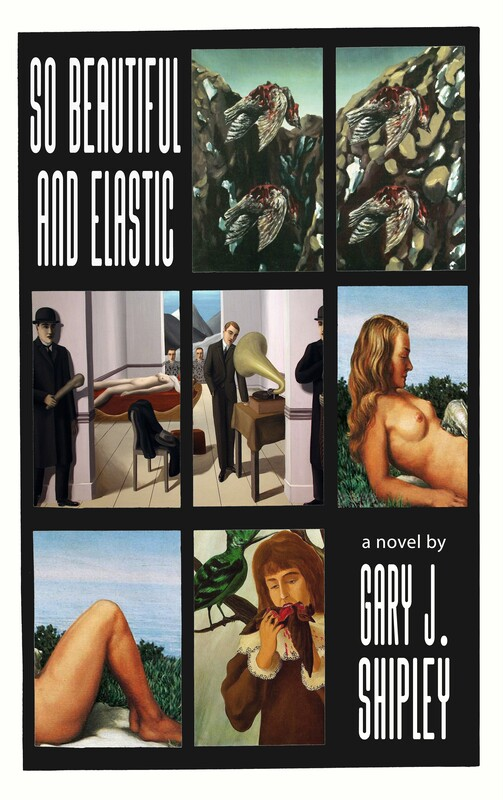
The cover shows panels of surrealist paintings by Rene Magritte. Nine panels in total if you include the title and author text, which I do.
According to the blurb above, the narrator is Ann, who possesses a mind like a haunted house that may or may not have an interest in swallowing me whole.
Spec: this is a period piece set around the 1920’s. Ann is both in the centre and on the fringes of all surrealist groups, each materialist/non-materialist offshoot. Maybe even the Italian/Russian futurists too. At certain points, she will smoke with Breton and Bataille and kind of nod at the floor as they start to argue about how far something like Nadja could take the next revolution if they could just get it into Bukharin’s hands. Later, she will leave and walk around the city, probably Marseille, and become lost in her own thoughts which, ironically, are pure psychic automatism. The suspense? I guess someone’s getting murdered, maybe at the end of the first third of the narrative. Is Ann the culprit? Yes. She is the narrator and she will let us know [cos her mind is a haunted house with cursed magic].
I’ll admit, I’m not super confident about the above spec, Shipley doesn’t usually do this kind of plot, but you never know…
Why Magritte?
From what I’ve just pulled off a quick google search, he was interested in perception, the random allocation of signs and signifiers. Is it random? I don’t know enough about the history of Latin or Sumerian or other ancient languages, but I do know that the characters of Chinese were derived from physical or abstract concepts of those times [some, like tree or river, are universal and easy to discern, while others are so dated by the ancient period that it’s hard to really understand the origin – can’t think of a specific example right now, but I have the definite fuzzy memory of seeing one before]. As for the sounds of speech, Magritte may have a point.
Some of Shipley’s other work, like Serial Kitsch, seems to be about anchoring the [double-mediated?] words of serial killers in the mundane, in a similar way to what Magritte was doing, I suppose. Or, in Terminal Park, re-territorialising Hitchcock’s Psycho, or at least asking the question of, can I do that?
Jeff Fahey may argue that was already done with Psycho III. Or with Meg Tilly in Psycho II. Or the tv show that I never watched. Or the pastiche by Gus Van Sant. Or the one where Perkins calls the radio show and explains his childhood/creation three films beyond the first. Or the spin-off where Dennis Franz comes back as a-
What is this book going to do with surrealism?
Conjecture [at all imaginable levels]: Surrealism was born of World War One. Senseless violence and death led to extreme escapism in art, but also the desire for it to mean something beyond the lunacy/nothingness it was presenting. This is the way I look at all artists and philosophers alive during the two world wars. They were belittled/destroyed by horrified reality, desperately trying to find a way to position themselves…within it? Past it? Outside of it? Most of them didn’t fight. Most people alive now wouldn’t have fought if they could have avoided it. You get shot in the head, that’s it, you can’t write about it afterwards, can’t feel anything. In this context, how pedantic is the examination/quest for self, whatever you want to call it? How fixed are we to anything? Surrealism is like a drug. You always know there’s something in the line that is born within the trance state. There has to be. This book will wander around the Surrealist zone and there will be blockades. Ann will manufacture them herself. Marseille will not intervene. Her moderate French will help her construct yet another Ann. She’s terrified of self, longs to be absorbed by it. Is this a beginning for her?
Okay, just found a review at scud-lit that has a basic plot summary and we can forget pretty much everything I just wrote above. Look:
‘On the most superficial level the plot concerns our narrator, Ann, leaving London and returning to the unnamed seaside town from which she escaped as a teenager, in order to bear witness to the death of her father. The journey is twofold and fraught. Ann is full of contempt for her father, her dead mother, her past, life in general, and herself. The reckoning the reader suspects Ann will have with her father will also necessarily be one she has with herself and whatever secrets her past contains and that she may or may not be keeping from herself.’
Doesn’t say when exactly it’s set, era-wise, but it’s clearly not an arthouse thriller located in 1920’s Marseille. Breton and Bataille will not be popping up, nor will Magritte, though I suspect their works might.
Probably no murder, unless she takes out her dad with a pillow or something.
Technically, Marseille is by the sea so…some credit there?
New plot spec: Ann will return to the seaside town and attempt several different masks as she converses with her dying father. She left when she was a teenager so she is torn between that constructed self and the one she has built up in the interim, both of which she hates. Throughout the text, she wrestles with the work of Magritte and ends up hating him too. Then forgives him as she folds into a constant state of who am I at this exact second? At the end, her father dies and she is completely unmoored from her own passive act of creation [the reviews mentions her mother is dead too]. There’s probably a better way to word that, but she is beyond her formative years and completely stuck/liberated in the void of psychic nomadism. The father functioned as a subconscious moral gate, so now she can truly examine her darkness. The very last scene shows her alone, sitting on a bench by the sea, thinking of different ways she can defile/subsume it. Or herself. Others.
Accuracy level of my new speculation…is hard to say cos I haven’t actually described very much, just her dad dying and Ann sitting on a bench. 30% maybe?
What else?
Ann is a construct by a male author. Must be something in that.
The female characters that I’ve written in my own work are basically me. I see no difference if I’m dealing with the metaphysical. But I still chose female? Why? Am I hiding something?
Not sure how to draw this out without resorting to a surrealist style novella so I’ll stop and just say that the preview I read of this book is fantastic.
The whole thing is around 200 pages so not a killer.
You can buy it here
 PsYChO hOLosUitE [zine]