
+++
[Disclaimer: as with all the pieces in the Other Books series, this is just a tongue-welded-to-cheek speculation about what might happen in Green Fuse Burning, mostly as a way to promote horror/experimental work. I have not read the book. But I may read it later to see how wrong/prophetic I was]
+
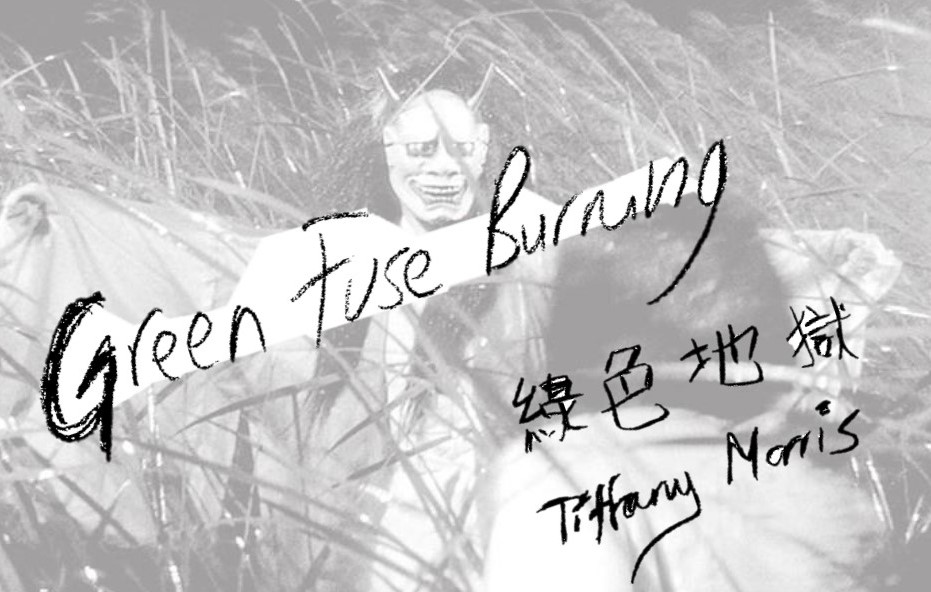
This one pulled me in the same way Reanimator did, with luminescent green on its cover.
Plant-related green.
Horror green.
And the promise of more green from the title.
Actually:
‘The first edition of Solaris was a green hardback. Many asylum patients had a copy by their beds. Green is the colour of hopelessness.’ – Dysnomia++ [2015]
But also the colour of ecstasy.
To me, at least.
Will Green Fuse Burning deal in this kind of duality?
Here’s the plot summary/synopsis [whichever one is correct]:
‘After the death of her estranged father, artist Rita struggles with grief and regret. There was so much she wanted to ask him—about his childhood, their family, and the Mi’kmaq language and culture from which Rita feels disconnected. But when Rita’s girlfriend Molly forges an artist’s residency application on her behalf, winning Rita a week to paint at an isolated cabin, Rita is both furious and intrigued. The residency is located where her father grew up.
On the first night at the cabin, Rita wakes to strange sounds. Was that a body being dragged through the woods? When she questions the locals about the cabin’s history, they are suspicious and unhelpful. Ignoring her unease, Rita gives in to dark visions that emanate from the forest’s lake and the surrounding swamp. She feels its pull, channelling that energy into art like she’s never painted before. But the uncanny visions become more insistent, more intrusive, and Rita discovers that in the swamp’s decay the end of one life is sometimes the beginning of another.’
As with a lot of these Other Book specs, I don’t know the author, have yet to read any of her other work, so a lot of the guesswork I come up with might be way off base.
But might be way on base too.
I don’t know, there’s a vibe I get when reading that synopsis, a vibe similar to a story I wrote a few years back, where a Victorian-era activist fixed on the preservation of Manx language and culture, Sophia Morrison, appears as a spirit in a remote, cliffside house and forces someone who is depressed and not Manx to learn the language instead of grubby English.
Technically, Morrison was indigenous to the Isle of Man, and possibly queer as she never married and lived for a long time with a fellow Manx writer called Josephine Kermode…but she was also [allegedly] a bit elitist, in that she rallied behind the Manx language/culture only when the lower classes of the UK started coming over to the island for cheap summer holidays.
And with the UK brand of colonialism in this specific case [unlike in Ireland], it was more a quiet erasure of the culture instead of ethnic cleansing/genocide. Far as I know, they didn’t massacre the locals or give them diseased blankets like they did in the US and Canada.
Did they do the blanket thing in Canada too?
I have no idea, but with colonialists, you can usually assume the worst.
Anyway, that Sophia Morrison story, which was a bit of a mess to be honest, ties in to Green Fuse Burning…in my head only, pretty much…but it’s there now so I may as well just leave it as is.
Themes of Green Fuse Burning?
The various blurbs mention eco-horror and indigenous loss and personal grief, and the synopsis describes the MC going to stay at an isolated cabin near a swamp that produces weird noises at night. Also, something about an end being a new kind of beginning, which gives me distinct Pet Sematary vibes.
A few weeks ago, I wrote a spec for Star Shapes that predicted a small cult taking supernatural revenge on behalf of a native tribe in Alabama, and Green Fuse Burning could be treading similar ground. Not an exact twin, as the set-up is different, but definitely in the same swampland.
Is it actually revenge?
I’m not sure about this aspect. The idea of revenge seems unlikely given the swamp setting and the lack of nearby white people to eviscerate/punish, and that kind of feels like a white-centric plot anyway i.e. the natives are coming for us, I didn’t massacre anyone, our town mayor is one tenth indigenous, why are they so savage etc.
From what I’ve read of the author’s website, she’s indigenous too [the Mi’kmaq nation], possibly from the region she’s writing about here, so there could also be a level of complexity at play. The synopsis says the MC is detached from the language/culture of her ancestors, so this might just be an attempt at reattachment, done in a creepy, greenish way.
Will she turn into a swamp thing via hallucinatory/voluntary death?
There’s a strong possibility.
Is it the same culture she’s descended from, or a perversion of it? Something abject and malformed due to historical suffering? Is that where the horror lies?
Or it could be atavistic [feels like the right word, if not, try ancient], an old cradle of the tribe she originates from that has been forced into cradling activities once more, only this time featuring extreme gore and eviscerations?
There are several directions this could go in, I think. And it’s only 107 pages, so it has to get there relatively quickly. Unless it doesn’t get anywhere, which I’m also a big fan of.
MC goes to cabin, hears voices from swamp, starts turning slowly into a plant woman while life goes on around her, likes it.
I say plant woman because there are plant stems coming out of the mouth on the cover.
Will that be it?
The synopsis tells us the first part of the novella, the trip to the isolated cabin, so I’ll start my spec from there.
[Tiffany, you can close your eyes now].
Spec: The MC settles into life at the cabin. She’s there to paint and, like most artists, that’s exactly what she’s not gonna do. Instead, she wanders the surrounding area, meeting a mix of white and indigenous people who squint and look at the ground a lot, and then comes across a lake that feels very similar to the one from a French film called Stranger By The Lake. Still grieving the death of her father, she focuses on both the possibility of water-suicide and the joy of having your own little spot of safe, invented nostalgia.
Note: The two ideas could intermix here, suicide and sanctuary, which can be dangerous ground in the wrong hands, but if those hands are skilled…
At night, she hears noises outside, someone dragging a body through the woods. That can’t be right, not at an isolated cabin with a mysterious past, so she looks out the window and sees nothing except an owl rotating its head to look back at her [if no owls in Canada, switch to moose].
She tries to sleep but dreams of her father being suffocated by a large white man in a piranha plant costume. When she gets closer, and peels off the costume, she sees it’s not a white man but herself, face twisted in insane ecstasy.
Wide awake and caffeine-fueled, she pivots to the language app she downloaded earlier, attempting to say some basic greetings in Yaqui. She wanted to learn her own tribe’s language [Mi’kmaq], but the app hasn’t been invented yet [note: I checked and there is an app for the Mi’kmaq language, so you could probably sub it in here and keep the ‘detached from native culture’ theme by making her mispronounce several words]. Annoyed at her mistakes, and then further annoyed by her curses in English, she picks up the paintbrush and starts swishing on the canvas. For some reason, she feels irritated at the lack of green in the resulting image, so irritated that she throws her coffee cup at the cabin wall and watches as blood dribbles out from the cracks.
The next day, she asks the locals if anything bad happened in the cabin before, but she can’t understand their responses as their faces are glued to the pavement. Sorry, sidewalk. [Is it sidewalk in Canada?] An indigenous woman shakes her head, muttering, ‘what do you think happened, brainiac?’
‘A white man with money bought the place then molested and/or murdered indigenous girls there?’
‘Girls and boys. But still, a solid guess. You’re staying for a week, right? Whatever you do, don’t go to the swamp. Or the lake. Or outside at night. Or during the day. Don’t speak English or act white unless you’ve got someone equally white and more objectionable there with you. Understand?’
‘Kind of.’
‘[Mi’kmaq language].’
‘Sorry?’
‘You didn’t understand that?’
‘No.’
‘Not even one word?’
‘I’m learning Yaqui at the moment, but my-…’
‘Wah, you sure you’re one of us?’
‘Err…’
‘Okay, doesn’t matter. Just don’t say anything. Pretend you’re mute. And if you think you hear someone dragging a corpse past the cabin, relax, it’s just the wind.’
Unnerved but also excited at the possibility of her father resurrected as a swamp being, the MC rushes back to the cabin. On the way, a random white guy waves at her, which she ignores. Go to the lake, go to the lake, go to the lake, she repeats to herself over and over, and when she finally gets there, it’s already sunset and there’s a faint green glow on the surface of the water.
She wades into the water up to her waist and feels something wrapping around her ankles. ‘Daddy?’ she asks, but there is no response.
The something retreats/disappears.
She thinks of going further farther in, to immerse herself, but stops after a few steps and returns to shore instead. Then slaps herself for cowardice and rubs her face in the swamp dirt. Goes back into the lake and drinks some of the water. Shrieks ‘where are you?’ in broken Mi’kmaq/Yaqui.
Back at the cabin, the walls look like Varo’s had a psychotic break and swamp vines manifested as the hallucinated enemy. The MC has the wet part of the paintbrush in her mouth, with lips and half her face streaked in green. ‘This place is mine,’ she shouts, throwing the remaining paint at the window and smashing it. After cursing in Yaqui, she walks outside and curses directly at the broken shards of glass. In the distance are more noises. Could be nocturnal animals, could be indigenous locals secretly abducting white people and sacrificing them to a swamp beast, there’s no way to be sure unless she investigates so she does that and, yup, it’s the latter. The same white guy who waved at her earlier is tied to a tree, naked, green goo seeping out of his mouth as he recites the crimes of his ancestors.
The MC is quickly discovered by the kidnappers, who turn out to be white also, and it’s a bit awkward as they realise they can’t let her go unless she swears not to say anything to the cops. Luckily, the situation is quickly resolved as the kidnappers are pulled into the nearby lake by a series of vines and fail to come back up again.
[Thinking about it, this subplot sounds a bit ridiculous/redundant. Doesn’t really match the isolated setting of the cabin if there’s a group of white people lurking about. Unless it’s all in the mind of the MC, working as a subconscious form of self-punishment?]
Most people would be alarmed, but the MC is in a kind of trance state now, still dazzled by the paintings she frenzied onto the cabin walls, and it’s only when she lets out a muttered, ‘so fucking good,’ in English that reality breaks, with another vine grabbing her by the throat and dragging her into the lake.
If she were white, or terrible at holding her breath, she would be dead for sure, but a voice says stop and the vine obeys. Spitting out lake water, the MC calls out to the voice, which she recognises as her father’s. A weird plant-like creature appears at the edge of the lake and guides her out.
Rough sketch of plant-like creature:
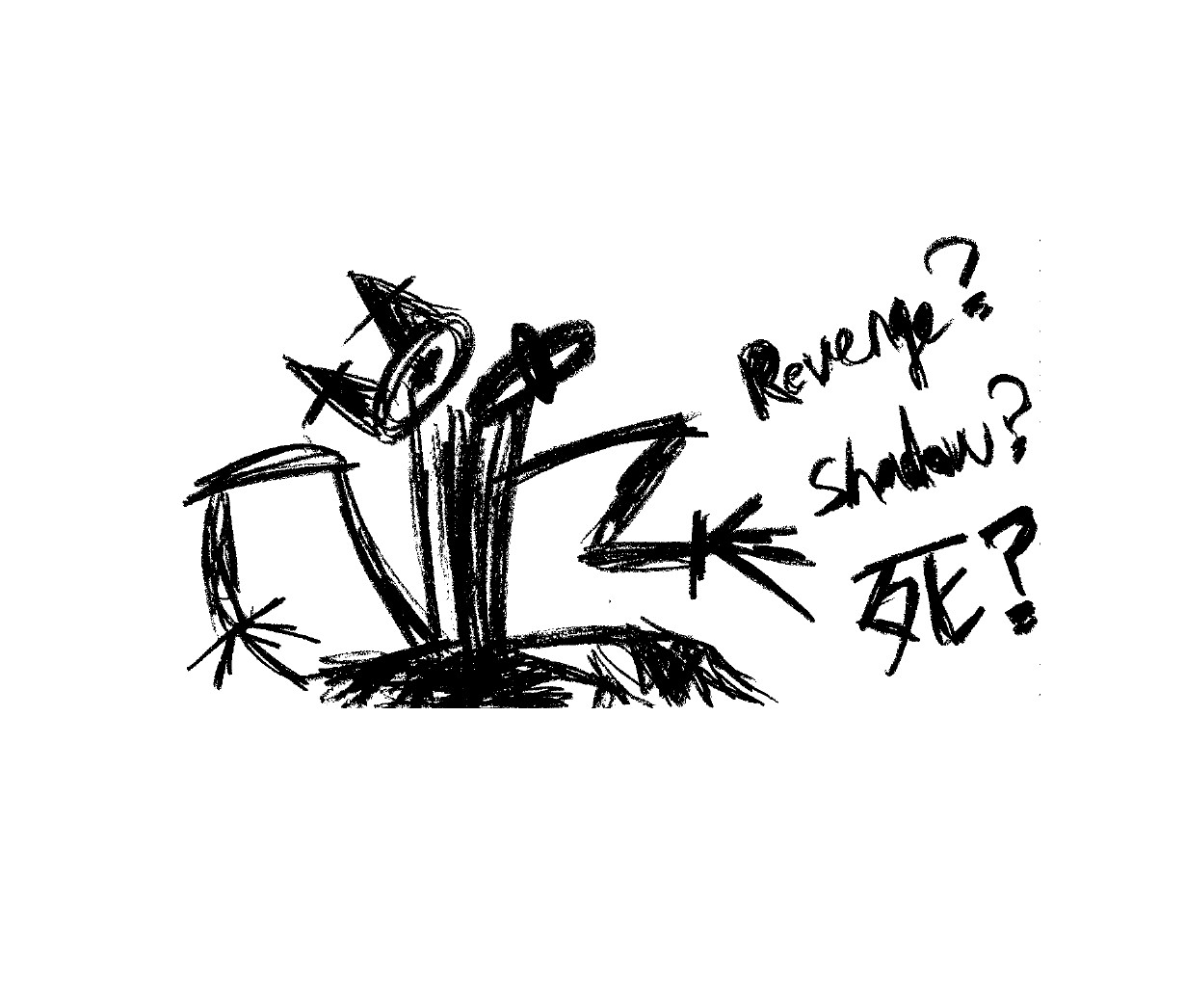
It tells her that it’s okay, the cabin has been cleansed via her amazingly green art, though they still plan to burn it to the ground later, weather permitting.
‘Are you really my-…’ she starts to say, but the plant creature puts a vine tip to her mouth and says in a whisper, ‘We are everyone. Before and to come.’
Confused yet hiding it quite well, the MC looks back at the lake and see a body floating there. Probably one of those weird white people, she says, putting her left palm against her chest. Definitely not me.
Ending 1: it is her. She drowned herself and now she’s part of the swamp.
Ending 2: it’s one of the weird white people, and she’ll have some explaining to do to the cops unless she fishes it out, ties some rocks round the waist, and pushes it back down deeper.
Ending 3: it is her, but this is not the afterlife, it’s a pocket realm where some of her tribe have hidden themselves since the colonialists came. She is finally home.
Ending 4 [ultra-bleak]: it’s her girlfriend, drowned by the MC herself as she hallucinated both the white kidnappers and the vines attacking her. The swamp is, in fact, the detached rage spirit of her tribe, targeting all who come to the cabin or nearby, only now it has lost the ability to distinguish between the colonisers and descendants of the tribe, and finally proceeds to drag the at-this-point-willing MC into the lake as she makes failed lunches lurches towards the corpse of her girlfriend, trying to bring her along too.
There, all done.
Okay, I cheated a little with the alternate endings, but I couldn’t decide which one to go with. I’m also fairly certain that the white people as kidnappers part won’t feature as it’s just too…white liberal-ish, and white liberals are far too passive to bother with that kind of thing [propaganda of the deed tweet].
Basically, it just doesn’t make sense.
But I do like the pocket realm within a larger deteriorating realm idea. A place that looks like shit, but is in fact a sanctuary. The question is, what lives there?
Not sure.
Either the plant-like creature in my pic above, or a mirror version of the MC?
Re-reading the synopsis, I think it might be the latter as personal grief is mentioned and this is all taking place in a remote location. Definitely no white kidnappers, feels too busy, too connected to the indigenous revenge theme and I’m not sure anymore if that’s really the focus of Green Fuse Burning.
Personal grief = mirror version of MC, possibly costumed as the plant-like creature.
What does it want?
This is a horror novella, so things might get pretty dark. Therefore, it could be a punishment for the MC not using her tribe’s language or continuing the culture?
I don’t know. It would tie in if the theme is cultural guilt i.e. she has transgressed too far and the swamp is both purgatory and home; one that she feels is deserved [purgatory], another that she yearns for out of grief and shame [home].
Okay, I think I’m gonna go with ending 4, the ultra-bleak, dead girlfriend, swamp as perverted force that she willingly submits to.
Dead girlfriend is dead cos she’s not from the Mi’kmaq tribe.
Perverted swamp = heritage mixed with ambiguous rage, either from the tribe’s historical wrongs or the MC herself.
Theory: the swamp cannot operate without her life-force, and organises itself based on the MC’s psyche. Hence, the horror swamp.
Hmm, not the most uplifting ending ever.
Maybe it can be a happy swamp later, when the MC pushes through to the other side of her grief and becomes fluent in Mi’kmaq. When that happens, the green colour of the vines becomes brighter, fluorescent even.
It is possible. Implied somewhere in the text, the final chapter perhaps?
But right now…following ending 4…it’s doom-scape and dead girlfriend.
Epilogue?
The art she painted on the cabin walls becomes internet famous and hundreds of white people turn up to take pictures of it.
And the swamp is waiting for them.
Final shot is a vine slithering out of the lake, the MC’s voice whispering, ‘stop looking at me, stop looking at me.’
If you wanna find out for yourself what happens, whether I’m right about even 2% of it, then you can find Green Fuse Burning here.
 PsYChO hOLosUitE [zine]