
+++
This one is a little bit different, a de-con-struc of a character from DS9 that started out marginal and ended up slightly less marginal within the greater whole. Non-canon stuff will be skipped over cos I don’t really know much about it, and, from what I have read on memory-beta, it demystifies Garak to a ludicrous degree, which, if used, would make my whole piece pointless.
Thanks to Nick Greer for offering some edit suggestions on this madness.
+
+
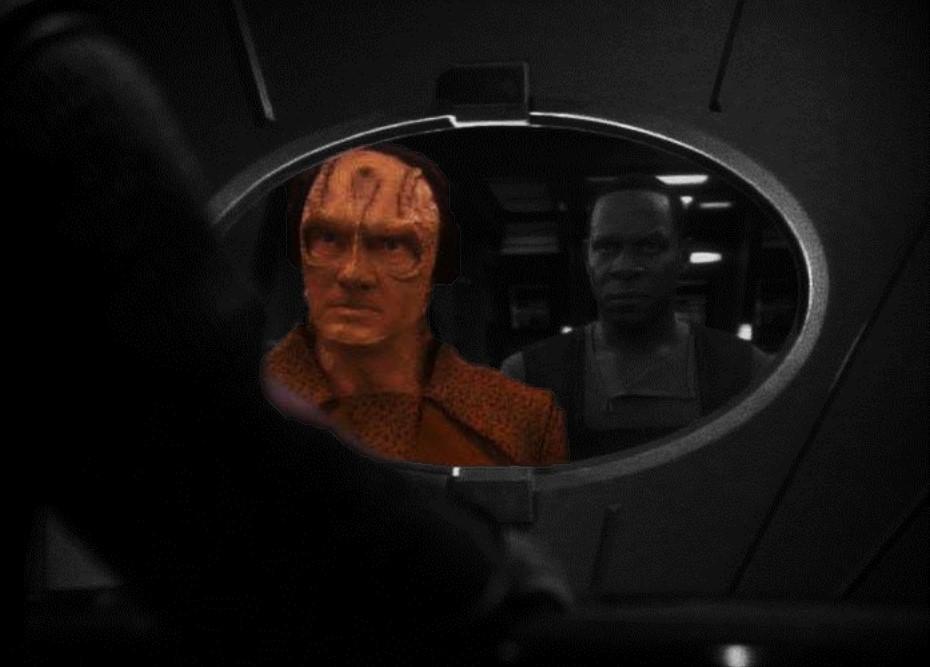
CAPTAIN SISKO: Who’s watching Tolar?
GARAK: I’ve locked him in his quarters. I’ve also left him with the distinct impression that if he attempts to force the door open, it may explode.
SISKO: I hope that’s just an impression.
GARAK: It’s best not to dwell on such minutiae.
+
Best not to dwell on essay structure either as this is gonna be all over the place.
Probably a lot of run-on sentences and cut-offs.
Some shorthand on Trek canon, episode title errors, mangled quotes, overuse of ‘but’ and ‘probably’, the complete deadening of ‘marginal/whole.’
Tentative theme: Garak is Deep Space 9 and Deep Space 9 is Garak.
Or:
Garak is the dark, reluctant, beating-despite-itself heart of DS9.
Or:
The marginal is an encroaching whole.
Or:
Garak schism chaos.
Whichever one reads better.
Maybe add in Dr. Bashir as the optimism counter-aspect, plus the Cardassians in general, Major Kira and the-
+
+
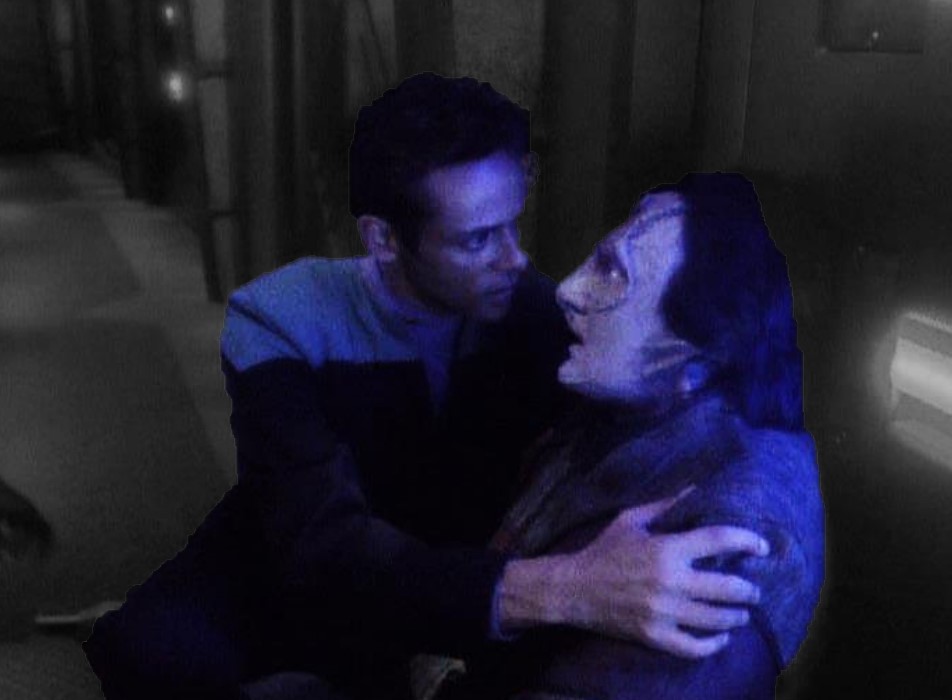
DR. BASHIR: What?
GARAK: I was. I am. I shall be.
+
Some background:
Introduced early in Season 1, when the stations new doctor, Julian Bashir, was over-enunciating every line – reaching a nadir in the episode where his brain got jumped by the essence of a dead alien serial killer who perhaps spoke that way naturally, perhaps not – the Cardassian character of Garak had obvious potential but no permission to grow or exist beyond the single episode he was in, let alone survive until the very end of the show, yet that’s exactly what ended up happening.
Why?
Spec:
1] Every first season of Trek is notoriously weak, and a slippery side character like Garak easily stood out [though he doesn’t return until the beginning of the following season]
2] Andrew Robinson brought everything to the table [including a spare table].
3] Someone for Dr. Bashir to play off.
4] A clear match with the dark theme that the show couldn’t fully embrace but wanted to.
5] Mesmerism.
+
+
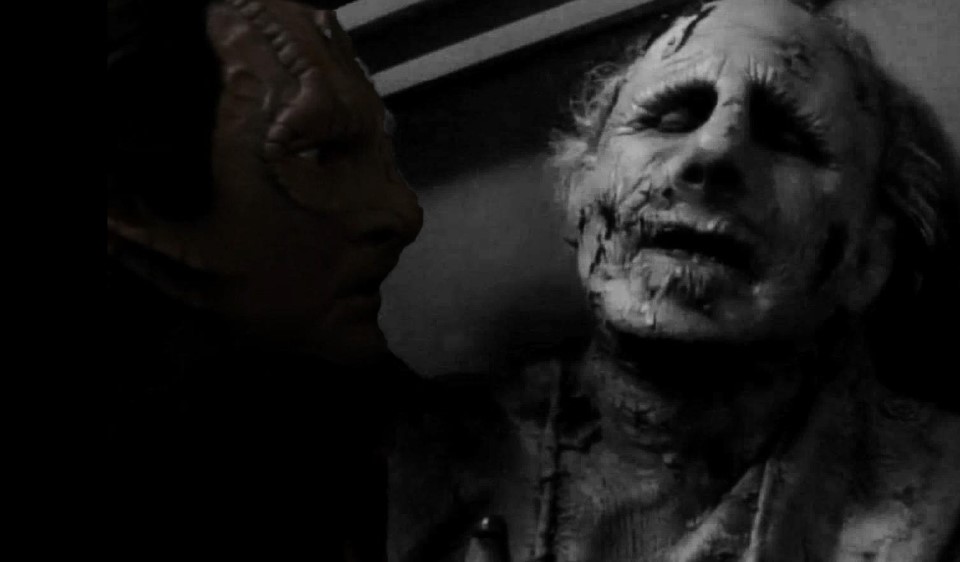
ODO: I’m malting.
GARAK: This way, Constable.
ODO: Me? Follow you?
GARAK: There’s this door down here and I bet there’s something behind it.
+
Apparently, in the original script, Garak was written as gay, which, given the way the rest of the series panned out, seems kind of doubtful. Not with that writers’ room. Ronald D Moore. Ira Steven Behr. Rick Berman, the show’s producer and misogynist third eye. In an alternate pocket void, sure, they could be gay, or keen to write a gay character, but in this one, in the era that DS9 was located in? With a good-looking guy like Bashir as the pillow?
Ah, I just checked, and it was the actor Andrew Robinson [Hellraiser] who intentionally played Garak as gay, not a script direction.
Stereotypically gay?
It was the 90’s, quite rare to see any other kind. Apart from within gay cinema itself, penned by queer writers [Rose Troche, Cheryl Dunye], performed by queer actors [Leslie Cheung, James Lyons, Guinevere Turner], directed by queer directors [Greg Araki, Troche, Dunye, Almodóvar], occasionally all three merged together.
Consistently gay?
Within this universe, in his very first appearance, Garak presents as strikingly effeminate; the soft mannerisms, suggestive tone of voice, deliberate hand movements towards Dr. Bashir’s shoulders. A kind of Boomer/Gen X construct of how a gay character should function. By season 2, this construct has vanished, subsumed by the Machiavellian aspect of the character, and, another two or three seasons after that, it’s like it never existed at all as Garak finds himself shoehorned into a sex-implied-sort-of relationship with Ziyal, the illegitimate [teenage!] daughter of another notable side character, Gul Dukat…notable in the sense that Dukat’s a complex villain for the first five seasons before being pushed off a narrative cliff with the cartoonish pah-wraith storyline that, if you squint long enough, can potentially be rationalised on a character level, but as a dramatic choice within-
Does it matter if Garak is gay or not?
I can’t answer that.
Yes?
Despite superficial nods, mainstream Film and TV in the 90’s still slouched puritanical when it came to gay relationships on screen, at least from what I remember of it, so any kind of queer representation would’ve been a good thing. And DS9 did let Dax kiss another woman. But two guys? Or, technically speaking, a reptilian humanoid and a guy?
Marginal buckles, whole wins.
This time.
+

+
DR. BASHIR: Of all the stories you told me, which ones were true and which ones weren’t?
GARAK: My dear Doctor, they’re all true.
DR. BASHIR: Even the lies?
GARAK: Especially the lies.
+
According to the character himself, Garak functions as a tailor on the station [functions, not works] in a future where replicators could probably just do that kind of work for you. But, beyond the façade, he is in fact a former spy, cast into exile by agents unknown. Is the cover profession a reference to Tinker, Tailor, Solderer, Spy? Undoubtedly, and there’s a kind of beautiful frustration in the way Garak constantly laughs off the suggestion that he may have been involved in high-level espionage at some point in the past.
+
BASHIR Assuming you’re not a spy…
GARAK: Assuming…
BASHIR: …then maybe you’re an outcast.
GARAK: Or maybe I’m an outcast spy.
BASHIR: How could you be both?
GARAK: I never said I was either.
+
He WAS a spy. IS a spy. WILL always be a spy.
All the main characters in DS9 are aware of this, yet the details never fully arrive. It is a field beyond a wall that is unscalable to them. So they speculate instead. And fantasise. About action-images in that field which they are not permitted to visualise. Performed by a character whose current iteration – their iteration, Garak the maybe-spy – will not fit into that specific psycho-terrain. A psycho-terrain which presents as marginal but, beyond the script, operates as the whole. Not object-revenge, but the infinite periphery, advancing…
Is this an attempt at invasion?
Can it be survived?
+
+
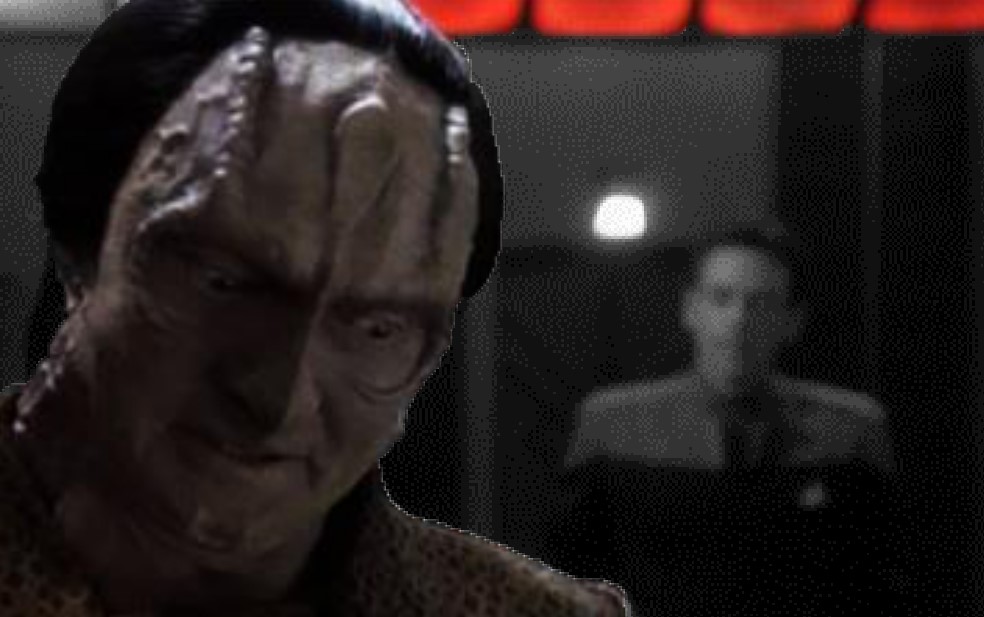
GARAK: And you think that because we have lunch together once a week you know me? You couldn’t even begin to fathom what I’m capable of.
+
In Season 2, as his screentime changes from marginal to semi-supporting, Garak’s backstory is slowly unraveled by Dr. Bashir into smaller pieces of backstory, any one of which could be a lie. There was a friend called Elim who betrayed him. His own first name is Elim. He let some Bajoran orphans escape. He did it cos they smelled disgusting. He can’t go home. He misses home. He hates all those associated with home. Home is where his abusive father is. Where his nanny resides. And countless other contradictions.
It turns out there is an implant in his brain that he, at some point in the previous two years, switched to continuous pleasure mode in order to deal with the bleak reality of his exile, and now it’s malfunctioning to a fatal degree, but what exactly does that mean, exile? A sabbatical from torturing people for information? Wet works on Romulus and Bajor?
The character of Garak is villain turned rogue turned neutered pet turned something else, something ineffable.
And he was never a villain anyway.
Not in the eyes of the viewer, or the writers’ room [the parents?], or even some of the other characters on the station.
A seductive agent of chaos?
Perhaps.
We the viewer [or just me?] are attracted to him from the very first shot, just as Dr Bashir is. And, in a similar vein to the popular Klingon character of General Martok, who joins the series in Season 4, we put aside all the horror they’ve likely taken part in, all the murders and executions and fascist brutality, cos deep down, in the part of us that watches wild animal rescue vlogs and longs to pet the abused lion, we don’t believe they’ll ever hurt us. Or in this case, hurt the main cast of DS9.
And we can’t picture those former horrors anyway.
Cos Garak smiles a lot.
Shrinks his form.
Fascinates us.
This sense of connection is so totalising that, even when lead characters who we also have affection for diminish or insult him, our reaction is to reach for the kite shield and plant it rock-like in front of the Cardassian Stasi analogue.
‘He’s not that bad, leave him alone.’
‘You don’t know that he actually killed anyone.’
‘No one we know is dead.’
‘He’s funny.’
‘Guy’s in exile, at a low ebb.’
‘If you insult him, he’ll store it up inside and one day things will not be in your-…’
[the above quotes are not actual quotes, just conjecture]
+
+
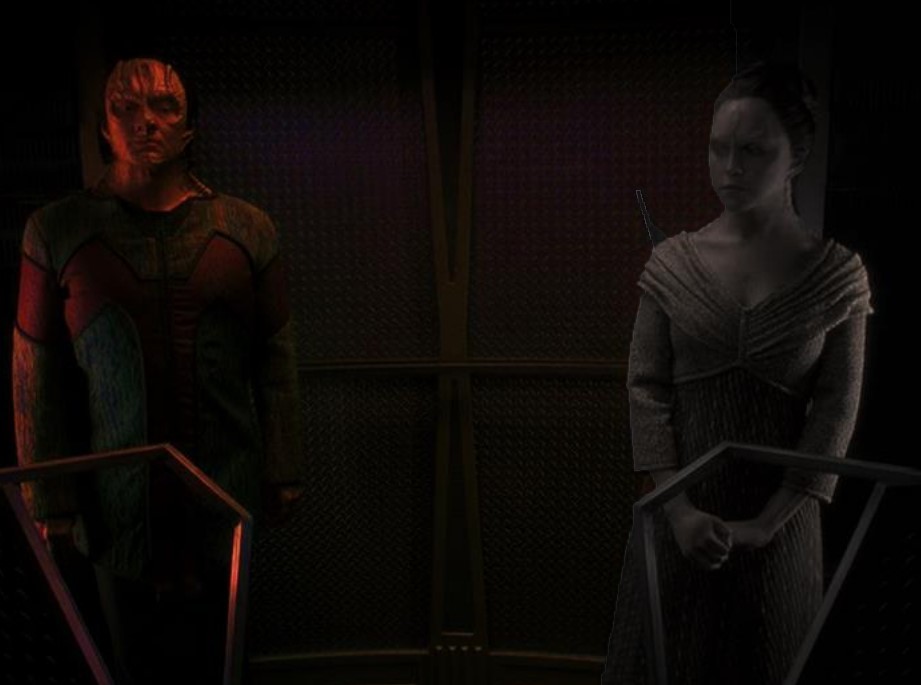
ZIYAL: You’re intelligent and cultured…and kind.
GARAK: My dear, you’re young, so I realise that you’re a poor judge of character.
+
Unlike DS9, this is rambling.
Mostly cos it’s me and no writers’ room.
Garak is DS9 and DS9 is Garak. That was an argument presented at the beginning, though what it means, who knows?
Spec [off the cuff]:
In opposition to the original series and The Next Generation, Garak possesses a darkness that permeates the series yet cannot be allowed to nestle within the main cast. A darkness that filters in and infects characters like Sisko, that is itself infected by the basic goodness of Dr. Bashir, and which then adjusts that same goodness into something streaked and tainted that does manage to survive the adjustment but not without a glimpse of abject grey domain.
In this way, can we call Garak, a side character, the interstitial mover of the whole show?
He never attempts to become good, and does not see his actions as bad. Does not relitigate them [out loud].
To him it is all semantics.
As he states in the season 2 episode Cardassians, ‘I never tell the truth because I do not believe there is such a thing.’
Yet he does believe in reality. The way the galaxy is as opposed to what Dr. Bashir wishes it to be. A fixed, static view that, as the series progresses, ultimately becomes incongruous with his own fluid state as a character.
Or incongruous with his actions.
Actions = character?
Interior = absent/nebulous?
Marginal =
End spec [cuff gone].
+
+
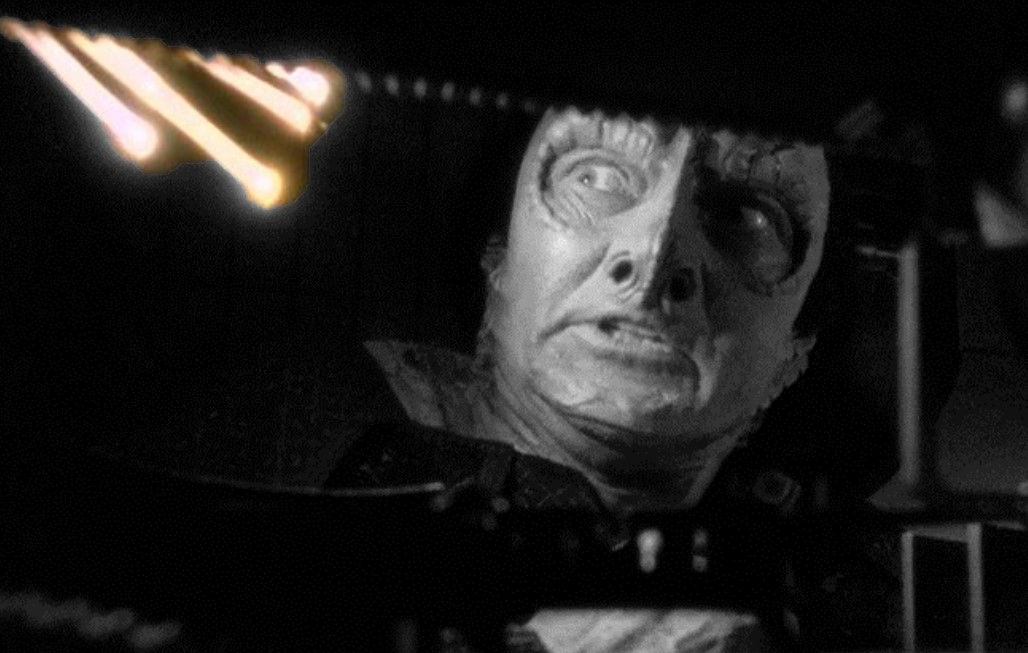
Garak sits alone in his quarters, an empty glass of kanar on the desk nearby.
In his left hand, darkness.
Right hand, a book.
Shoggoth on Cinema I.
As the wormhole is seen opening through the window in the background, the Cardassian clears his throat and reads out loud to his own glass.
GARAK [weary]: Alone on his slimy raft, with only a colony of monkeys as his race, as his final performance. The landscape beyond…undwarfed, promiscuous.
+
No character in DS9 goes completely into the void whenever they exit for a few episodes, or even treads water in the background; they continue to actively progress things from within their own little territories [or maps, given the distinct lack of auxiliary detail provided on their interim activities]. Gul Dukat, another Cardassian, is a prime example. From Season 4 to midway through season 5, he turns up on screen maybe five or six times, and each time you see what he’s been up to in the interim, the clear irritation in mood that he, a Cardassian nationalist, tries to repress as the empire he ostensibly served and revered is humiliated by the invasion of the Klingons until, finally, he does what all small-nation fascists do when their backs are against the wall; hook up with a bigger fascist, curb the walking goo jokes, bite his tongue when they point to a map and say, ‘hey, why’s your territory so tiny, reptile man?’
At some points, in certain episodes of Season 4, we almost feel sorry for him.
An actual war criminal.
The very worst the marginal has to offer.
Gul Bush?
+
+
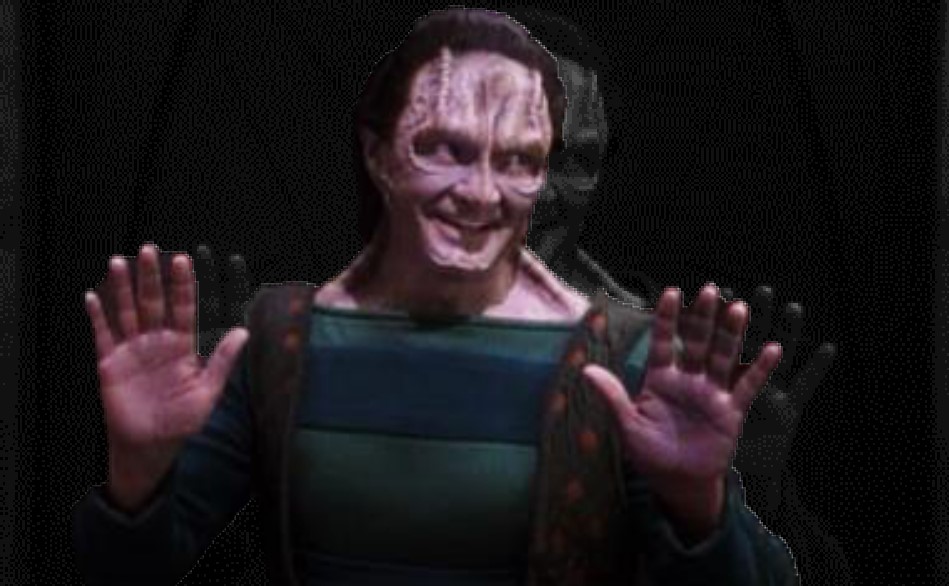
DR. BASHIR: You’re very kind, Mister Garak.
GARAK: Oh, it’s just Garak. Plain, simple Garak.
+
Plain in the sense that he’s not that at all.
Simple being the other person with a phaser hole in their back.
Midway through Season 4, the curtain is drawn back just far enough for the Cardassian tailor to play along with the consensus-traits of his past identity. [Consensus from the audience/writers’ viewpoint, seemingly based on spy novels written by John le Carré]. In fact, in Our Man Bashir, the writers skip the dance and wield him directly to make fun of the idea itself. Entering a fantasy Bond pastiche written for the optimist counterpoint and occasional pervert, Dr. Bashir, Garak remarks that he joined the wrong intelligence agency when he sees a luxurious Las Vegas hotel suite doubling as 1960’s Kowloon, and later goads Bashir into stepping up and becoming a real spy by ordering him to indirectly murder his friends.
Is this the marginal stretching its limbs out into the whole, testing the limits?
All within a holo-deck simulacrum of a fictional past reality?
Does it truly believe it can succeed?
What qualifies as infection?
At the end of that episode, a loophole is found, and the morality of Dr. Bashir manages to keep the subordinate [encroaching?] reality of Garak at arms’ length, yet…
Is there a limit to this act?
Has the fringe not always been encroaching?
In Trek, yes, for all eternity. The Federation itself, those on the lower decks, civilians, other alien races, how they all realistically function, the potential conflicts and contradictions. These concepts/institutions are often alluded to, sometimes glimpsed, visited, talked down to, but never truly allowed to exist cos how can they be in an hour long show? Same thing applies to the dark rhizomes of spy craft. The writers dabbled with the rogue [Federation] intelligence agency of Section 31 in later seasons of DS9 and were pilloried for it. Not Star Trek, too grubby, future humans wouldn’t do that in this [fictional] universe. Garak, on the other hand, perhaps due to his alien background, continues on, able to navigate the terrain of the whole with only occasional pushback.
The marginal has found its ideal face.
An implied past of never-defined horror with an active present of kill-your-figurative-grandma cynicism that refuses to come into full contradiction with the activities of the main cast, or, as a final achievement, absorb it.
In plot terms, he shoots those who are permitted to be shot.
Usually Cardassians.
The fascist kind.
While the rebellious types are merely patronised or deemed irrelevant to current aims.
And when he’s not shooting, he’s having lunch with Dr Bashir.
A moderate infection of the parochial whole.
What do they eat in the future?
Unknown, but there was one episode where they were exchanging Naruvian chocolates. Or Delavian? I’m not sure, but it definitely ends in -ian, as most alien names do in Star–
+

+
CHIEF O BRIEN: What’s the matter?
GARAK: Well it’s just that lately I’ve noticed that everyone seems to trust me. It’s quite unnerving.
+
In civilian [and predominantly earth-tone] clothes, with relaxed body posture, using a diplomat’s tone of voice, Garak shirks the void-images of his espionage past and becomes genial coffee date, while the audience sits docile on the next table over. Or not docile, not quite, but not forgiving either as the subject presented to us is both active and passive. Actively charming and manipulative to a degree; passively-
No, too rigid. Too anchored to the now.
Moving and latent?
The moving part is the series of imagined, Bond-esque action-images that operate as the layman’s intrigue towards spy craft, the vague maybe-ontology of a character that comes from presumed horror but is currently walking outside that vampire castle with the gates shut.
See, Garak has killed and tortured people, of course, but that was before, and he would never kill or torture people on DS9 [Yes, he tortured Odo, but that was in the Gamma Quadrant!].
The latent part, Garak’s real past, is rendered inconsequential. There is no tangible signified behind those theoretical murders i.e. such murders are never brought up. Nor a sign/signifier as the writers refuse to present us with the faces or recordings of any of the past victims.
[Correction: there is some discussion of Garak’s time on Romulus and the contemporaneous poisoning of a Romulan Pro-consul, but that is unseen and, at the risk of being glib, an acceptable murder as no one really likes the Romulans.]
His previous state is elevated to the level of mysterious, background element, a danger that will emerge now and then in permitted form, but never spill over onto the lead characters that we are also attached to [time spent with = attachment].
Exceptions?
In Season 5 episode Empok Nor, Garak murders a human yellow-shirt [who isn’t very likeable, to be fair] and ties up another fan-favourite side character, Nog, with intent to eliminate him too.
[Invasive marginal [Garak] vs assimilated marginal [Nog]? For the right to infect the whole?]
Yet, it’s fine, as this murderous behaviour is provoked by patriotism gas pouring out the vents, meaning it’s not really his fault. And he feels terrible about it afterwards, asking Chief O Brien to tell the yellow-shirt’s widow that he’s deeply sorry for her loss. Or, in another way, he performs the action of feeling terrible. Speaks out the words attached to that emotion. With Garak, it’s never clear. He is a character with no centre. No…not that. He is a character with a shifting centre. A swirl that temporarily congeals as a centre then dissipates into an amorphous mass of other potential centres that may form when called upon. Not psychical nomadism exactly [hi Nick] as Garak is rooted too deeply in artifice/performance, and it is that which consciously shifts, possibly to safeguard the true centre from being exposed.
But a shifting directed by who/what?
The swirl itself. The Id. Instinct predicated on mood. God in the weeds. The Satan of Prince Prospero. Pinhead. Marginal esoterica.
Is this going anywhere?
No idea.
Feels like there are moments where the whole/periphery interrogation comes together easy, and then other moments where it’s not clear to me what periphery even means or how Garak fits into any of this, and moments beyond that where none of it works at all, just reads as the same points repeated in slightly different language, confusion at what I’m actually trying to-
+
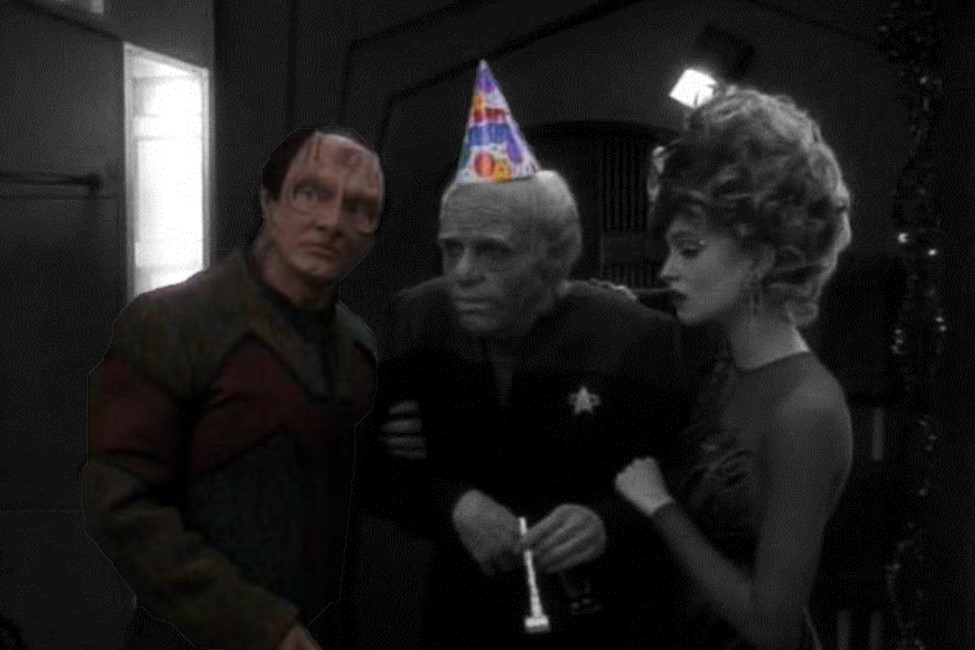
+
ESTRAGON: I can’t go on like this.
GARAK: Well, the truth is usually just an excuse for a lack of imagination.
+
Probably shouldn’t use I here…been fighting it all the way through this piece, not sure why…but about thirteen years ago, when things were bleak, I used to watch Star Trek in fragments to keep me from dropping fully into…the void, abyss…whatever you wanna call it. In some cases, I would watch whole episodes, but soon they became exhausted, so I pivoted to specific scenes that I knew would keep me stable, and in doing that, started to notice more and more the characters on the periphery. Not just the characters themselves, but their movements, their facial reactions, the way they operated when the main cast was talking.
[Watch long enough and you will yearn for the marginal to usurp the whole. For absolutely nothing to happen].
One of those scenes was Garak and Bashir having lunch on the balcony outside Quarks, first discussing the play Julius Caesar [as foreshadowing for an event at the end of the episode], then the observed eating speed of different alien races. The whole thing goes on for about three to four minutes, nothing but character and conversation, and I didn’t care about the threatened plot, I would just play this scene over and over and…I remember reading someone say, you can’t just have a show with characters doing mundane things like eating lunch and hanging out cos it would get dull…yet that scene…could’ve gone on for two hours and I wouldn’t have stopped watching it.
It was all I had.
At that time.
Just two characters, one main, one fringe, talking about things unrelated to the plot.
Having an unspecified lunch on a space station that exists in segments, as a series of previously-built sets with interstitial gaps filled in by…us? Me?
Forcing the marginal onto the whole.
Shifting attention towards the marginal, the mundane.
Restructuring the marginal to function as the whole which is then interrupted by the displaced whole the true marginal that is the episode story.
Marginal characters, no plot = a shot of reality? The chance of it?
As usual, I don’t know.
Some people call it world-building, a thing to fill in the shadows at the back, for the audience to see and then move on from.
I do not wish to move on.
I won’t move on.
I’ll move on.
That scene is one I still go back to, even now. The beginning of Season 6, episode 8 too, after the station has been won back. Low-key discussion scenes between Sisko and Kira, Sisko and Martok, Sisko and me as an invisible fly hovering just out of shot.
Let He Who Is Without Sin [Season 5], with Sisko, Odo, Dax and Worf having coffee for four minutes at the start, talking about an upcoming holiday.
When It Rains… [Season 7], the first fifteen minutes, Kira getting a Starfleet Commission.
Way Of The Warrior [Season 4], Odo having breakfast with Garak, the changeling explaining how he pretends to drink the-
+
Yourself. All parts. All schism aspects.
+
Does Garak, in his newly attained place within the whole, get the dreaded arc?
In the eyes of a scriptwriter, yes, it’s inevitable. People change, right?
And there are definite traces of it.
Look:
In the final season, the former NPC is backing up Major Kira in the Cardassian rebellion, and helping the Federation in the Dominion War [with the psychological cost of this highlighted in one episode, a move that confirms both Garak’s elevation as a character and his infiltration of the series as a whole].
But he doesn’t fundamentally change.
Cos he’s never truly been static.
Never had a fixed interior core.
Incapable of-
Garak, at this current moment in my brain, is a changeling in the Deleuzean practice. In one episode near the beginning of Season 5, he’s playing devil’s advocate for the Cardassian Occupation of Bajor, while in the latter part of Season 7, that switches to an astute observation that Damar [another Cardassian bit-player, former villain], has a certain romanticism about the past. The implication being that he himself does not. Even though he previously showed evidence of it. Unless that was just contrarianism, a fleeting costume for that specific moment? Or inconsistent writing?
But what is Garak’s view of his own past then?
That it may not have happened?
That it happened elsewhere?
When he closes his eyes, does he picture the crimes he’s committed or does he reduce them to a lie that with enough practice can be proven as such?
Proven to who? His own psyche?
Were they actually crimes?
Unlike Gul Dukat, Garak never really attempts a defence of his actions during the Bajoran Occupation…because there were no actions. Not on record. He existed as a ghost which means he never existed there at all.
There is simply no horror past for him to be pinned to, just a romanticised version of 1960’s cinematic spy-craft.
His character remains fluid, nebulous by design.
Any confession he gives is in fact a lie.
Any lie could be truth.
Guilt is something the main cast-
+
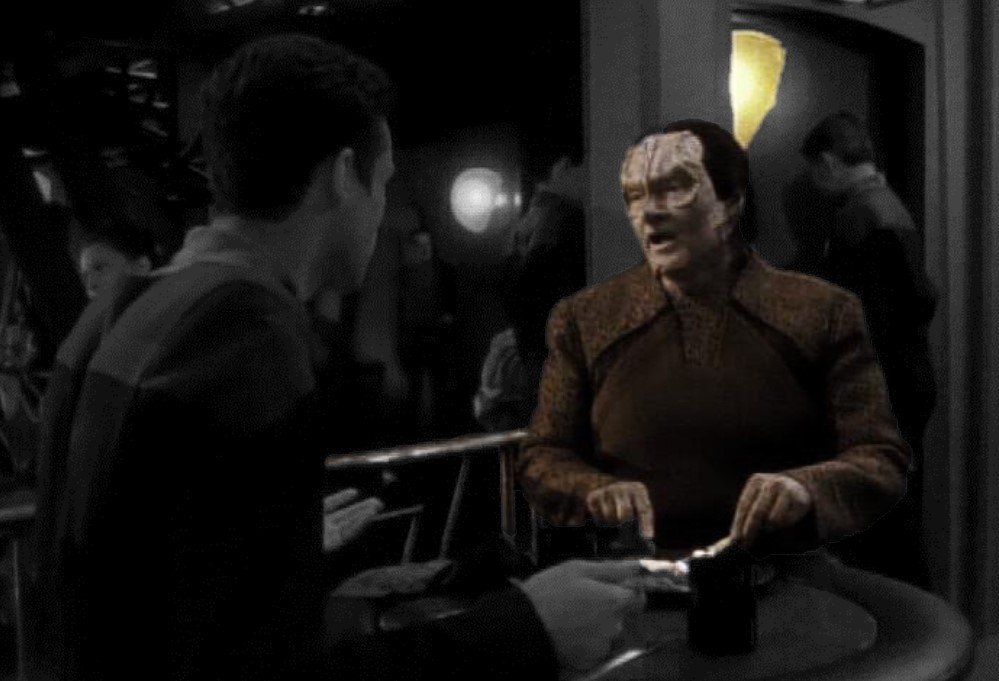
+
DR BASHIR: Recently, I’ve been feeling small, narrow…unimportant. As if life…other life…is happening just round the corner. Just out of reach…out of sight. And my brain insists it’s nothing, that the things in Ops, the Infirmary, on the Defiant, they are the matters of consequence, yet…are they? All of them?
GARAK: Yes, I was on Romulus, but I’m afraid I can’t talk about it.
+
In a line that sounds convincing when I read it back to myself, DS9 without Garak would’ve been a show with only the sliver of a theme. Entrapped by its own attempt to break away from the utopianism of TNG while simultaneously remaining chained to it.
Too harsh?
The costume of the idea then.
One of the darkest, most lauded episodes, In the Pale Moonlight, could not work without the side character of Garak. He is the man who can do the things that Sisko as a moral person, and part of the utopian whole, cannot be permitted to do i.e. blow up a visiting Romulan senator. The marginal exerts a power from within the infinite scope of its vague terrain. Garak, despite some advancement, remains on the periphery. He is a fuzzy signifier. An intruder within the diastole. One interrogation in seven seasons and he feels awful about it. Begs for forgiveness when death is near. Stacks up grudges. Allows them to expire. Shoots those who have wronged him. Don’t worry, Kira, Sisko, Odo, he’s got your back. Your enemies are his enemies at the current time. He’s not that kind of patriot anymore. Cardassian literature is second to none. You’ve changed him, he never changed you. That Romulan senator was a dickhead. He wouldn’t shoot me in the back. Not a bad guy when you actually talk to him. The marginal has been tamed by the whole. The whole is a moderator. An absorber of all crimes. Defending him is not the same as condonement.
What past?
+
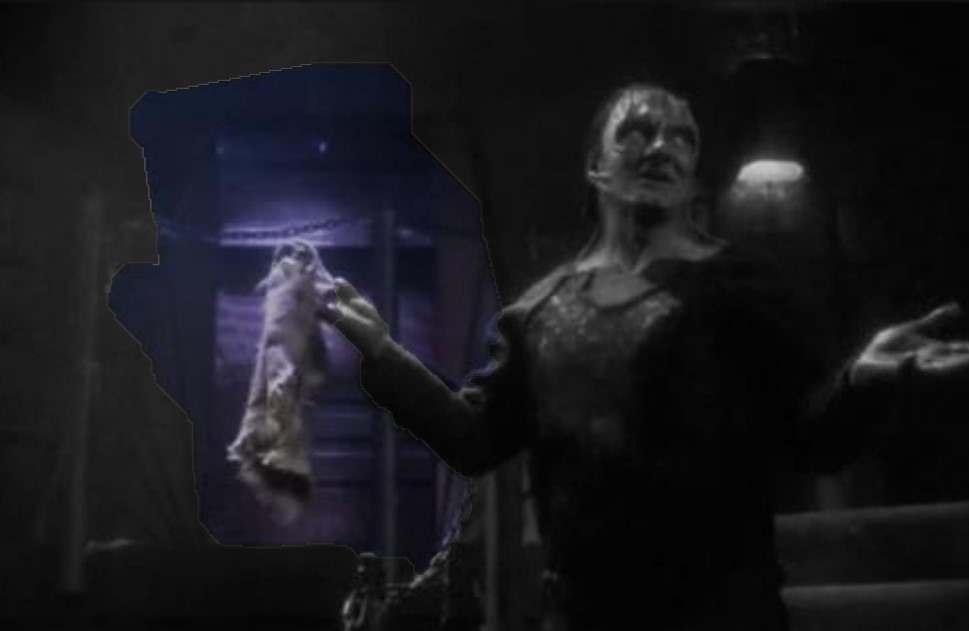
+
UNION LEADER: You broke the strike on Avenal VII. Infiltrated the miners and lied to them, manipulated them.
GARAK: I’m sorry, was that not work, comrade?
+
Nearing the end of Season 7, the old Garak returns. Not as a signifier of the marginal, exactly, but as its own discomfort when forced in prolonged time-images stretches of time to fully occupy the whole. Confined to the stage of a covert labour meeting focused on toppling the oppressive Dominion, the former spy is challenged by a union leader to explain the crimes of his agency years. The other [also intrusive] fringe character on screen, Damar, is unable to help as he also possesses an unsavoury past, and the main cast, at this point, has been reduced to the solitary, opaque figure of Major Kira in a Breen costume, lurking in the shadows at the-
 PsYChO hOLosUitE [zine]
One thought on “[De-Con-Struc] Elim Garak // Andrew Robinson”