

~~~
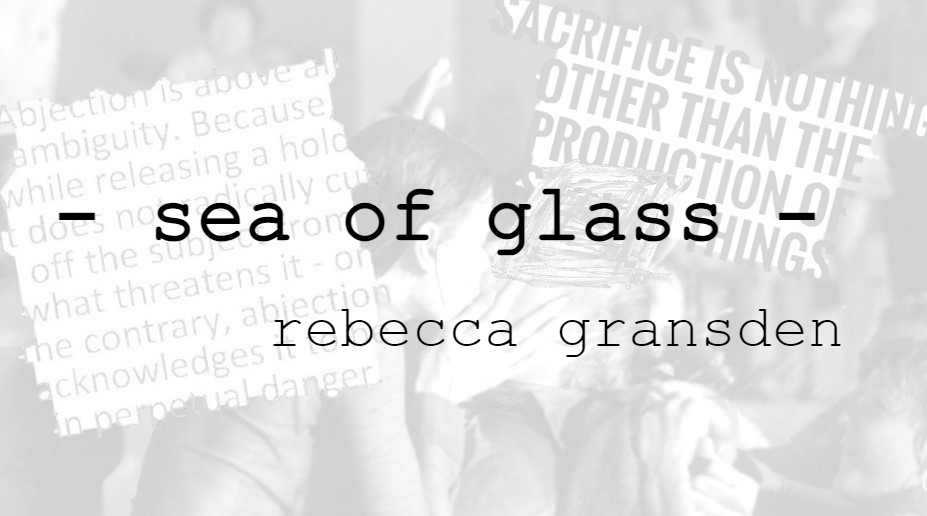
Title: Sea Of Glass
Author: Rebecca Gransden
Premise: an indentured-cypher called Kattar re-enters a building that may in fact be a lux reconfiguration of [Capitalist?] Hell and is slowly overwhelmed by it.
Subplot: A beleaguered Chairman tries to keep shit together before ripping it apart again.
Publisher: Cardboard Wall Empire
~~~
“I won’t die,” she said, manic, “I’ve been here for days.”
+
Conjecture:
Writing can detail but not convey the abject, only visual images can.
There is no visceral sense of disgust in a written description of someone’s guts leaking out [no warmth in them being put back in either].
Unless the book/text itself comes to life, reduces the distance?
Or feels like it does.
+
I don’t know if anyone ever claimed the above, it may just be me. And it’s based solely on the fact that I usually skim or skip the hugely descriptive parts in novels, which is where the abject usually lies. Where I suppose it lies. Abject in terms of “filth,” not the thing that lurks behind it.
Do I read intensely enough? With enough discipline?
Probably not.
But still…
Description = something already sketched in my mind after the first base signifier. E.g. The castle sat on top of the hill. Castle, to me, would be something from a Corman-Poe film. A matte painting from the Masque of The Red Death or The Pit And The Pendulum. Any further detail about the castle will be fighting against this fixed image. The more specific or elaborate it is, the harder that fight will be for the writer.
Exception 1: Ray Chandler, especially his descriptions of people.
Exception 2: Sea of Glass.
+
The city was juggernaut. Kattar went to the glass wall—a section away from direct sunlight, rays left to stream into the room from another side. From shade the sun smothered the skyscrapers in a vomity poultice. Septic diamond spires making sweet romance with joss paper. Oxymoronic foundations liquidising self-actualised boardrooms before a visit to the haberdasher. Slam the brakes. White heat window scales radiating blisters and hackneyed tycoons. Penthouse. Is next to godliness. The very middle view here, Kattar felt dizzy.
+
Far as I can tell, after reading the whole thing once, Sea of Glass is a novella of incessant description. Not just on a superficial, textual level, but something beyond that. I’m not sure I can put it into words…a kind of live essence…where the description exists beyond character and plot, permitting itself both the rules and the breaking of them…even, at times, superseding the narrator, who appears to be omniscient and coldly unconcerned with the main character’s emotional state.
Hijacking the narrator?
Things are delineated with a level of detail that is incongruous to the character within that environment. In fact, Kattar, the protagonist, is pretty much subsumed by it. All the victims and obstacles and lunatics and half-people he encounters within the building are…pillars to it? Long ago subsumed. But with it enough cognitively to remain nonchalant about things. Or to play their part?
Is this a hijacking?
Kattar initially chooses, instinctively, to look for an EXIT, but is quickly overtaken by events along the way and the people he comes across. Every now and then, he’ll say, hey, that EXIT, where is it again, but really he’s already started to sink into the Hell that appears to be describing itself into existence as the novella progresses.
This thing is very present continuous.
Setting?
The building exterior is glass, the surrounding area is glass, the interior is a slowly unravelling chaos agent. Where what should be the abject becomes more commonplace than a wall or a corridor. Turn a corner, see a corpse. Go through a dark doorway [they’re always dark, void-like], trip over a woman with her legs ripped off. Take another door, end up at a banquet table with the decaying cousins of those castle-people in Hour of The Wolf.
Outside the building is mutating danger. Poisonous gas? Window-reflected burnings? The end of the world?
I’m wandering here and what I want to do is talk about two things, the abject and description, and the utility or effectiveness of both in writing. And then wander while doing that.
+
The traction of the air. Three pygmy people swept past Kattar, kicking the stack of cardboard boxes, shredding them into paper dust down the street, away from the flames, so they wouldn’t catch and light everybody up. Tachypneic toy dogs crawled along the gutter, snapping at his heels only to curl away in wait for the next legs. The buildings edificed the sky, a sky in ice-pole raspberry blue somewhere up there. Great sticks of gleaming blocks, outstretched in avenue, made to be bold and dwarf, the kings of the survey, your measly head an abstract under the bitter flashlight.
+
This is the opening paragraph of the novella, the main character buried in there somewhere by things happening around him.
What exactly is going on?
Description of chaos, some kind of incident, a fire perhaps.
Children of Men vibe.
Scattershot thoughts, character detail.
Buildings actively smothering the sky.
Bold and dwarf at the same time.
On The Silver Globe.
Three random pygmies being more dynamic than Kattar, our MC.
The chapter goes on to describe [skewed] a white van on fire and a man trapped inside, and then leaves that behind as Kattar staggers, injured, into the building that he is the cleaner for [allegedly, as we never see him wielding a mop or feeling distressed at all the shit he may have to disinfect later – there is no later, that soon becomes clear]. In his hand, a pair of gold-rimmed glasses that an elderly man has just passed on to him outside, an object of value a few pages later as he uses them to bribe his way further into the supposed safety of the building.
Or technically the back exit, which is where he usually enters from.
At this point, things are relatively normal/mundane. There is or was danger outside and now he’s in a giant glass building that he should be familiar with.
But the description…disputes this.
Kattar has never entered through the reception before, and has therefore never entered properly. The reception area is described in meticulous detail even though Kattar himself is semi-concussed from an explosion outside. An explosion caused by the reflection of sunlight onto an already enflamed white van [plus man].
That was my reading of it anyway.
Why describe a lobby in such detail when the main character wouldn’t notice it, and is in no fit state to care?
Something is wrong.
This might not be our main character’s story.
The same way Tarkovsky would set up shots and the characters would just wander in and out of them, as if auxiliary to their own terrain.
Is the building a cousin of the zone?
+
I was just editing an old novel of mine [Purple Muon Castle] and, similar to a lot of what I write, the narration is suffocatingly close third-person. The description parallels/twins the thoughts of Daniella, my main character, like an out of body version of her own self. And a lot of me, obviously. As a result, most of the description is quite jarring, or stuttered depending on Daniella’s mental state at that moment. Sometimes it’s quite repetitive or clipped, usually when I can’t picture the location distinctly in my head. [To be honest, descriptive writing has never been my strongest point, mostly cos I’m not that interested in reading it in other books]
Opposing this, the narrator in Sea of Glass is like a tick hitching a ride on Kattar’s shoulder, completely detached from his viewpoint. In fact, it’s closer to the building’s thoughts if anything.
+
As the novella moves, the building gets stronger, more pervasive.
It sucks in the narrator.
When an object becomes hyperreal/projected-sentient, does it become abject also? Wouldn’t the table or the TV, at that point, feel as if it had been exiled? Exploited?
Could be entering mo lei tau terrain here…and I’m sure I’m gonna repeat some of this later…maybe in the next section, but…
Object wants revenge from the human perspective, from what our heavily mediated culture has done to it, from what we would do if we were it.
It’s not actually alive.
It has become gifted with life via ceaseless mediation.
In potential, as long as we exist to mediate it [fear it], it is invincible.
Does the object truly want anything?
The table or TV is too small, too caught by the individual. [I wrote this line a few days ago and have forgotten what it means, but will keep it here anyway cos I’m certain it meant something].
The market is the biggest one I can come up with. Market or market forces. The nonsense-abstract that the rich forgot they made up and now worship as a faceless god. They are also the ones that translate it. Not claiming it wants anything but acts like the universe itself.
In Sea of Glass, the object/abject is the building itself [possibly also an analogue for market forces, I’m not sure – Rebecca?]
Does this construct truly give a shit, about anything?
Is there meaning to all the victims who are mangled inside it?
Can we make it care?
[No]
+
Kattar traced his eyes a final time over the gold frame, shining in his hand, the vision of the elderly man and his cataracts unshakable. She reached out for the spectacles, took them carefully and placed them on her face.
“You should vacate this area too,” Kattar said.
“Yeah, I know. I’m just going to sit here for a while, see if they suit me.”
She slumped and sank into a distant reverie, caressing the frames, running her fingers the length of the gold, poking her digits through the holes where the shattered glass had inhabited.
+
I don’t know what the receptionist wants with the glasses and I’m happy it’s left oblique obscure cos this is the entrance to a new spin on Dante’s Hell. Or Barker’s Hell, considering the upcoming depravity.
But this idea that the shattered glass had been in that lens space before…is that valid? It existed there, whole, but the shattered state is new, which leads to the question, does that bring an altered sense of its own state? Does it remember what it was like to be whole? Did it imagine it could be shattered one day? Is it the same thing it was?
Things are constantly becoming = I can’t believe I used to dress like that, watch that show, was that really me?
Objects have life in this novella cos they are being heavily described. Not just historicity, but verbs and psycho-physical intent. They are a part of the building which is also alive, possibly sentient. Or is it not abjection? The Chairman later says that he created the chaos monster [Mr Wayfarer] that’s ripping everyone apart throughout the building, and then banished it to the walls. The Queen of Worms, a corpse that shows up halfway through, is…I assume…the defiled mother. Most victims Kattar meets, or follows the instructions of, are business as usual. Do we have a meeting? Are you looking for someone? The building itself is out of control in expected ways.
What is the metaphor exactly?
I don’t really care. That is not a way I can read this thing. I have to immerse myself, dedicate my brain to the descriptive passages cos I struggle to do that in all other novels and I feel that I’m not reading properly and at times I switch off and think, the words are poetic, elegant, elegantly wretched, but it’s not enough to keep me there, especially in the longer, bulkier paragraphs, and what is the metaphor exactly? I should focus on that. But that leads to the end of three or four little roads – Late Stage Capitalism, Climate Disaster, Egotism, Glass-phobia, Abject Revenge – and I want to feel the novel, not conclude it, and when I do manage to block everything out and focus on the description, I can reach the sense that I was aiming for, the trance state that fixes the words as living, squirming things and the main character, Kattar, as someone who happens to be there with those things, in frame, temporarily, following orders.
Do I care about what happens to him?
No.
Does it matter?
I’m not sure.
+
“Thought we’d have this all ready for you but, unfortunately, due to some unforeseen delays, which always happen but are never accounted for, the show will not be going on today.” He flexed the aluminium of his can, sloppy liquid sound and metallic crackling. The auditorium thronged with the silence of him up there, onstage, gazing quizzically over the pit to the heads, so few they didn’t matter anyway. How many heads would’ve been needed for the audience to matter? “You’re those zeitgeisty folks, ain’t ya?” The stench of alcohol flew from the stage to infuse the place, carried in the diminishing light. “I work in construction, always have, in the blood. I saw what it did to my father, haggard and bent over with destroyed bones before he was old, and I thought, well, might as well sign up for that. Pays regular. Folks like you will always need guys like me to build the scenery.”
+
This isn’t the last time the stage setting will turn up. In this scene it’s quite funny, the builder starting off with an apology to the two people-shapes in the audience that the show won’t go on, then drifting into insults and a backstory monologue.
Kattar does the same thing later in the text.
Abruptly letting out a…soliloquy, I guess, as there’s no one else on stage or in the surrounding seats…and then carrying on as if it never happened.
Possessed by the environment, its specific role.
Would the builder really get beaten up by a toff though?
Or is that merely the fantasy of the building that is formulating itself throughout the text?
This is not real, obviously.
At the start of the novella, the building was the safe space, an interior that didn’t have a fire burning inside. Kattar was its cleaner. And now it’s something else entirely. And ten pages later it’ll be different again. Yet most of the characters met along the way act like it is functioning the way it always has, the way it’s supposed to. Which makes no sense as they are all falling apart and dying. Were they okay the day before? Does that version of the building still exist? Were those gold-rimmed glasses always shattered?
Is it inevitable that the abject will cycle back, each time slightly less disgusting?
It doesn’t matter, they’re still alive.
At that specific time.
You have to admire such dedication to the current state of things, even when your face is peeling off.
+
The city met him, glass panels perpendicular across the street reflecting milky honey in hive-like gold, the surrounding buildings imposing opulent recidivism in refraction.
+
Sometimes the description is so unorthodox you have to stop and think, what, the buildings are returning to crime? Or they’re causing the people who witness them to return to crime? The people inside?
The refraction has polluted the sunlight in some way, causing it to figuratively return to crime?
To be honest, I don’t know what this description means.
But I get a sense of it. I feel it somehow. Maybe I’m becoming better at functioning at this level of immersion. I don’t know. Or maybe the novella up to this point has earnt this?
It’s mischievous.
The building knows itself to be insane and now and again will allow the narrator to drop in a line of absurd contradiction that makes me laugh. Mostly the dogged attempts of the victims to keep working, keep making money for something higher up that appears intent on murdering them.
This isn’t narrated. It’s not a story. I think.
+
The trapdoor gave and a foot sprung up, dirty and bruised. The body ascended, twisted, inverted, guided by rope, flopping at the knees, cracked skew-whiff at the ribcage. Discordant grimy guitars rattled in minor chords, reverb in a whirlwind around the theatre. Her thighs ready to split, like an unpricked sausage. Someone’s daughter. Someone’s daughter. If this is Anna then that’s too bad. The woman’s dress had fallen inside out and over her face, her hands peeking out from under the hanging material with wrists bound, a tattered bra rotted into her skin, the rest of her naked and bare. Someone had stripped her, hoisted her up, hidden faceless. Kattar couldn’t decide how to react. The sight of her was a world. The dress was stained, with dirt, excrement, patches of fluids. He found a clear section of hem and lifted it, to confirm her deadness. The shadow underneath showed a face beaten and shocked, lacerated cheeks pointing to a forehead with letters carved, the right way up for him, upside down for the woman. ‘Queen of Worms,’ it said in bloody cuts, as worms slimed through her hair and balled squirming inside the hole of her open mouth. Her eyes were shut.
+
Back to the abject quote at the start. Does the above qualify?
In writing, words can signify something intellectually, an understanding of a concept, but to transfer an actual picture of the thing, a convincing one? When I read the description above, my head gives me the corpse of the military guy from Day of the Dead, or Tina in a body bag from Freddy 1, both of which are theoretically abject [not just death but violent death], yet in practice…is there any feeling of horror if I’m not physically seeing it with my eyes?
Come to think of it, is there any horror in the film image?
The abject is negated by duration and repetition [and maybe the internet].
In film, I have become inured to most images of horror. Someone getting stabbed in the eye or dick or cunt or having their ankles sliced or their throat cut may have affected me the first time, but that power has waned.
In novels, is it even there to begin with?
Could something like Begotten work in that medium?
Most things in Sea of Glass are disgusting, abject, repugnant, but there is no correlated feeling to reflect that. I am one with Kattar as he barely responds to each new depravity.
This Queen of Worms may as well be paper-mâché.
Don’t know her, don’t care.
No one else in the building does either.
Did she have kids? A dog?
No idea.
The abject no longer exists as horror-vibe.
I expected a disgusting corpse to rise out of that trapdoor.
I’m fine with it.
A bra burnt into a woman’s skin.
Worms crawling out of wounds.
Fluids, pus, slime, bile etc.
It’s Angela, Queen of the Demons.
Laura Palmer in Twin Peaks.
The true abjection would be someone having a non-slit throat.
Not having their legs torn off.
In fiction.
But then, what is the system being disturbed by that?
Capitalism by definition needs the horror as sustenance but not directed at the people in the glass tower. Types like Kattar are the ones who get defiled. The working class, the marginalised.
Is this retribution?
The Queen of Worms is literally a figuration of the most excluded part of the self – the mother. I guess the worms are related to the earth somehow. I’m not sure. But there she is, fucking up the symbolic order of the Chairman, who we meet decaying in an iron lung, forcing him to face something that he believes he created [is abjection a conscious act?], something he thinks he can eventually get the better of and renew under tighter control.
If abjection is a live thing, he’s gonna try and monetise it. Cos it’s been monetised for centuries.
But this is revenge.
Of the abject, not us.
You have to play your role.
Don’t you?
I’m drained on this point, not sure if I can find a decent answer. I actually started on the deficiency of words to create a sense of disgust and think I lost my way a little. Still don’t think it’s possible. I’ve never been scared or disgusted reading a novel. Could just be me though. Some of my friends thought IT the novel was scary. I thought the tv mini-series was. Then I watched it again as an adult and…not good.
+
“The way out is behind you,” the voice said. “It’s not the exit, just a doorway.”
+
Description running on its own engine, describing everything beautifully, hypnotically at times, forcing it to reflect life and the worst kind of an end to it. By its own sheer, dominating output throughout the novella, it becomes reduced. Familiar.
This might be intentional on the author’s part.
Probably is.
Abject in this novella = the prison slowly absorbing the city?
But most of those prisoners would be minor offenders, or set up by the cops.
This analogy doesn’t work.
Abject in this novella = Godzilla slowly absorbing the city?
Slowly?
Not destroying it?
Don’t know what I’m saying here. Lost my track.
If I’d read High Rise, I would bring that into this but I haven’t. The only Ballard I’ve ever touched is The Unlimited Dream Company. Can’t remember much about it, just that the protagonist crashes a plane into the Thames and then becomes a messiah. Don’t think that’s relevant here.
Is Kattar the reason the horror doesn’t land?
He is as glass-like as the outside of the building containing him. Technically, he gives up on free will around page 25, saying he’ll pass himself over to the building’s direction. At one point, his ex-girlfriend turns up, then exits. He lets her go off and does nothing simply cos she says, I’m warning you, do nothing, or I won’t go with you later. He kills a man cos another man tells him it will help him get to the EXIT, which he remembers that he wants intermittently. The stage constantly presents itself to him and he doesn’t really know what to do. He proceeds through doors that are more darkness than anything.
Never does he say, what the hell happened to this building? It wasn’t like this earlier.
Is it cos he came in through the front? Inverted his role and the environment holding it?
Did he die at the beginning and the rest is a what’s-their-face adjective journey into Hell, where up is down and down is something he has zero interest in?
Somewhere in the middle of the novel, he feels bad that he’s going down some steps instead of up, certain that it’s the wrong direction, yet that should be where the EXIT is.
Theory: cos he gave himself to the building, it has now reconfigured him. He doesn’t want the EXIT, he wants the uppermost floor. Or doesn’t want anything. Not in an emotional way. There’s no desperation in his actions, just a kind of plodding arc towards the next black hole, and then slight confusion when it’s the stage again, or another mangled corpse.
Counter-point: he’s in shock. This building’s doing some weird shit. People he neither knows nor cares about are dying. They were dying before he arrived. Someone at the top might have a key.
Has Kattar given up?
Esperanto could be the code to this. That’s what my gut is telling me. It’s used as the chapter numbers [I thought it was Italian at first, until number four or five when it started to look Slavic] and one of the later characters takes the language itself as a name.
A manufactured language that was supposed to unite the world [under Western hegemony], yet became a punchline. A tongue with no mother. But Esperanto in itself was a solution that came from the top [more or less], an invention that they believed could be spread and managed. A bastard child that lacked organic ontology. I don’t know this for sure, but it seems logical. Something designed to cradle the expansion of a thing that shouldn’t have been allowed to grow this big i.e. capitalism soon-to-be renamed adventurism. A glass-sealed Hell that we’ve all become accustomed to. At home with our back-from-the-war abjections, that WE never really exiled anyway. It’s a bit obvious, but feels accurate. I’ll be Kattar-like and stick to that.
+
Wherever he goes, he degenerates, installs havoc and destruction, then leaves the rubble, the process reinvigorating him. What he does is parasitic, but it’s sanctioned by his targets. There are no victims behind glass.
+
In Solaris, it was the main character’s fault for going to the space station.
It was Hari’s fault for not adapting.
It was Tarkovsky’s fault for turning on the camera, writing the script.
My fault for watching it.
Your fault for reading this.
I have sanctioned everything that I have not yet eliminated.
I write sci-fi that pleases no one except myself.
Description is Hell.
Hell asserting itself and drawing us in.
I don’t know what to do.
+
Should’ve looked this up earlier, but apparently sea of glass is a biblical reference that symbolises a layer of purity.
Not sure that works anymore.
Skyscraper morality?
+
Sea of Glass is available here.

 PsYChO hOLosUitE [zine]
2 thoughts on “[De-Con-Struc] Sea Of Glass // Rebecca Gransden”