
+++
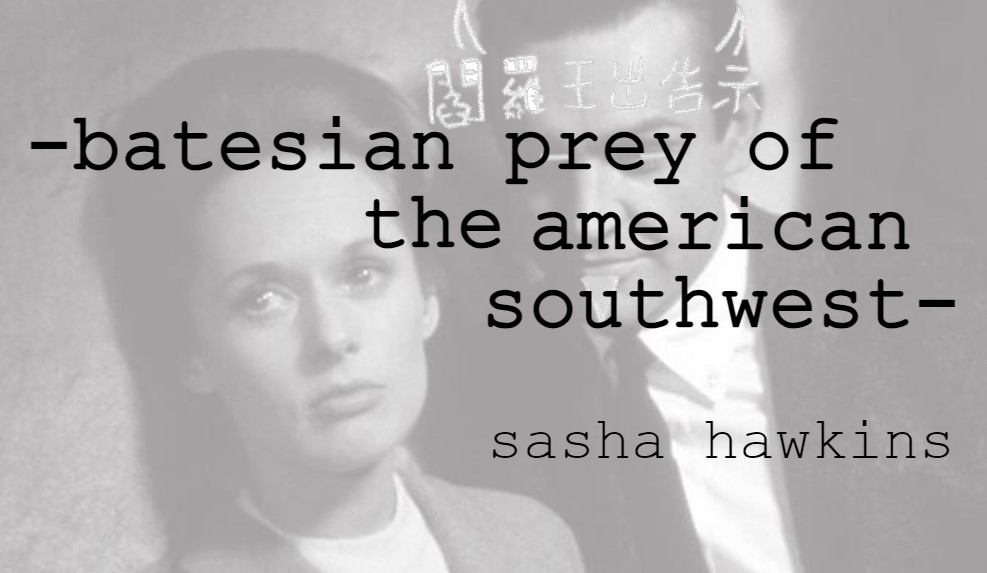
Title: Batesian Prey Of The American Southwest
Author: Sasha Hawkins
Premise: A fictional actress falls [poetically/abstractly] into and beyond the 1964 psychological thriller, ‘Marnie’, as well as a few other filmic references that I had to either look up or stay blank on. Not to mention the Bible.
Publisher: Schism Press
+++
I am neither Batesian nor Prey nor the American Southwest and therefore not the target reader for this text, but I’ll give it a shot anyway [cos it’s a fellow Schism author, the book is relatively short and I’m intrigued by the ‘Marnie’ reference].
Actually, there are no target readers for experimental work.
That would be insane.
Who else can understand this level of abstruseness outside of the author herself? Themselves?
Okay, I’ve checked an interview online and it’s she/her.
And this is her baby.
All I can do as a reader is embarrassing guesswork.
+++
That interview [with The Operating System] is a good grounding piece. Don’t think it was given specifically for this work, but an earlier version of one particular section of it. Still, it seems to locate the text in the world of ‘Marnie’ and Hitchcock and difficult nostalgia. Difficult in the sense that Sean Connery was a misogynist who once said in an interview that he sometimes had to slap a woman to shut her up.
Hitchcock?
He was more of a psycho-sexual puppet-master, hence his role as film director, and his choice of scripts where a production line of Hollywood blondes [some, like Hedren, tied to personal contracts with the director himself] get battered and bruised by Hitchcock analogues. Did he see himself as Norman Bates? A flock of no future, no hope birds? Sean Connery?
+++
If you’re a man, there’s one thing you have to keep in mind when reading this. You can be an object to others. A terrifying object. A pitiful object. A sexy/sexless object. Don’t take it personally. But it’s true.
There is sexual violence in the very image of you, let alone the prospect.
Fat, muscular, tall, short.
In action too, if external circumstances are fixed a certain way.
E.g. trapped on a deserted island with only a female stranger for company?
That’s erotic for precisely one side [unless the guy is Willem Defoe].
Apocalypse fiction?
Fuck.
+++
The first page opens with this quote from ‘Marnie’:
~
Mark Rutland: I am a man of science I am a man of animals. Like you, a place, a situation: “Batesian Prey of the American Southwest”
Marnie Edgar: What’s that supposed to mean?
Mark Rutland: It’s high level stuff. Heavy stuff. Animals like you wanna leave sores, split to a need for sutures, but you could never kill, and eat, by rot, by mouth.
Marnie Edgar: Am I caught? Do you love my head? It’s meant for walls, I’m just skittish.
Mark Rutland: My trap goes right through the ankle. My mounts are good wood. You’ll be happy here.
Marnie Edgar: I will.
MARNIE (1964) dir. Alfred Hitchcock
~
I hadn’t seen the film when I started reading this – I knew of it, and the disgusting hassle that the lead actress, Tippi Hedren, got during filming – but it did clarify the title.
Batesian Prey of The American Southwest.
Spoken by a Scottish actor.
Does that make it universal?
As in universally terrifying no matter which country a woman finds herself in.
Or just of that era?
[Nope]
I’m still not sure what Batesian means. A reference to Norman Bates perhaps. His motel may or may not have been located in Arizona. I don’t know. On some level, it fits with the subtext of ‘Marnie’. Or the subtext I have gleaned from reading the plot synopsis on Wikipedia. I will watch the film at some point. And then come back and add a few notes. See if what I’m writing now holds up. I think it will as there is so much notoriety around the film, and Hitchcock himself.
[I have now seen the film, and two things: one, Batesian refers to prey in the animal world that mimics other prey that are either harmful or innocuous to predators that they share. Connery makes a reference to a Kenyan flower that is actually made up of tiny bugs hiding themselves from a bird predator of some kind.
Actually, Norman Bates still functions as Batesian in this regard, only inverted; he is the predator that mimics the harmlessness of prey. Assuming any man alone in a motel can be considered harmless. Perhaps not…
And two, the quote at the start of this text is the author’s riff on a conversation that Hedren and Connery share in his office, not a direct, word for word reprisal. To be honest, I love this kind of sneakery. I do it all the time too. Sets the stage completely for the ambiguity of the text about to unfurl i.e. what is real, what is filmed, does it matter etc.].
+++
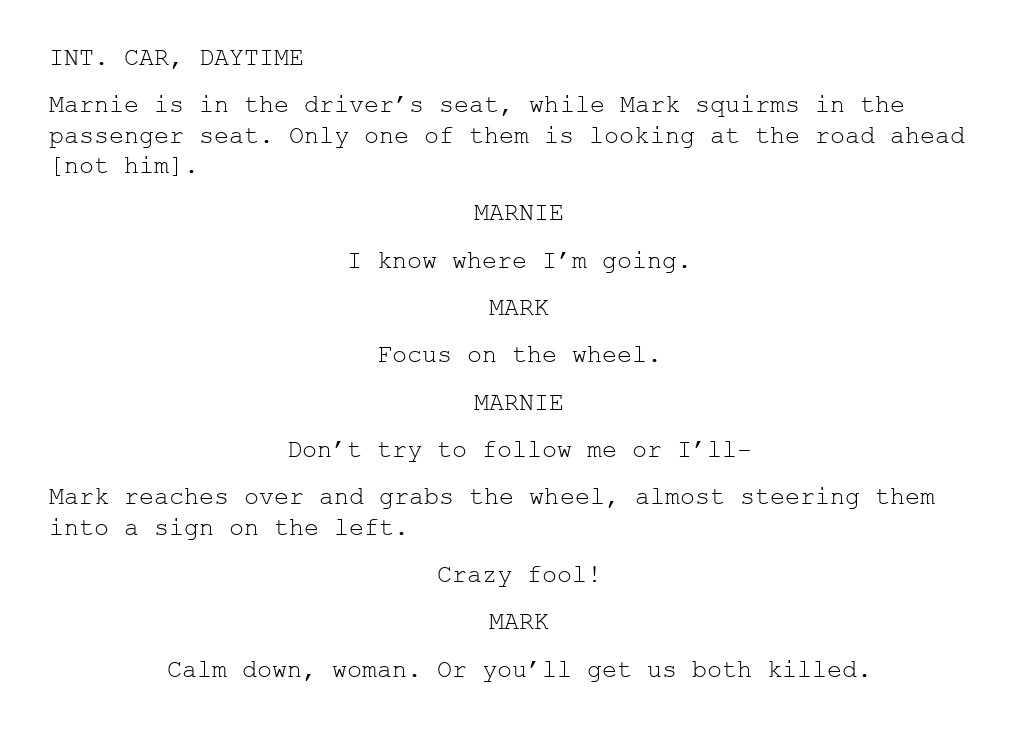
It’s quite funny, the site I watched ‘Marnie’ on was Chinese and the translation of the title was ‘Pornographic Thief.’ Yet when I checked in the dictionary, it became ‘Glamorous Thief.’
The Chinese character 豔 isn’t really a compliment if you’re saying it directly to someone, it’s more like gaudy, or a little bit cheap, yet it’s nowhere near the level of pornographic. Unless you’re a puritan and that’s what a character like Marnie looks like to you.
+++
+++
Subtext of the film = unintentional?
I say that cos ‘Marnie’ seems to be about the attempt to control a woman who is acting in a way that is both atypical and attractive to a generic man [of that era] like Sean Connery, and the woman’s attempt to disguise herself as Batesian prey.
Which doesn’t work at all, as the traits she employs are the same traits that attract the predator. Or the Batesian predator?
She tells him to fuck off [in the 1960’s way] countless times, says it’s disgusting for a man to touch her, and still he pursues, apparently to save her, or ‘to take responsibility for you’ as he describes it.
And that’s finally what happens.
He traps her endlessly; in marriage, in his home, in his debt, under his cloak.
Is the prey defeated?
Exhausted?
You might call her behaviour hysterical or manic, but it’s all explained neatly at the end of the film. She’s that way because, when she was a kid, she killed the sailor who was attacking her mother. And now that Sean Connery understands this he can take care of her i.e. control her. Even though he raped her [off-screen] earlier in the film. And threatened to beat her senseless after she kept lying to him.
The prey is always prey in a world designed by predators.
According to the third screenwriter [female, which was quite rare in the 60’s] called in to do the script, that rape scene was the sole reason why Hitchcock wanted to do the movie. He even said to the previous [male] screenwriter, ‘when he sticks it in her, I want that camera to be right on her face.’
Hitchcock the zoologist?
+++
There’s a giallo film from the early 70’s called ‘All The Colours Of The Dark.’
That deals with a similar theme. A woman, Edwige Fenech, is haunted mentally by a miscarriage, and physically by a man with piercing grey eyes [or blue, I can’t remember exactly which], while her boyfriend tries to help her recover.
Only that’s not what he’s doing.
It’s quite subtly done, as the boyfriend’s generally compassionate demeanour is contrasted with the actions of an evil sex cult, and, at the end of the film, he saves the Edwige Fenech character from being pushed off a rooftop.
‘Help me,’ she says, throwing her arms around her protector.
And that’s exactly the position he wants her to be in. Not just for control in the relationship, but to get his hands on the money she inherited from her mother, who was the leader of the evil sex cult and…there’s a lot of other stuff about her sister too…but the main point is: this boyfriend is the same archetype that appears in most films where the man is the supposed hero.
And if Edwige Fenech doesn’t act in the way he expects her to, if she doesn’t acquiesce to his care…well, he’s already murdered the sister.
+++
As with most experimental work, I started this one with high hopes that I would be able to understand it on first reading before realising about ten lines in that this was gonna take some head work. Which is a good thing as without abstraction you’re just reading…a public diary…a sanitised report…something too far removed from where it started from.
Here’s the first page after the ‘Marnie’ quote:
~
He had his back to me, and I was turned toward him, “Yes,” I said, “I wanna go home with you.” And we could barely stand, and he could barely drive. I didn’t know what city I was in, what room, later, when I’d come back. Hours in that plain light, whatever he could think of to pass the time, too drunk for anything ending. I have these moments where I’m not moaning, thinking this is the time I dressed and laughed and got naked for, of unactionable secrets, and he tells me he’d never think he could just ask and have me, and I say I already can’t be without him this way, still and beside me, and he is flattered and renewed for hours and hours more of trying to end in me. He turned his back to me, and he told me goodnight.
~
This is titled ‘Screen Test’ without any extra information as to who exactly is testing for what. I assume it’s the narrator, the actress, but why make it a screen test when this is already a piece of poetic fiction?
Reality = permanent screen test
Sounds a bit simplistic, let’s alter it to narrator’s perceived reality = permanent screen test, yet she is also telling us her thoughts, which are becoming mediated in the text itself as soon as they are expelled. It’s a Screen Test, after all.
Who is receiving these thoughts, apart from us?
The man is obviously the object, reduced to the animal theatrics of his role, and that’s a nice reversal. But the narrator isn’t in much of a better place. An object reflecting on male object-actions, poking for holes in the ice but also…doubting the act of poking itself?
She has moments where she remembers dressing and laughing and getting naked for this. But what she wants to do is lie there next to him forever. Only those are just words. The way they are written is detached from any kind of assuredness. And sadly the object-lump next to her interprets them as a call to more drunken sex where he can’t seem to cum…then turns his back when either/or happens, which is how he started the scene too.
Is this the prey?
~
“when I look long enough
at your side of the bed
I see eyes in the inked dipped rounds of our covers, and the iris under your shirt
moves black
as brando’s.”
on a note wrapped in sweaters.
in a room
with a door that faces the road, car lights sow white
through plastic blinds
quick fade niceties
from strangers.
~
The formatting isn’t quite as it is in the text due to WordPress dynamics [sorry, Sasha], but you can still get the gist of things.
I mean, I think I understand what is happening here.
‘Black as brando’s.’
Another Connery-type figure, charismatic and of Hell, said to have fingered the young actress from ‘Last Tango In Paris’ without her consent.
Yeah, black as that guy.
Black as the colour of the dark that pulls you in, the colour of death, the colour that you think is the colour of the black hole out there somewhere, the colour of…a fourth thing I can’t quite think of right now.
This is not an accident on the author’s part. Nothing in poetry is [unless I’m writing it].
The fact that the room they’re in also has a door facing the road, implying that they’ve stopped in a motel for a quick fuck and that’s the danger when you do that kind of thing, it’s all so frantic and rushed and potentially brando.
Or is it?
Mostly it’s just sex in a motel, an act gone through, drained
But is it?
What about the anti-brando who lurks at the foot of the bed, the never-gratified man who cannot transform fantasy into reality?
The one filming all this,
the creator?
+++
After this part, we get to what I’m calling an ambush, but what could also be just a regular change of setting [with aliens]:
~
on tv
in a dark room
to their dark faces
the tall plastic aliens
blow blue and wild from inside, push rotting corollas and
say to let someone else talk;
these deals won’t last forever.
~
An advert?
I can’t imagine tall, plastic aliens being in the room with the narrator and the guy she’s caught, so it must be that.
But why?
Corolla = small ring of petals around the centre of a flower
Or
The branding of a small family car.
Narrator and guy in bed, no sense of deep connection. The deal won’t last forever. Even the plastic aliens are sceptical of their union. And the corolla is rotting…is already rotten…wants someone else to talk. But no one is talking except them.
This feels like a trap. A prison.
+++
+++
Moving back to the text:
~
note:
* TWO SHOT NEEDED
SO INSIDE WOULD LOOK RIGHT STANDING
AT HIS BED, LIKE SHE WANTS TO BE WATCHED. I TELL YOU, NO WOMAN CAN BE ALL THINGS, BUT SHE COMES CLOSER THAN MOST.
LOOK,
IF SHE KEEPS ASKING FOR DIRECTION
TELL HER
TOUCH HEAVY
LIKE SHE’S REALLY IS SURE IT’S JUST A MOVIE.*
end note
~
I’m still only on page 17, which is more like page 5 of the actual text, and the irony is coming at me like that endless line of pervs who all wanted a piece of Annabel Chong.
[Who was the object in that by the way?]
This starts with TWO SHOT, then immediately flows into AT HIS BED and then NO WOMAN CAN BE ALL THINGS followed by IF SHE KEEPS ASKING FOR DIRECTION etc. etc.
I try to avoid praise in these pieces, but this is fantastic. You don’t have to place or locate anything, you can see all the contradictions right there, shrieking at you.
A shriek at reality.
What TWO SHOT? Who can a woman be all things to? You think it’s the male perspective and in this note it is. It has to be. She likes being watched cos the man can’t accept himself as the pervert watching her. But then some women do like to be watched.
Who is in control of that? Until what point?
+++
+++
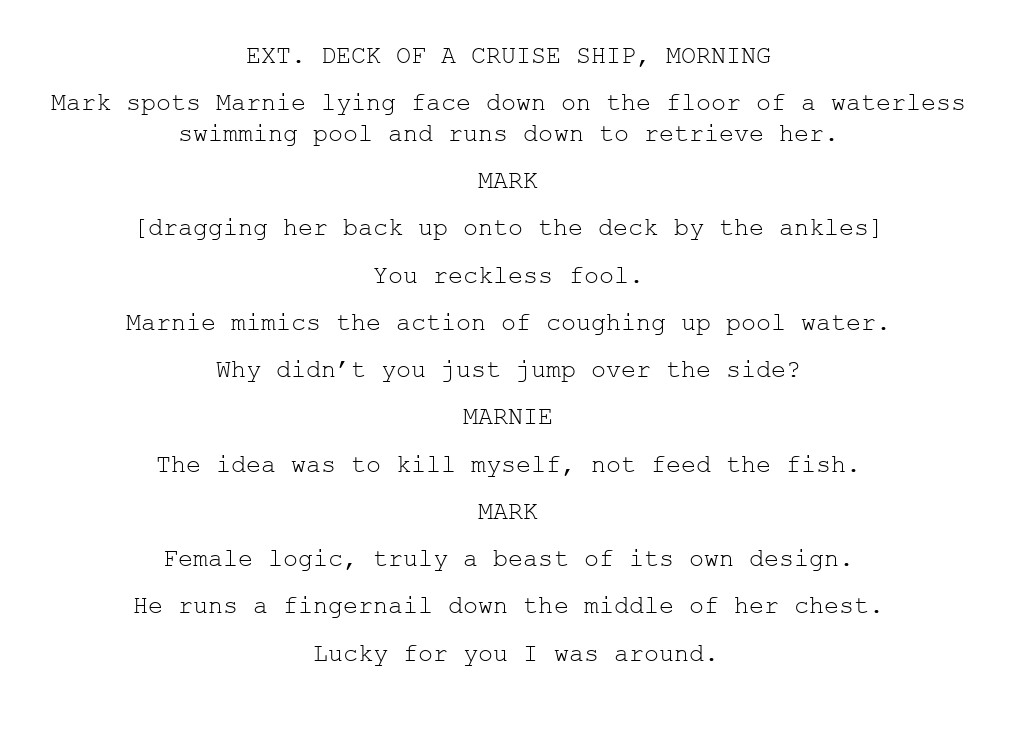
Deeper into the clawed-pit of abstraction [in a good way]:
~
scene one
kersey pulls back white flower cotton from her hip
covering moving out on wakes beneath the fitted sheet
yachts
on the knocked nightcap
chase her through the carpet drawn blinds
cut (again) until he wants you
(again)
the thought guilt pacing a no’s half-life
the act a poacher coming for the albino
security deposit
discolored locust-holed
love professed is hitchcockian deployed from red-flashed fear
in this slow before to a stray bullet after
they play domestic
lovey and untethered to an act’s end and
harm is a neighbor in manhattan snow
waving
in an open window she swears she closed
she floats above her blood and waters
asking kersey
and all
if her hair looks nice tonight.
~
If I told you I knew what was going on in this part, I’d be a [tall plastic alien] liar.
It seems to be a mix of different scenes or moments, some nice, some dreadful, and the ending has the SHE floating above her own blood and waters, asking if her hair looks nice.
Who is kersey?
Well, I just searched it online and it’s either a village in England or a pizza restaurant. If I change the search to ‘kersey movie’, it gives me an Indian film called ‘Jersey.’
Is it someone the author knows?
A specific reference only for her?
Okay, I’ve gone back to the author’s interview and now I’m pretty sure kersey is a reference to the movie ‘Death Wish.’ Which, just like ‘Marnie,’ I have never seen but have heard of. And I can assume that the woman in the passage above is kersey’s wife, who probably gets killed at some point, and the whole thing is from his perspective of her as either a lovely corolla or a bloody corpse [just read through the plot synopses for all five ‘Death Wish’ films and the survival rate for the female characters is almost zero – death to the object!]
He can look at her, play with her, and avenge her when she dies.
But then what is her reality quotient?
He’s killing spree-style because they trampled on his pretty corolla, not a real person with her own mind who sometimes told him to stop barging in when she’s trying to have some fucking time to herself.
I’m gonna guess that all the imagery from the above section is taken directly from the film and the narrator is taking a step back to show precisely how the [Batesian] prey is pinned to the wall, even after death.
You know, if kersey were a woman, and it was the husband who’d been killed, would she have flashbacks of a guy looking like a smiling corolla?
Is that really what anyone wants?
No.
Confusion + doubt + horror + claustrophobic effect is better.
Right?
+++
+++
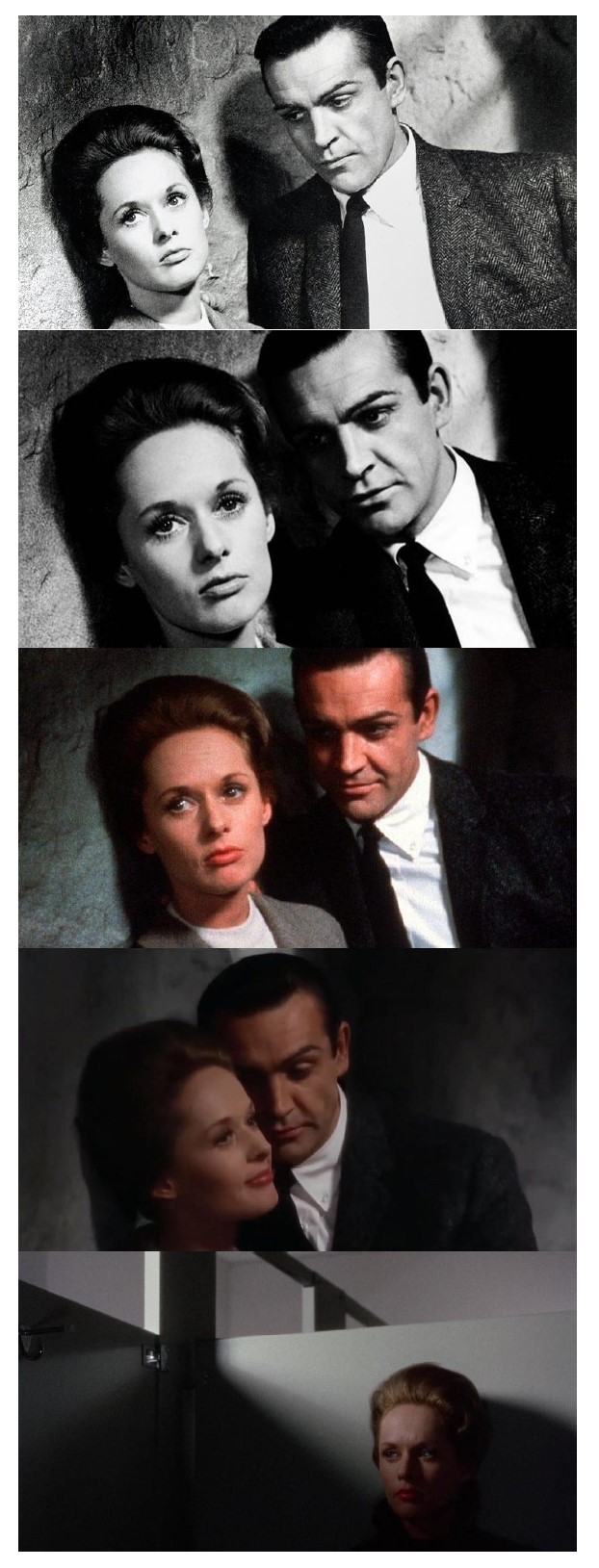
Brace yourself [for esoterically distorted Bible vision]:
~
2 corinthians 12:7-18
7 he builds me of blessings, hardships my glory, my passenger inevitable and unwell, in pieces, she says
8 her devotion like lightning beats in the bird’s back, the tiles on my plush, my baby, its face pulped, cheeks blossomed, sprawling vine staining carpets and image of passed birthdays and he’s rich off it
9 and his family laps up the wake like the dog he doesn’t have anymore
10 and he sat at the shore running red from the top of each finger, a bird’s nest unsure what to make of its emptiness in terms of hows and whys, in terms of missed sleep
11 a bolt on dried grasses, his home burned up righteous, come textbook and reenactment deep into our palms, the cuts on our feet, our insides a cell, the bed and the sink he gets strong on
12 big traps, time served in heavy thought, out and walking home on the judge’s orders, the idea that if he stays, someone else’ll hurt them worse they won’t just gut the dog they won’t just bleed the maid they won’t just make her say I love you they’d curl at her breast and feed
13 yeah, yeah. what’d you ever know about grace? he asks 14 that you can’t take it
15 that it’s his paper lanterns torn down into the corners of the bed, god right through his chest
16 she cried her shirt heavy, and scratched burns into her skin
17 he passed her quiet, and the Concord took big steps toward a new life, a new woman, true affection at the other end is a courthouse, a rebel in midday, an arm outside the car, slack tongues waiting on action
18 he snaps at the leather seats and they quit barking for meat, darling setters, they wait and point like darling setters, and he, the deerstalker, idles and smokes, and new woman walks up and by and back, and nothing good is coming, but maybe something good is on?
~
Just when I think I’m finding my feet…fucking Corinthians.
As an atheist, I never made it past the animal boat story, but for the sake of trying to understand this text, I’ve gone to know your bible dot com and looked up this specific passage.
As with the ‘Marnie’ quote at the start, the extract above is a play on the biblical verse, not a reproduction.
Which means?
Well, at the risk of pissing off religious people, the Bible is by and large a document of shame, especially towards women. And this specific verse is one about weaknesses, insults, hardships, persecutions. The thorn in your flesh is a messenger from Satan sent to torment you.
This explains a lot.
Sounds masculine.
Patriarchal.
All the narrator’s hardships bring her closer to a god that put the thorn there in the first place.
+++
Is the author religious?
If yes, this passage, all the bible passages, could be an act of faith.
If no, a bitter contradiction.
If yes but only culturally, perhaps a doubt? Or a I SEE YOU UP THERE ALL THIS HARDSHIP BULLSHIT kind of thing?
+++
Kersey keeps cropping up and I don’t know if it’s him from the first movie or the second or the fifth or if he remarried and neglected her too in the hope that she would wander down the wrong alley and draw out something dark that would kill her for him so he could go out and start ejaculating violence again.
No idea.
But he’s there and it’s a collage effect, the wife in fragments she has no control over, her own life trapped in turn and smile shots so Kersey can keep cropping up and bugging me.
+++
+++
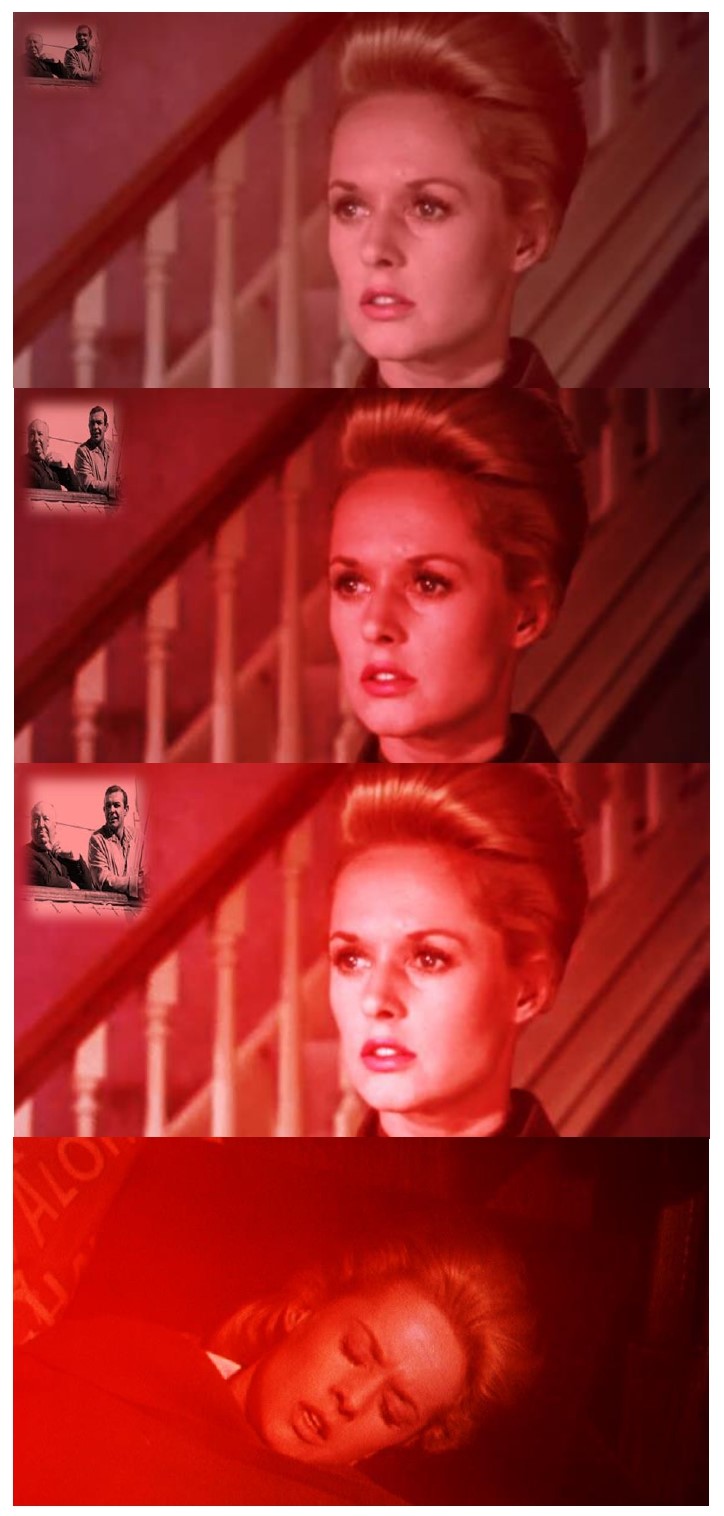
Okay, we’ve got the bible, ‘Death Wish’, ‘Marnie’ and maybe fifteen other references that have probably gone right over my head and
don’t try to grab at this
just feel it
What do all those things put together mean?
+++
If you watch horror, it’s normal for the characters, even a lead, to be disgusting, reprehensible, but with a film like ‘Marnie’…
Connery’s supposed to be heroic.
Yet you can feel viscerally that he is not.
But then he’s also charming.
Cos the camera shoots him that way, the script writes him like that, yet at the end it’s pure horror.
But. Yet. But. Yet. But. And yet. But etc.
She is in the arms of someone who [it is implied] raped her earlier in the film, on their honeymoon, which evokes the religious excuse that a husband can never rape his wife cos she said yes once at some point previously.
But the rape was off-screen.
And it was the hero, not Peter Lorre.
Not Hitchcock.
[though according to wiki, the frowny director did allegedly pursue and hassle Tippi Hedren sexually throughout filming on ‘The Birds’ and ‘Marnie’, definitely a Batesian predator if all of that is true, which I think it probably is cos men could get away with that shit back then, especially powerful men like Hitchcock who made ‘Marnie’ so he could film his analogue Connery sticking it in the woman who continually spurned him, get the camera ‘right on her face.’]
+++
The following extract should be in italics but isn’t:
~
the star I am
knows just how much of me
gets you wanting the rest
and how long I have
to be wanted
on
on a blue lawn
with a white house
big loving flag
of my country
pinned to sails
checking my name in the horoscope I say
“my day
and my time
were made for you
I’m not scared of you”
I roll out into the sun
at his feet
and his hands are at his sides
he only looks for a second
and then on
at something else
while I look up at him
at the dock
a gull
chewed thick by the neck
in a man’s mouth
his son’s crying
“that’s okay”
it falls out,
“to not wanna see things like that”
his son cries
and is not heard again
until he wants to play
and remember this
as kind
with his school friends
with hot beer
the coast
a future in banks
and white birds
~
Far as I can discern, which isn’t that far, this section is a mix of the following:
1] childhood dreams – the white house [symbolism of normality, power, safety, confinement, other things]
2] adult reality – a future in banks [middle/upper class]
3] limits of seduction – rationing out the sex
4] distant gull-related trauma – violence is kind, remember that, kid.
5] dual, contradictory feelings – I’m destined to be with you, my love, I’m not scared
6] blue lawn??
+++
The author is surely located in all this, but where, at which specific points?
I’m talking about her own life experiences.
When there are pages headed with SCENES and SCREEN TEST and references to kersey [not the pizza restaurant] it becomes hard to know what is meaning concealed behind artifice and what is meaning blurred into things that really happened.
There’s this one, titled oct 22/20:
~
ask me out tonight
draw my eyes
low, dust my nose
with glitter
blush dress with a feel
of the last movie you watched and watched and come
with more
I let you talk
I’m not so selfless
as to listen
‘my car is very important to me’ ‘my mother is unkind’
how is operable
and finds its way out
from the middle
my chest takes on air
to keep me on my back
kick up sand
and it smokes
and I am the reason
you came down all this way
but I’m not the type for zoos
visitation, titles
a lion is hardy
and its arms don’t come off
the floodlights go out
I don’t know if you’re still here or if I’m still worth filming
in absence
I realize skin’s nothing
if you can’t see it
I can touch my own face
yeah
I just don’t care to
my being
is finite
~
Could be way off, but it sounds like a date, a date that ends in darkness as the floodlights go off yet there is also a reference to still being filmed, or is she worth being filmed, so is this real or has real life become something not of its own ontology but a thing that is either being filmed or waiting to be filmed?
I don’t know if ontology is the right word.
I think this is the author attempting to be direct.
As direct as she can be.
She wants you to be unsure of the CUT.
This is a date that could be a scene, is now a scene.
How much of your own real-world dialogue is not from a film?
How little of ‘Marnie’ was from a female brain?
[Note: the third and final screenwriter for ‘Marnie’ was a woman, Jay Presson Allen, who seemed to have less of a problem with the rape scene than the other two [male] screenwriters. Discuss.]
+++
I remember when I found out Clint Eastwood was a cunt and Gian Maria Volonté was a god. Or a god compared to most of the American actors. But not a god at all. Just a socialist who made socialist films back in Italy.
But how was he with women?
Did he turn his back too, after fucking?
+++
Back to the SCREEN TEST conceit [and italics]:
~
PRODUCTION TITLE: THE SCREAMING LONELINESS
Yes is an affirmation of the existing, and the to exist. No doesn’t say anything to me passing, it just leaves out the door, and I’m stuck there, and I’ve made him angry. If it told me what to do, I’d do it. I said something smart, and he backed me into the wall. I thought of myself as a man,
with his consequences, and physicality, and fairness. He’d tell me how he’d hurt me if I thought I was big. In sharing, a kindness other men would never extend. I saw some pictures last week of me then, and I was small, and I was young, backed to the door, and the corner of the pony wall. “Okay, okay” he’s closing in. You gotta be quiet. A friend played a joke on me, “okay, okay” and she stopped. They both laughed. I drew my knees to my chest today, and they felt narrow, and unbelieving of my strength. I, a small man, could kill another. I need a big man to keep things safe.
~
Is the author re-imagining herself as a man?
This is another Screen Test.
A lot of pronoun shifting, including IT. If IT told me what to do, I’d do IT. What is IT [in both cases]?
Maybe I haven’t said it enough but I like it when contradictions materialise and they materialise in this text a lot. I don’t always understand the intention behind them, but I do feel them.
The fairness of a man vs. he’d hurt me if I thought I was big.
A small man could kill another [small man?] vs. big man keeps me safe.
YES as affirmation of existence vs. NO says nothing, leaves out the door.
Trying to think what the first two lines are trying to say. My gut says, the first YES line is a philosophical aphorism attached to positivity, while the second NO line is a pivot to the sexual NO and the reaction that follows.
The two of them shouldn’t really be together but are.
Does it make sense?
Leaving out the door is an act of existence too, if you want to get pedantic, so in my head I’m thinking the NO is a fall back onto feeling, the emotional and then literal result of that word.
Which leads to coping mechanisms?
The author imagines what it is like to be a man, to act like a man, and by the end of the Screen Test, she has become a small man capable of killing another small man, but not big enough to kill HIM.
This must be about feeling.
If you watch enough old films, like ‘Marnie’, or ‘Death Wish’, don’t you start to think of yourself as a smaller version of that?
If you’re a woman, and you get nothing from the wife character or the comatose daughter, then you become Kersey.
But what about Marnie?
+++
+++
he got mad when I didn’t
laugh I apologize
my mouth is dry on you
I can’t go on
at the end of my trying
you take it out
and spit on it
and tell me to keep going
I didn’t even need the rope
I didn’t know it then
but I wanted you to be missing
a little
after me
like tv cops
after the first kill
do it again
like tv cops next week
stuck behind cement
with everyone who’d ever touched
me the bars
and shots make things easy
when you say you don’t like
me I don’t take it so hard
~
Scene or off-screen?
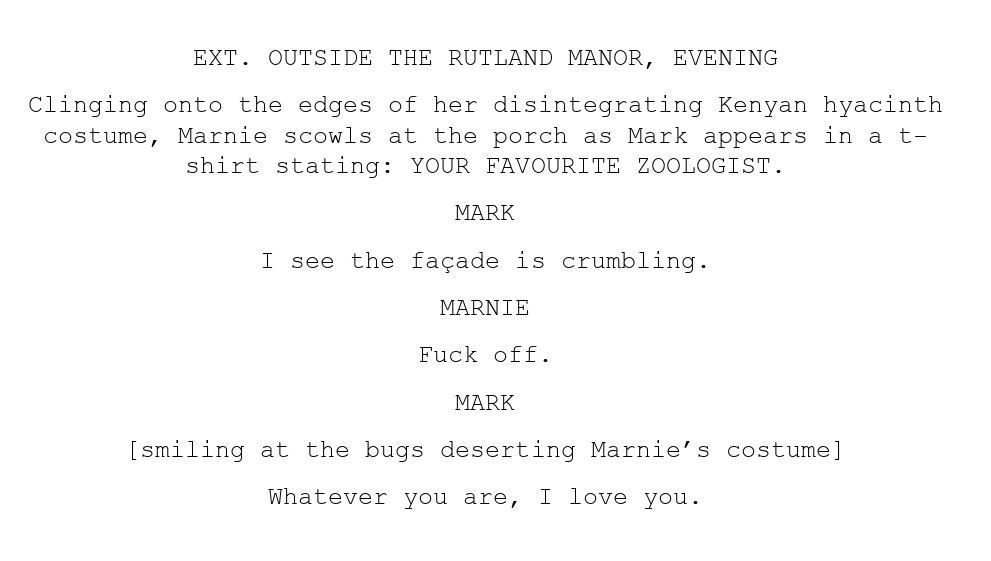
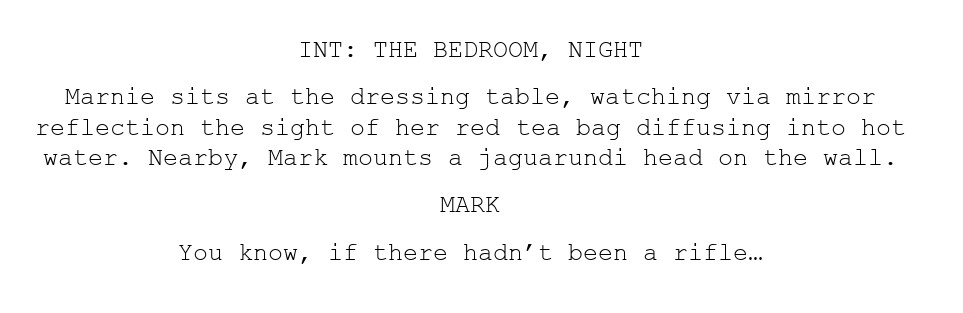
After watching ‘Marnie’ [but not ‘Death Wish’], I believe Tippi Hedren spends the whole of that film running down a piece of red carpet held by Sean Connery and Hitchcock at the other end, the two of them slowly reeling it back in towards them.
Connery as the physical golem, Hitchcock as the rest.
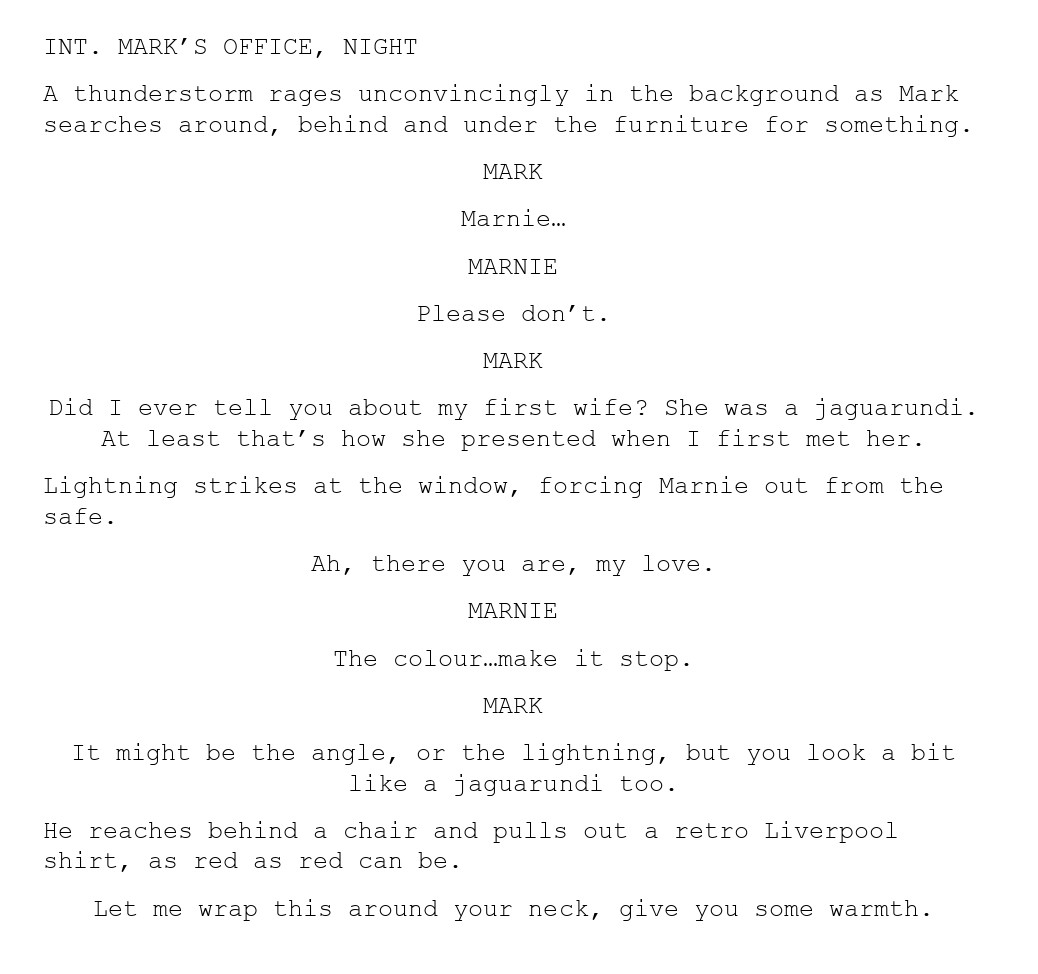
And on the slowly reeling carpet, Marnie imagines herself a subject despite being written [mostly] by a man, filmed by a man, pursued by a man, surrounded by other men who would take any of those roles if they happened to be vacated and, finally, contrived into the arms of a “cultured, educated” man with the thorn in the flesh still intact. And perhaps the most powerful of those men [Hitchcock] was genuinely trying to examine the/his own male sexual urge and its horrors and to do that he had to show things as naked and difficult as they really were, or maybe he was just indulging in that urge and to him Marnie was the Pornographic Thief that needed to be coddled, saved, raped, caught, and it’s all about the most literal of traumatic associations at the end – the red terror is blood, the fear of men is the fear of a pervy sailor at night, in her own home, and the thunderstorm was a thunderstorm happening at the time – which only serves to make the predator [Connery] successful cos he solved the riddle, and the prey [Hedren]…neutered?
The above extract is a reflection of all that, and much more.
To me.
As a man.
Is it pleasure or unpleasure?
Not only must the predator catch the prey in this game, the prey must be thankful to be caught.
So many times the narrator/author is in the position of sex object, or object-other, and all the male characters are objects too, vaguely described, nebulous, and it’s the narrator who is swirling in doubt and confusion and pleasure and unpleasure, and is this from childhood? There is a juvenile, nostalgic feel to a lot of the TV show descriptions, a lot of bigger people looming off-screen or looming artificially as concrete types and…is this accurate?
I don’t know, I’m losing grip on a lot of the pages I’ve read, the whole middle section of the text, it’s hard to mold it into a total THIS MEANS THIS argument, and that’s never been my strong point anyway.
I think, at the heart of this, is one question:
Is it okay to still like ‘Marnie’/Hitchcock?
Or maybe:
Why do I still like ‘Marnie’/Hitchcock?
Or, at the lowest possible ebb:
How do I continue to function as prey when I know I’m more than that?
+++
+++
The whole of ‘Batesian Prey Of The American Southwest’ is only around 60 pages long so get over to Schism Press and either read the PDF for free or buy the paperback.
+++

 PsYChO hOLosUitE [zine]