+++
Title: Ponds
Author: Nick Borelli
Publisher: Schism Press
Plot: the world ends and other worlds end also. But end is just a transition to a new world, which will become a mutated version of all that came before. Mostly in the form of animal sludge and swamp water.
Subplot: A vampire gets some unexpected down time at the bottom of a pond.
Sub-subplot: Time breaks, patches itself together again, wanders lost through the catacombs, exits to ritualism.
+
‘You must imagine what you can’t see. All the mould and muck and blood and puke. It’s everywhere, Mole.’
+
About ten pages into Ponds, I got hit by a nostalgia train, the old picture book version of The Wind in the Willows that my sister used to ban me from reading. I remembered the page with Toad dressed up as the washer woman, being chucked off a barge, the bit where he crashes the automobile, the climax with him and the other conservative animals taking back Toad Hall from the working class ferrets, stoats and weasels [who could all be variations of the same animal, I’m not sure], the general reverence for the riverbank and its café culture lifestyle, the weird god head in the forest, the brothel in the wild woods etc.
Then, as a realist counterbalance, my brain leaked in all the rabbit deaths from Watership Down, the bleak misery of slaughter/migration, the arbitrariness of following a seer etc.
And finally circled back to Ponds again.
Each book has its counterpart, as Borges may have said to Bioy Casares one time.
+
The last de-con-struc I did [Vitiators] was quite draining, not least cos I forced The Fold into it when I should’ve just left it in the library with Anti-Oedipus and Notes on Benjamin.
[Definitely no philosophy texts this time, no way].
After surviving that chaos, I needed something to help me unwind.
So I read a children’s book in Chinese.
Then watched Cybernator.
Then picked up Ponds [or opened up the pdf file on my phone].
You know all books on Schism Neuronics are free to read this way? It’s a goldmine. Especially if you live in a faraway land with high postage costs and can’t afford to buy many paperbacks.
Though I’m thinking I might buy Ponds at some point.
Put it next to the Wind in the Willows book that I probably won’t end up buying.
[Note: I won’t buy it cos I just loaned it out from the library and the writing isn’t great. The animated film isn’t very good either. Could be the politics embedded within. Kenneth Graeme worked for the Bank of England. Toad is a sympathetic character. The riverbank is the bank of the suburban Thames where upper middle class people dwell, while the wild woods are Brixton or Toxteth. Actually, I’ve just checked and there’s a socialist re-write of Wind in the Willows called Wild Wood where the ferrets and stoats and weasels are given the reins of the narrative, and their invasion of Toad Hall is seen as a revolutionary act that ultimately breaks down due to infighting and cultism, making way for a melancholy ending, and I think I might buy this book instead. Sadly, the author died last year so I won’t be able to get him to sign my Emma Goldman doll].
I actually skimmed through Ponds when it was first released last year, and it seemed quite whimsical, with small sections instead of chapters, oddball character names, and only fifty pages long once you took out the cover page and promo stuff.
Didn’t notice the total commitment to decay and mutation at that time, not sure why.
But I noticed it the second time.
In some ways, it’s playing with similar themes to Vitiators, only without the vitiation. Or the subjective vitiation. As in, Nick [the author] approaches the worlds of Ponds mostly as a detached, scientific outsider.
The more I think about it, and also cos I wanna squeeze it back in, the text reads kind of like the text in Wind in the Willows. There is a narrator overseeing things, and occasionally characters that offer both a perspective from behind the telescope [Lord Waterbrash] and from within the swamp [King Jellydisc, Crew of the Drop Ceiling], and, instead of a reverence for the ecology of the riverbank, there is forensic observation of…an ecology disintegrating…reforming?
The comparison still needs work.
But I will come back to it.
+
There is a lot of death and sludge and miscellaneous abjection in Ponds.
That is definitely a theme.
Yet it’s all done in such a fun way.
A creative way.
Example, look at this for a list of characters:
Lord Waterbrash – scientific observer, Lord of Waterbrash Manor
King Jellydisc – capricious king who is dead, alive and sadistic all at the same time.
Romanesco Broccoli – mutant with a nice variation on Odo’s Cardassian neck trick.
The Captain of the Drop Ceiling – Pirate leader who does his own thing, possibly supernatural.
The crew of the Drop Ceiling – a mix of humans and mutants, fond of ceremonialism.
Count Fleshweather – Like King Jellydisc, both ancient-historical and future-vivacious.
The Host of the Transparent Spider – cameo appearance only, seems powerful.
Teenagers – forget what they do, but they do it.
Witches – cruising by in a UFO, experimentalists.
Vampires [as decapitated heads turned flounder fish at the bottom of the swamp]
The Jester – utilises mutation for parlour tricks.
Some of these characters, like Lord Waterbrash, pop up quite a lot throughout, others appear to already be dead. But then not dead as the last half of the book sails off the time tracks and sometimes you think you’re on one planet but you’re actually on another.
I’ll come back to all this later, as I go through my notes.
Don’t wanna repeat myself too much.
Might even be some sketches.
As abstract as it gets cos I can’t actually draw.
+
LORD WATERBRASH 1
Lord Waterbrash puts his eye to the lens of his telescope. He sees a planet with a titanic gray spot marbled with red in its ocean, a feeding frenzy of sharks, hundreds of miles wide, that has been going on for millennia. He adjusts the telescope and sees a haunted planet dragging ghosts behind it like a comet’s tail. He takes notes of their positions in the sky and adds them to a book along with those of all the other murky green worlds he has seen in the heavens. He rests his head on his desk and is soon asleep. He dreams of a witch wandering through a supermarket, muttering curses and launching them at the displayed meats, causing salmonella and e-coli to bloom in their tissues. That evening he eats white asparagus and cauliflower for dinner.
+
The basic set up, or a recurring location, is Lord Waterbrash sitting behind his telescope somewhere inside Waterbrash Manor. Using his advanced equipment, he observes different far-off planets and feels disgusted about the sights he sees.
In this first paragraph, he couples the observation with a dream [not a nightmare] where he’s chased around a supermarket by a witch who is intent on cursing the meat and spreading mould/e-coli.
Then he wakes up and eats vegetables for dinner.
Mix of superstition [the witch], realism [the supermarket] and sci-fi [spying on other planets]?
Or is it materialism + superstition + vague knowledge of other places?
Either combination will end in you as a vegetarian.
+
Hate to bring in the painted whore carcass of symbolism, potentially religious symbolism too, but a storm devastates Waterbrash Manor in the next section, resulting in the creation of animal sludge and new variations of [mostly] aquatic life.
Somehow Noah Lord Waterbrash survives.
Forget the religious component of that, I don’t like it.
The storm is the prophecy of climate change fulfilled?
No, not this either.
Lord Waterbrash’s manor would be fine, unless he’s an aristocrat in Florida or Bangladesh. Or that island where the leader signed some policy papers underwater.
Ah aristocrat…another link to Wind in the Willows i.e. Toad of Toad Hall. There is a distinct late Victorian vibe to the beginning of Ponds. Probably an attempt to match a familiar aesthetic to the rapid-speed Darwinian mutations taking place after the storm hits.
But then, where exactly is the storm hitting?
Waterbrash Manor is the initial victim, so it’s that specific planet, yet after this, throughout the whole novel, every location, every planet is affected in the same way, with constant storms and endless mutations.
Is this an example of the outer-textual [a phrase I just made up that must have a proper way of saying the same thing]?
Not subtext, not context, something beyond that.
The storm doesn’t just infect the in-text locations, it infects everything that is subsequently written down in the book.
E.g. it is already on the page before the words appear.
Sounds a bit wanky, what I mean is…Nick is trying to give the feeling that a sense of decay is existent outside of the story/text, that an invisible force is forcing these continual mutations even if it makes no narrative sense.
The storm hit Lord Waterbrash’s home.
It should be localised.
It is not.
It did in fact hit the paper.
And is now spreading.
[Not sure how to continue or elaborate on this point so I’ll just call it authorial intent for the moment. Intent that goes beyond the logic of the narrative. A type of absurdism maybe?].
+
I think the text might be alive. That is the effect that Nick is going for [or has created via trance psitronics].
Like Mike Corrao’s ‘Spelunker.’
+
AFTERMATH
Waterbrash Manor was no more, crushed beneath the storm of frogs and aquatic mammals. The ruins now lay beneath twenty feet of meat and scales, fermenting in the sun. In a thousand years, the mutant tribes residing in the surrounding forests will dig wells on this patch of earth, knowing that the water they draw will be filled with tadpoles.
+
As there are no other characters in the first few pages, my sympathy/intrigue lies with Lord Waterbrash. He had a weird dream, it wasn’t more than two sentences long, he reacted by changing his dietary habit for one meal. This is relatable for me.
Relatable quickly becomes unimportant.
As does morality.
+
On Instagram, Nick posts pictures of creative creature models I assume he makes himself. They are splices and mutations of existing animals [I think, could be wrong though], guided into a new form.
[Note: I just checked and they are models for tabletop games. They look very impressive, incredibly detailed too].
I don’t know if this is the reason why Nick wrote Ponds, so he could put those models into a suitably bizarro narrative. Or if the models came to life Puppet Master style and forced him to type out a future that could harbour mutants such as themselves.
It doesn’t matter really.
Ponds is defined by the mutants it creates.
Lunatic mutants that aren’t the result of hundreds of millions of years of evolution, but one hyper-physical storm that clearly brought Kristeva’s notion of the abject along with it.
Revenge of the abject?
+
‘Here today, up and off somewhere else tomorrow! Travel, change, interest, excitement! The whole world before you, and a horizon that’s always changing. Look, Mole, over there, a colony of chemosynthetic bacteria! A vampire head mating with a paper bat! A haunted house constructed of mould instead of traditional wood fibre! Let us bathe in them all!’
+
Frog Castle.
The descriptions in Ponds are full of contrasts, maybe contradictions too if you think about the nature of all this sludge.
In Frog Castle, there is a grand marble staircase that shrieks decadence/opulence/other -ence words, and then, occupying the same space, small dunes of dust and dead lilies as brown ooze.
A lily as brown ooze?
Is that a natural endpoint given enough time for decay?
I have no idea.
Although it is a perversion of the environment, and there is disgust when you think of a puddle of brown ooze, it isn’t really written that way. It’s just there, sharing space-time with another element [marble] that humans happen to think of as dazzling or resplendent.
Brown ooze is everywhere, to be honest.
And there’s no point lying cos Ponds doesn’t care. It is like a non-racist Darwin walking around the planet, chronicling and categorising the new forms of weird life taking root after the storm.
I don’t think there are any humans in this book. [Note: I checked, there are].
No one specified as human at least.
Maybe the crew of the Drop Ceiling or the teenagers.
They could be human.
But I’m pretty sure it’s not written.
A sense of the human?
In the same vein as Wind in the Willows, where the river animals wear clothes and glasses, own cars and houses, possess hopes and fears and compulsions, the characters of Ponds also have this aspect to them. They are human enough. They function that way. But if you saw them, you would probably shit yourself. So they’re not human. And yet they’re not animals either.
They are the new world.
Which is located where? When?
+
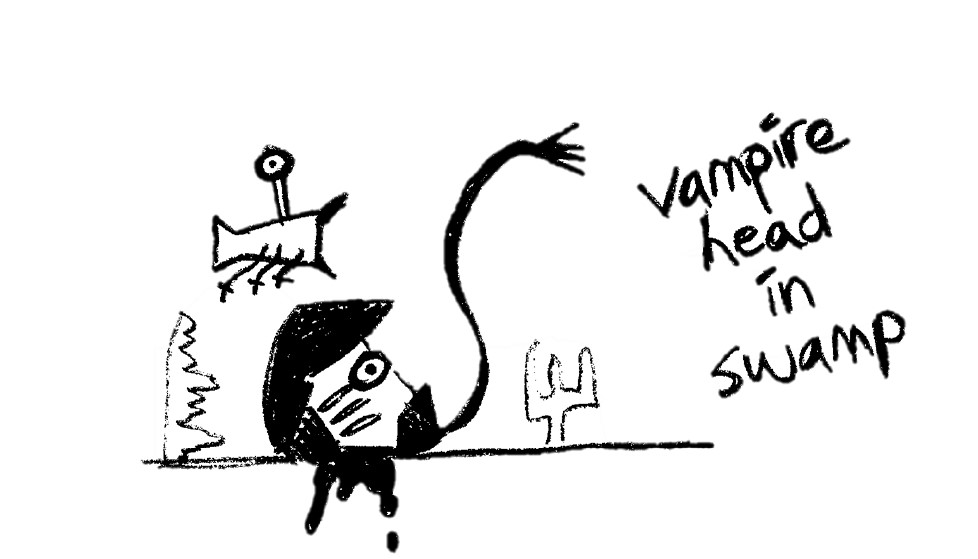
Vampires.
Or Vampire heads to be more precise.
In Ponds, they have become a servant of positivism.
Their heads are thrown into lakes to sink to the bottom and live among the catfish.
After some years, their eyes will migrate to the top side of their heads.
At which point, they will look like this:
+
A DREAM
He dreamt he was in a mansion, walking down a wallpapered hallway towards the sickroom.
There were two rows of three beds inside. On the bed closest to him lay a man-sized baby who was crying terribly and whose blankets dripped with urine. A man sat up in another bed, vomiting into a kidney bowl. Another ejected a stream of diarrhea into a chamber pot. An elderly woman gushed blood from a wounded finger. A leper in stained rags watched through a slit in his wrappings. He turned to leave this room of horror and discovered that the door could not be opened. The waves of vomit, blood and urine continued. The door would not open. It became clear to him that the room was overflowing and he would soon be drowned.
+
As with the rest of Ponds, this section is a detached account. A recounted dream of being drowned in a room of horror, by blood and vomit and urine. There is no emotion from either the narrator or the dreamer being narrated. They are about to die. Death via waste and expulsions.
Lord Waterbrash’s supermarket dream earlier was equally detached.
Maybe not so horrific, but it did make him vegetarian.
Is there a logic to the placement of all the sections?
The one preceding this horror dream was quite whimsical: the delineation of three secret entrances to mysterious tunnels. Read and felt a little bit like a Zelda game. And before that there was the short section concerning the vampire heads.
Mythology [vampire heads] + Mystery [Secret tunnels] + Dream psychology =
And whose dream is this exactly?
Don’t know. It is not revealed.
Lord Waterbrash’s?
Just like the mystery in Knut Hamsun’s Mysteries, the mystery is a serial killer with poison in a cup. Interpretative right up until the moment of death.
+
When I typed that Knut Hamsun reference above, I suspected it might be wrong, so I checked online and it’s actually The Minus Man with Owen Wilson that I was thinking of.
It’s weird, cos I did read a few pages of Mysteries at Uni.
But the main character in that book, Nagel, wasn’t a serial killer [as far as I know], he was just desperate to express the full depth of his own psychology. And through that expression, admit that he was just playing different roles. Which made the expression almost pointless. As soon as it’s out there as speech, it’s been mediated, right?
Hamsun was obviously a Nazi cheerleader in later life [a Norwegian proto-version of that dopey cunt Morrissey] but the idea behind his early work was sound enough: forget plot, expose the human unconscious.
Make characters contradict themselves, in story, in thought, in behaviour etc.
Confess all lies, then confess the lies within the confession.
And that’ll get you where?
Ponds doesn’t have a character with that kind of divulged, open psychology – Lord Waterbrash does do contradictory things now and again, but he doesn’t reflect on the doing of those actions – so it falls on the narrative itself to do it. Or the narrator. You could call it either one, the effect is the same.
The mutating world [and all that exist within] is alive with spontaneous compulsions that are accounted for scientifically, that are described in a detached way, yet at the same time, function narratively as inscrutable.
Why is the vampire head sinking down to the bottom of a lake?
What is the meaning of the horror dream?
Secret tunnels that do what?
+
THE TRIBE
An old man emerged, bored, delusional and almost blind after 750 years of wandering in the Catacombs. Fields of grass were now pine forests, the villages invaded by insects or dissolved by rain. He had been standing for weeks without moving when a group of hunters from a mutant tribe found him and carried him like a baby to the tribe’s elder, a wet heap of purple muscle with the head of a ten year old boy growing from its top.
They kept the frogs in clay jugs filled with water while the grafts were set. Eager to participate, he filled a jar at the pond, scooping up a batch of frogs eggs and transparent eel larvae with the slimy water. To that, he added the remains of frog glands and fly eggs. He left his pot in the sun for three months. When he poured out the contents, there were two animals: a white eel with the face and hat of a witch and a snake with the head of a rat. He crossed the woods, one animal trashing in each hand, and showed them to a group of mutants cooking around a fire. They looked away, embarrassed by the results of his efforts. One of them gently took them in his hands and threw them into the fire, patting his head as if he were consoling a child.
+
Now time is out of joint too.
Or it was already out of joint with the vampire heads who stay at the bottom of lakes for years.
It is both a living through and a historical account of evolution.
In TRIBE, a man who is both bored and delusional leaves the catacombs that have been his home for over seven hundred years and re-enters society.
Society is a world that is beyond him.
He is taken to a tribal leader that is a heap of purple muscle with a child’s head on top.
That tribe perform rituals that are insane.
The man joins in, performs them anyway, possibly to fit in.
In response, the tribe looks at this ancient figure as an ignorant child.
What is the meaning of this?
Can I drag Wind in the Willows or Knut Hamsun back in?
No.
Maybe later.
I think I said it before, in many de-con-struc pieces, but I’m not that interested in exact symbolism. I don’t know what any of this really means in terms of textual references or biblical esoterica [if the bible features at all].
Is the old man Noah?
Abraham?
They never had to communicate with a blob of purple muscle or create a white eel with a witch’s hat.
That’s pure ritualism.
The bible has weird shit too.
A possessed bear massacring 42 kids.
Probably seemed rational at the time.
Which time?
The man has been lost for centuries and is looking for a sense of order in the new madness he has just walked out into. Things were probably easier in the catacombs. But now he’s out and he must submit to the madness of ritualism otherwise the process of the ever-mutated world…will exile him? Consume him?
He could become animal sludge, another layer of sediment.
+
This bizarro glimpse of the future [assuming the man started his seven centuries at the same time the initial storm hit, which in itself assumes that that was the same storm and this is the same planet as Lord Waterbrash, which doesn’t actually make much sense as Lord Waterbrash is usually observing other mutating worlds through their telescope] is followed by a call back to recorded ancestry and family genealogy, which are possibly the same thing.
+
PORTRAITS
In the hall were portraits of his ancestors, little men with brown and curly hair. His grandfather who buried hundreds during the plague, his great great grandfather who ejaculated into jars filled with lake water and eel eggs to try to create homunculi. Others who wandered into the tunnels beneath the manor and were never seen again. He was the last of his line, lord of an underground mansion with moldy ceilings and warped floors.
+
[Note: I shift between ‘moldy’ and ‘mouldy’ cos my MIC WORD is set to UK spelling and Nick’s text uses American].
It’s not clear who the HE/HIS is here, but I’m gonna assume it’s Lord Waterbrash cos we don’t really have any other contenders at the moment. There’s also a reference to an underground mansion with mouldy ceilings so it’s a pretty good bet it’s him.
Placed next to the TRIBE section, this makes little narrative sense.
Narrative might be the wrong word – there is no plot in Ponds, only a beautiful/grotesque maelstrom – and sense isn’t particularly important either.
The basics are…a man got lost underground for 700 years, the narrator in PORTRAITS says that people get lost in the tunnels sometimes and are never seen again. It is a connection, but not necessarily a linear one.
Is the man who got lost for 700 years an artefact from mythology/history or a traveler from the present time period of Lord Waterbrash arriving in a distant future with even weirder mutations?
Here’s the different aspects at play:
Realism [the grandfather burying hundreds during the plague] vs. lunatic esotericism [wanking into lake water jars] vs. whatever losing yourself in an underground tunnel represents vs. finality [Lord Waterbrash is the last of his line, trapped inside a decaying mansion].
There is no special pleading for one theme/tone over the other, it’s just presented in sections and lines, one by one.
Everything is meshing together, time and memory and atoms and space.
+
THE DROP CEILING
The Drop Ceiling was home to a mixed crew of men and mutants. Twice a year they held a ceremony aboard the ship. The crew drank wine made from fruit, bread crusts and seawater, then powdered their faces and ran drunkenly around the deck while the captain climbed to the crow’s-nest dressed as a cloud. Cabin boys stood on the deck and threw chunks of sodium into the water which squeaked and burst as they jumped on the surface, sending out white sparks and explosions of light. The captain bombarded the men with rubber fish and frogs filled with sand until they all fell down drunk and bruised.
+
A ship sailing on mouldy waters.
Don’t know where this is.
Artist’s impression while depressed:
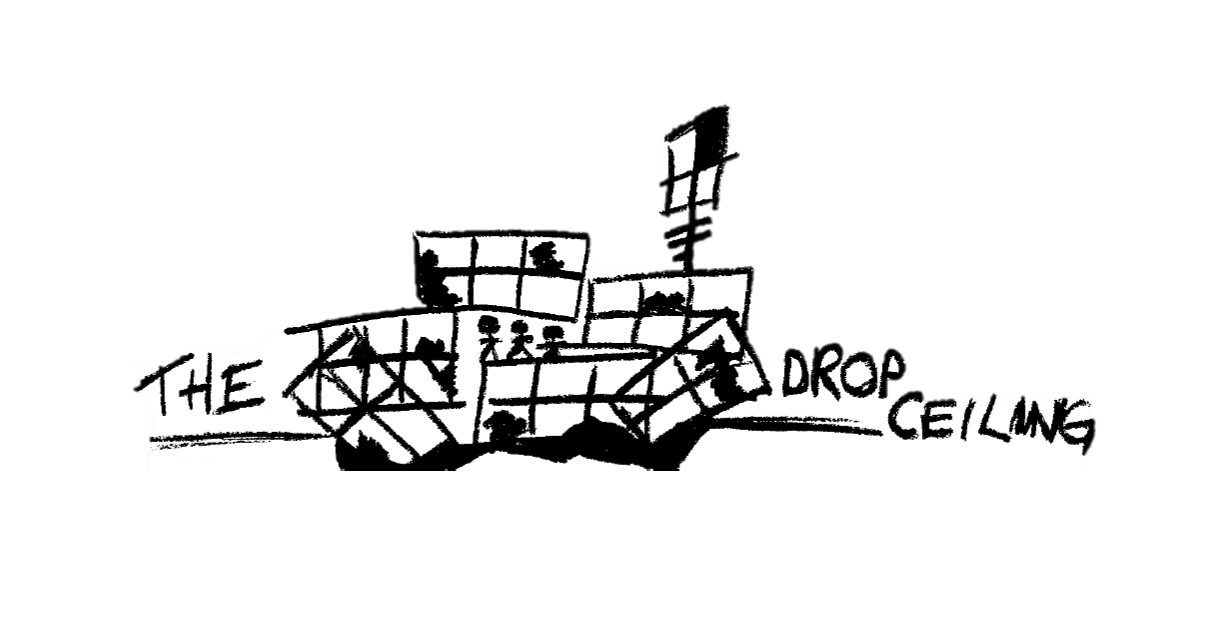
I won’t say Noah’s Ark cos the only similarity they have is that they were both boats of some type. And the Drop Ceiling has the chance of being a real thing in the future. I hope not as both the crew and their captain are depraved, merciless, but it is possible.
Perhaps due to the detached tone, Ponds can be quite funny at times.
‘…while the captain climbed to the crow’s-nest dressed as a cloud.’
The ritualism is back, or ceremonialism in this case. I promised there wouldn’t be any philosophy, but you can’t not mention Bataille and imperative expulsion here. The whole world is apparently covered by a mutating swamp, the crew of the ship is part of that mutation, and…I don’t know what their normal routine is, how much of it is centred around desperate survival…but they have drunken ceremonies twice a year and that seems to expel…something. Built-up waste?
+
The Ecology of Haunted Houses.
Another slip into the whimsical here, bringing in a modern breed of mythology…or superstition. And perhaps modern in the sense of the Late Victorian era, which is a tone that Ponds utilises for most of its run.
Mouldy silhouettes are growing on walls in the form of people who died in the house and minerals have replaced the wood of petrified trees.
Creatures within the grounds resemble Halloween decorations.
Reminds me a little of the gothic area from Banjo Kazooie [old N64 game].
Why blend in this kind of superstition/mythology?
Why not? It is also a form of mutation. Sometimes a precursor to actual science. Not the Haunted house aspect, but the animal splicing. Maybe one day soon a half-man, half-koala will be able to live for seven hundred years.
Houses do harbour dead people, the memories and traces of them. And that is carried forward into the future mutation.
What can a haunted house become?
‘10. The yeast harvested from the haunted houses will give bread unique and unexpected flavors.’
What benefits will it develop?
I think, in a later section, they are referred to as an omen, then a pest, and, finally, a resource.
Or that just might be my interpretation, I’m not sure.
At one point, they’re sliding off a deserted island, expanding into the swirling depths of the ocean sea.
To continue their mythologising?
+
‘But Mole stood still a moment, held in thought. He realized that Ratty sent his brother to his death in the Meat Grinder and entered the room to wish for his brother back – but the Room instead fulfilled Ratty’s secret desire for the preservation in bubble wrap of the slowly deteriorating Riverbank, rather than bring his brother back from death. This prompted the guilt-ridden Ratty to commit suicide. Oh Ratty, Mole sighed [mentally].’
+
Sometimes Ponds gets really silly.
Like the section MIND READER, which explains a ludicrous method to stop others from reading your thoughts.
It feels random, a detail that has not been begged for by anyone but is there anyway.
Cos there aren’t many characters to do the begging.
Apart from Lord Waterbrash.
No, wait, here’s someone called King Jellydisc…
…who is long dead.
It’s his crown that we’re introduced to first. And later the king himself will come back to life without explanation as the novella slips into the wilds of the non-linear again. But first the crown.
A fun aspect of reading this is to try and visualise the different creatures and locations, like Romanesco Broccoli, who can lose an arm and grow back two of something else as a replacement, and Bread Manor, which is made entirely of bread.
Here is what I think King Jellydisc’s crown might look like:
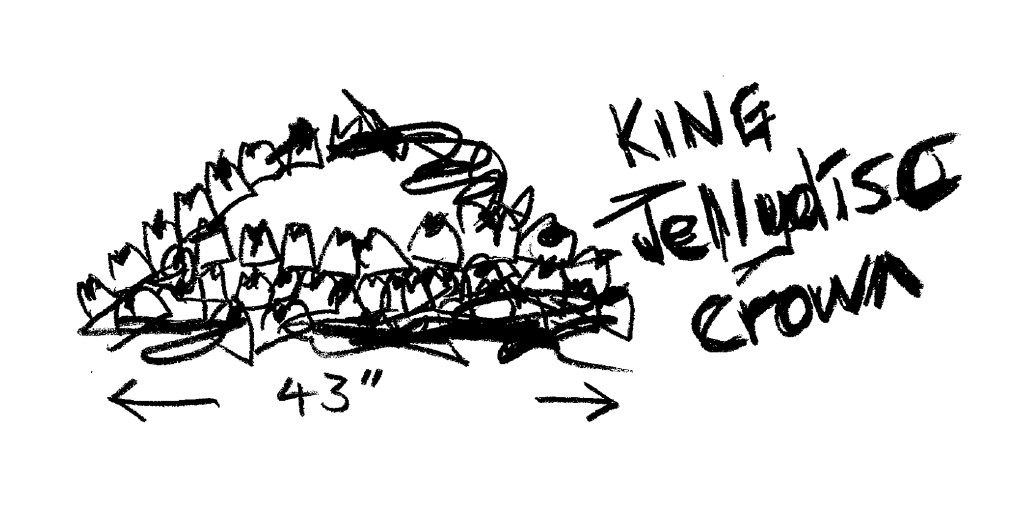
Why teeth fillings and not the teeth themselves? [yes, I drew the teeth as well, not sure how to draw a dental filling without making it look like a black smudge]
Could be a fascination with the attempt to arrest decay instead of the natural element [teeth] that is decaying.
A rebuke to the prisoners for trying to fix nature.
To resist its counterpart/twin, entropy.
I don’t know.
King Jellydisc has some weird proclivities, which crop up later when he returns from the dead [or the alive reaches his new state i.e. death?]
+
What does the world of Ponds look like?
There is no one world, I think, but a mass of worlds that are only sometimes individualised in the narrative, and even then, there is no name given. Is Lord Waterbrash living on the same planet as King Jellydisc or the Crew of the Drop Ceiling? No idea.
If we take this mass of worlds as an interchangeable terrain then it is a collection of distant-from-each-other continents connected by a swamp-ocean that people can traverse on foot, through muck and slime.
Theme: mutation of myth/myth mutation, World Abjection, Defeat of Death.
Similar to the landscape in Vitiators, there is no longer disgust at mould/muck/slime cos that is the total substance of the entire planet.
In the section PIPES, humans have become part of that landscape, or the infrastructure. In liquefied form, they get stuck in the-
It’s hard to describe so I’ll just put it here:
+
PIPES
A prankster had dug a pit in which he redirected eight pipes and cut them so that the liquefied people would gather at the bottom. When they coagulated, it was as a body the size of one person but a mass and a weight of eight.
Another notable incident occurred when a pipe that passed through a pond had been bitten in half by a turtle and a liquefied person spilled out into the water and mixed with a cloud of fish spawn.
+
Why have the people become liquefied?
Don’t know.
Are they still alive in that state?
Unclear.
The whole planet in Ponds is a mix of sporadic humans and numerous mutants such as Romanesco Broccoli, who has the exciting talent of cutting off their arm to grow back two new and different aspects of self.
[Note: I think I mentioned this before, but that is a common thing in a de-con-struc piece – hopefully repetition can bring with it greater sense and clarity. And if not, then chaos/confusion is intentional on my part and related thematically to Ponds].
Sadly Romanesco is a drive-by character and does not return.
+
‘Afraid?’ murmured Rat, his eyes shining with unutterable love. ‘Afraid! Of Him? O, never, never! And yet – and yet – O, Mole, I am afraid. He splices things that should by the grace of all things natural never be spliced. He observes through his telescope and interacts yet is neither influenced nor affected from one page to the other. He likes the sludge of the wild woods. He would coat the riverbank in it if he could, from reed to late night pharmacy. I fear him. He is everywhere. With his faith and rituals. Throwing those stupid metal nuts. Remaking The Fly. You should fear him too, if you have sense about you.’
+
There are a few recurring characters in Ponds, none more recurrent than the direct observer himself, Lord Waterbrash.
I don’t know if there’s a description of him in the text, so I’ve drawn my interpretation of him based on picking up Lend Me Your Character by Dubravka Ugrešić and copying the outline of the obscure, genderless shape on the front cover.
HE is used as HIS pronoun. I’m pretty sure of that. Though sometimes the sections do not make it clear who the HE is referring to. Could be King Jellydisc. Only he’s dead. For the first half the book. Then HE comes back again. Is it a HE? Yes, I’ve just checked. It is HIS crown that is forty-three inches. It is a HE.
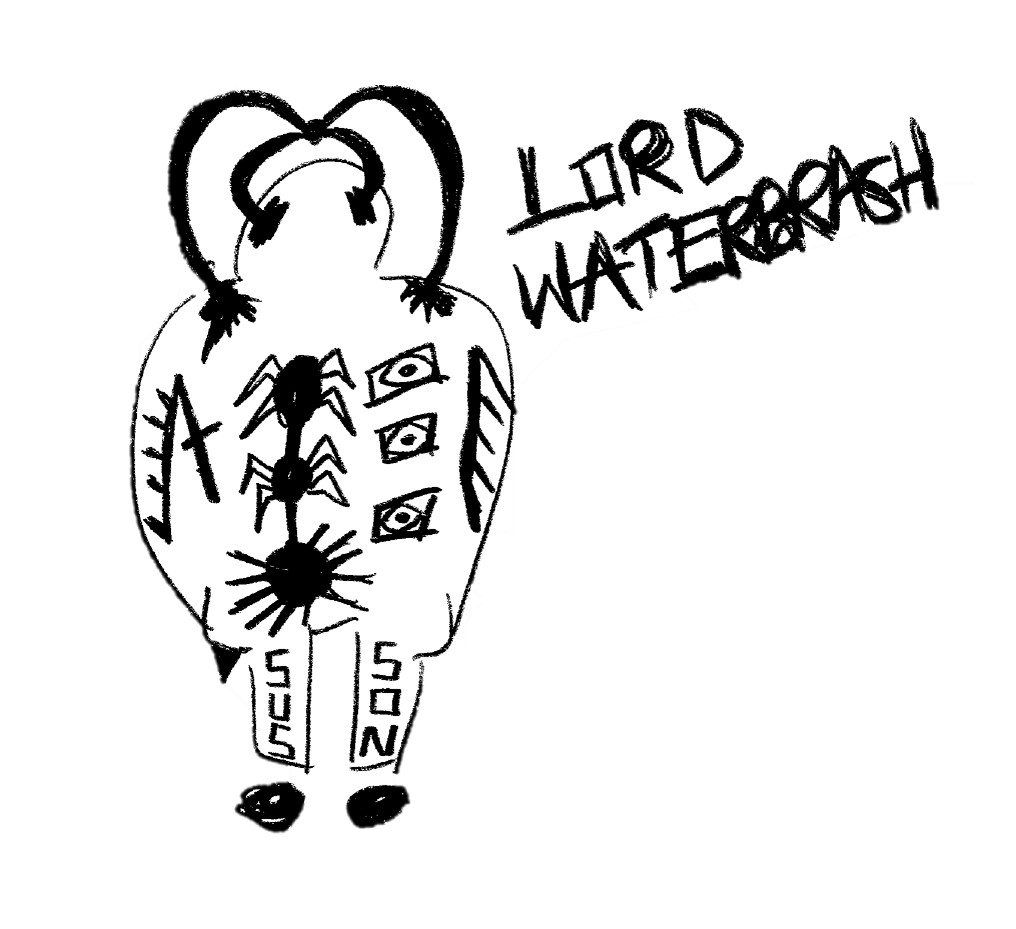
Lord Waterbrash is our introduction to the world of Ponds, whichever world that may be, and is a scientific observer of the distant past. It must be the distant past as he is looking at other planets and due to the time taken for the light to get back to his telescope, it must be a long ago mutation-event that he is looking at.
The telescope is both his TV and his shield from the content of that TV.
He cannot stop observing unless he feels disgust, at which point he can stop observing. And become a vegetarian for the day.
There are 10 sections with Lord Waterbrash. Here’s what happens to him in each of them. Let’s see if there’s a throughline [I suspect not] and perhaps some contradictions [I suspect many]:
1] Loses Waterbrash Manor/Mansion in opening storm despite eating vegetables.
2] Keeps a tongue and a pair of eyeballs in copper reliquaries.
3] Back on the telescope, observing a man with a ‘lung torso’ try to cough out a fly. Feels disgust. Eats tadpoles and razor clams for lunch.
4] Looking through the telescope, he feels on a visceral level the migration of his own organs around the body.
5] Remembers the killing of King Jellydisc, guarded by two mutant guards who clearly didn’t give a shit.
6] Philosophises about entropy vs. sentient entity with a vicious streak i.e. is the Murky Green Toad World following him?
7] Tours his fallow farms, collecting vegetable specimens for his study.
8] Looking at other planets again. One has a pile of soft-shelled tortoises like pancakes. Another holds an underground lab where spiders drink from an oasis puddle of pus leaked from tortured, mutilated and mutated animals. Lord Waterbrash loses his appetite for a week.
8] – 8 again, mistake? – Lord Waterbrash watches, 25,000 light years away, as a jester self-liquefies in front of King Jellydisc. Once again, he is disgusted. But still continues the act of watching.
9] More observation. More abjection made object-permanent. A vague mass covered in ten thousand spider legs.
Lord Waterbrash is God?
Us?
He is either non-linear or a-linear.
Cos he is both 25,000 light years away and right in the thick of it.
Is he really disgusted?
At some points, it feels like the narrator is a close companion to Lord Waterbrash, the telescope behind the telescope, but who is the narrator?
God beyond God.
There is no God in this madness for that God would also become a victim of mutation and the mutation requires no narrative or mythology to fuel its continued operation. There is no clarity in a world that is constantly producing new forms of muck and pre-rejection animal types.
Or: mythology can exist but loses a traceable origin point due to constant mutation of the environment that birthed it.
Then there are simply rituals.
The world is a flattened swamp with flattened creatures, but only sometimes, Other times, they are gigantic and multi-dimensional.
Humans come and go.
Lord Waterbrash does not appear to be human.
What is a human if not a mutation?
I’m lost.
+
‘I’m an ungrateful beast, I know,’ sobbed Toad, shedding bitter tears. ‘Let me go out and find them, out into the cold, dark night, and share their hardships, and try to prove by- hold on a bit! I hear the sounds of a circus elephant dying. Let us parade it inside a giant casket and cry like little boys. Then drop the beast in the city dump and carve up its meat. What do you say, Badger? Are you game?’
+
A VILLAGE
A village where people can grow to be any size, from less than eight inches to over twenty feet tall, but all proportioned the same. They have a festival every year in which they all position themselves at various points in a field, the larger the person the farther away, so that to an observer standing in a designated spot they all appear to be the same size.
+
An attempt to make the markedly/insanely different seem more or less the same, to force stability and logic on the chaotic swamp-system via a trick of perception.
That field they’re standing in won’t be a field forever.
It may not be a field in the next five minutes.
+
A PAINTING IN FROG CASTLE
The painting shows a piece of bread, half of which is covered in exaggerated mold spores. There is a red dotted line dividing the bread in half, and the green spores appear to have leaked across this border. In bold red letters on top of the image are the words “MOLD YOU CAN’T SEE”
+
A call back [by me] to the Wind in the Willows quote [bastardised] earlier.
‘You must imagine what you cannot see.’
The bread is basically covered end to end in mould and those red letters are an assist to help those without imagination see.
Quite funny, as Ponds often is now and again.
+
Speaking of bread, there’s also Bread Manor.
A mean engineering feat undone at the end by the growth of blue mould i.e. it collapses.
Here’s what it may have looked like before that happened:
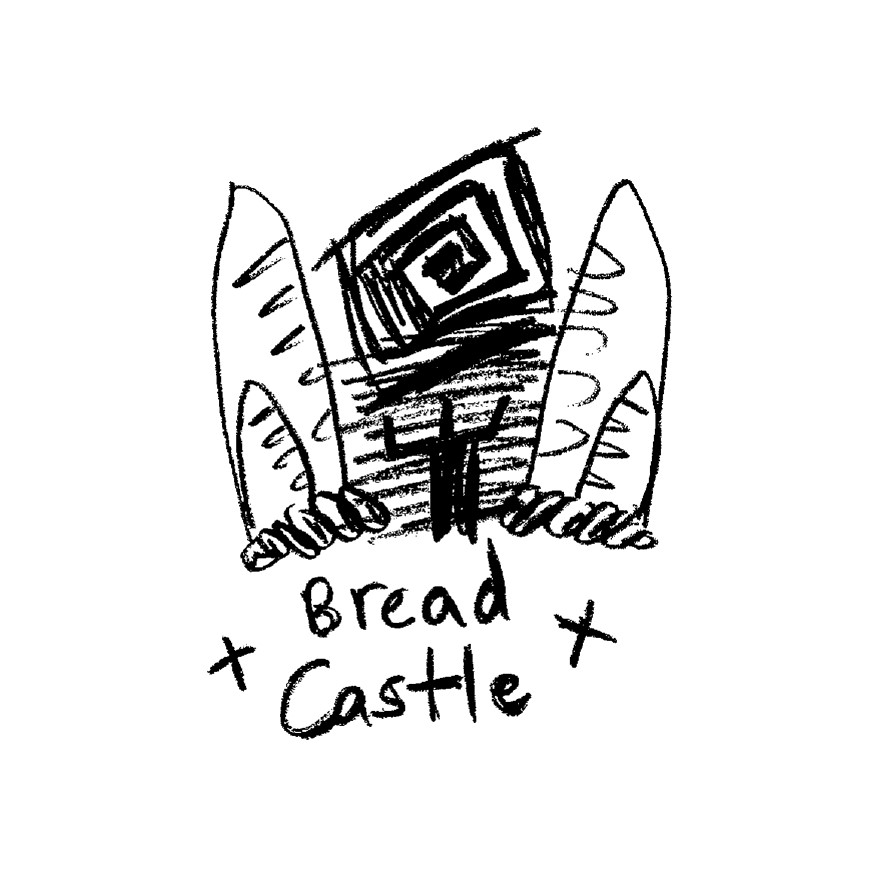
Pages 24-27 and other segments of the text broaden the Murky Green Toad World with a parade of surrealistic insanity, which is given a veneer of documentary-positivism by the scientific tone of the narrator.
Isn’t the entirety of Ponds a parade of surrealistic insanity?
Yes, but sometimes it has a specific focus, e.g. Lord Waterbrash, a certain location etc., while other times it vacillates between wildly different aspects of whichever swamp world we’re on at that fixed-linear moment.
You could call it world-building. Or world-mutating as things are constantly in flux. Look at the Haunted houses, they’re basically given a centuries-long character arc, as if they were buffalo or an indigenous tribe. Or a ruined family line in the aristocracy.
+
COAGULATIONS 1
And then after your meat is melted by the raw hamburger stuff in the coffin, where will you end up? Most likely in some mausoleum or grave in an abandoned necropolis, overgrown with twisted trees and haunted by ghouls. It just never worked the way it was supposed to. It was unpredictable, you’d only end up where you wanted to less than half of the time, and you’d be lucky if there weren’t big chunks of your body missing when you reintegrated on the other side.
+
Now there’s a YOU.
And in the next coagulations section, there’s an I.
Who is doing the narration here?
You = generalised humanity, in this case with their hopes for the afterlife and the futility of such hopes, especially in a Murky Green Toad World.
But then it mentions a mausoleum and an abandoned necropolis, which invokes the aristocracy, those with money to put their corpses in pretty homes.
Lord Waterbrash?
King Jellydisc?
Is Ponds charting the demise of the aristocracy because those are the ones who have tended to have their demises charted historically?
Most drawn-out characters either have a noble title or are lifted from mythology. I suppose the crew of the Drop Ceiling might be an exception, but don’t they have a pirate vibe [which also has a mythical element attached]?
+
COUNT FLESHWEATHER’S FATE
He lived the rest of his life as a tube of flesh used by a collector of rare diseases as a receptacle for tropical viruses and bacteria.
+
Another example of a character with a title.
This is his introduction, which is also his end. As in this is the first time we have seen him in the text and it appears that his story is already complete.
For reference, this is what he probably doesn’t look like:
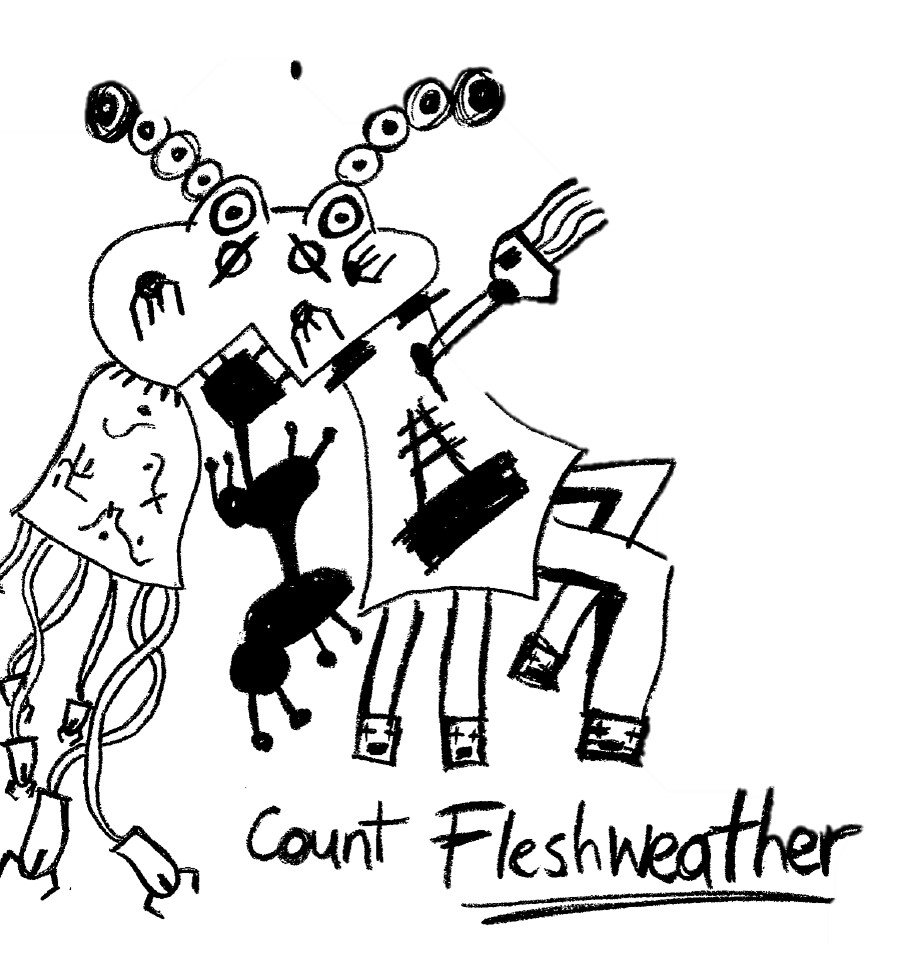
Again, it’s the non-linear.
Ponds works almost as a backwards narrative. Perhaps to do with the fact that Lord Waterbrash is 25000 light years away and all the past events he is witnessing are gradually catching up to him. But then it’s not purely backwards as Lord Waterbrash still continues to live his own life throughout. There is no clear demarcation in linearity. It could be after the initial storm on page two or several years before it, we don’t know.
We meaning I.
Can’t speak for other readers.
The text of Ponds itself, its own structure and appearance on the page, reflects the extreme mutations described within. The only compromise to order is the fact that it is laid out in sections. But those sections are random. So is it really order at all? Or, similar to the tone of the narration, an attempt to mimic a sense of order within chaos? And beyond that question: is any of this actually chaotic?
+
COUNT FLESHWEATHER
A laminated piece of paper with the words “MOLD MAGIC” written on it in green marker hung above Count Fleshweather’s bed.
+
He is alive and dead and haunting and superstitious.
Like King Jellydisc, the Count appears in the second half of the text to share his dark proclivities. And his randomness.
What does he represent?
Mysticism merged with the mould?
Seems like that’s the case based on the laminated piece of paper hanging above his bed. And the narrator later tells us that he has a sub-sub-sub-basement that holds a Black and Red Terrarium, both kept in a large glass cube. Which means a micro-ecosystem contained inside a glass container that it itself contained within a larger glass container, which is itself contained within the sub-sub-sub-basement of Count Fleshweather’s castle.
That’s a lot of containment.
An attempt to control the mutations perhaps?
Count Fleshweather is heavily superstitious, he believes he can dominate via Mould Magic.
He is also destined to die as tube of flesh, used by a collector to store exotic bacteria, as described on an earlier page of the text.
Such is mutation-ism.
+
‘There seemed to be no end to this wood, and no beginning, and no difference in it, and, worse of all, no way out. Best thing to do then, thought Mole, pulling out a piece of eroded chalk, is draw a pentagram. Place a call to my old chum, Satan.’
+
The last ten or twenty pages of Ponds feel meandering/arbitrary, as if the mutations and sludge have given up. Or the storm-evolution is subsiding.
Is that fair?
The text as a whole is arbitrary to a degree – there are only a few things, like Lord Waterbrash, Haunted houses, Drop Ceiling crew, that connect to one another [or to themselves] – yet the last section of the book feels even more arbitrary.
There is no climax for Lord Waterbrash. King Jellydisc and his jester turn up and do random decadent things. The haunted houses slide into the sea. Teenagers turn up and do not that much. What else? Witches in a UFO, soldiers, asparagus, a groundskeeper, crust, heads, etc.
Count Fleshweather and his mould magic experimentalism.
There is no conquering of this world, only ceaseless mutation.
Until…
+
THE NEW WORLD
You’ve crossed eight thousand miles of mud, willows, and lilypads, and lived through mosquito-borne diseases, alligator attacks, and boredom. Survived stab wounds and broken bones. You arrive finally in the new world and find that it too is nothing but empty castles and fields of dry weeds. A giant drop of blood falls from the sky.
+
Back to YOU again.
The new is the old is the new and all of it is mouldy as fuck.
Empty also.
+
You can buy Ponds as a paperback or read it as a free PDF here.
+

 PsYChO hOLosUitE [zine]