

~~~
Note: The story, ‘Prince Alberic and the Snake Lady’ was originally published in ‘The Yellow Book’, an illicit periodical in the 1890’s that was basically a precursor to Psycho Holosuite if you discount reach, readership and quality of output.
~~~
From the cover above, we have 7 daggers lodged in a yellow-greenish heart, unromantic, possibly ritualistic.
A reference to the titular story.
Yellow-greenish hue implies bile.
Heart, that someone cares.
~~~

~~~
‘HE LUSTS AND KILLS IN EQUAL MEASURE’
~~~
I would say he lusts more than he kills, unless it means actual physical sex and not just the imagining of it, in which case, I don’t know.
If he’s THE Don Juan, maybe 3 fucks/murders a day?
~~~
Actually, I’ve read this collection before, about nine years ago, and I wrote about it too. I’ve still got the file on my computer. And it’s on this site. Only 1k words, with not many insights.
I just said the first story was the best as I thought it was a novel when I started reading it, which made the structure appear insane.
I should read more books this way?
Hard to replicate that kind of mistake.
Doesn’t matter, I’ve forgotten all the stories and that piece, so I’ll do this one fresh, with little sketches in front of each story and maybe some extracts from ‘Purple Muon Castle’, which is the closest thing to Gothic that I’ve written.
Or maybe it’s not Gothic at all?
There’s a castle, torture, talk of more torture, sexual adventurism, sexual sadism, sexual masochism, sexual apathy, an occult mood, the black room of Satan etc.
Is that Gothic?
Is this?
~~~

~~~
What is Gothic?
Frankenstein, I suppose. Castle of Otranto.
Not Frankenstein, that was sci-fi.
What IS gothic?
Dracula, Jekyll and Hyde, Night of the Demons 2?
Or:
The feeling that every character you meet in the narrative has at some point in their life murdered someone. Or wished to murder someone. Or fears being buried alive. Is haunted by a dead wife in the body of a cat or painting.
Aristocratic decay.
Denial of that decay while living within it.
A mansion that will disintegrate at the end of the story through flame, demonism or shoddy workmanship.
The shoddiness is incidental, it’s the sins of the owners [and possibly their ancestors], really.
~~~
Actually
Actually
Actually
Actually, Soren [Häxan] writes a lot of Gothic-type stuff, I should ask them. Perhaps in the context of Vernon Lee specifically, as I know they’ve read their stuff.
Vernon Lee = Violet Paget
I’m not clear if the use of Vernon Lee as a male pseudonym was due to cultural pressure/trends or personal preference or identity reclamation, there’s no real info about this on wiki, just a strong assumption that Violet Paget was gay and liked to dress in male clothing. Beyond that, I’m really not sure, so I’ll treat 7 Daggers as a work by Vernon Lee and use THEY/HE.
~~~
‘Vernon Lee is remembered today primarily for their supernatural fiction and their work on aesthetics. They were an early follower of Walter Pater, who either had an intense inner life or advocated for it in art/literature, or both, or neither.’
~~~
Not ‘neither’, Pater did advocate for it. That’s what wiki says.
I need to stop hijacking quotes, inverting every single line.
And double-check everything.
Then you [I] won’t mistake sindoor for alcohol in one of your [my] stories.
[It’s okay, that story was rejected]
~~~
‘An engaged feminist, they always dressed a la garçonne. Scholars speculate that Lee was a lesbian and had long term, intense relationships with the Snake Lady, the Virgin of the Seven Daggers and Medea da Carpi, or analogues of them.’
~~~
Spec-fic.
Half me, half wiki.
Though we’re all writing as an act of revenge, aren’t we?
~~~
‘Lee was instrumental in the introduction of the German concept of Einfühlung, or empathy, into the field of aesthetics.’
~~~
This seems quite basic now, but probably wasn’t back in the late nineteenth century.
Should I empathise with the wretched Don Juan or the misery symbolism of the Virgin of the 7 Daggers?
The one who plugs themselves into me, my memory pool, moral or not?
Excise judgment.
A guy who embarks on a necromantic journey to an enchanted palace beneath the Alhambra has a similar kind of madness to my own.
If I were in a Vernon Lee story, I’d do the same thing.
And lack reality.
Sacrifice it.
I wouldn’t do anything.
And then write about it.
Slaughter my SELF.
Contextualise the remains, salvage what was salvageable.
What IS salvageable.
Am I a wreck next to much worse wrecks?
~~~
I was reading a piece about the hopelessness of Anarchism the other day, a guy calling ‘those without the will to do deeds’ cowards and what exactly did he mean by deeds?
Assassination?
Zine-making?
If you’re sitting in a prison for ‘doing deeds’, you’re not good to anyone.
If you’re sitting in a prison for ‘doing deeds’, at least you tried to do something.
If you’re dead through ‘those deeds’…
There are a lot of us cowards out here, writing.
~~~
~~~
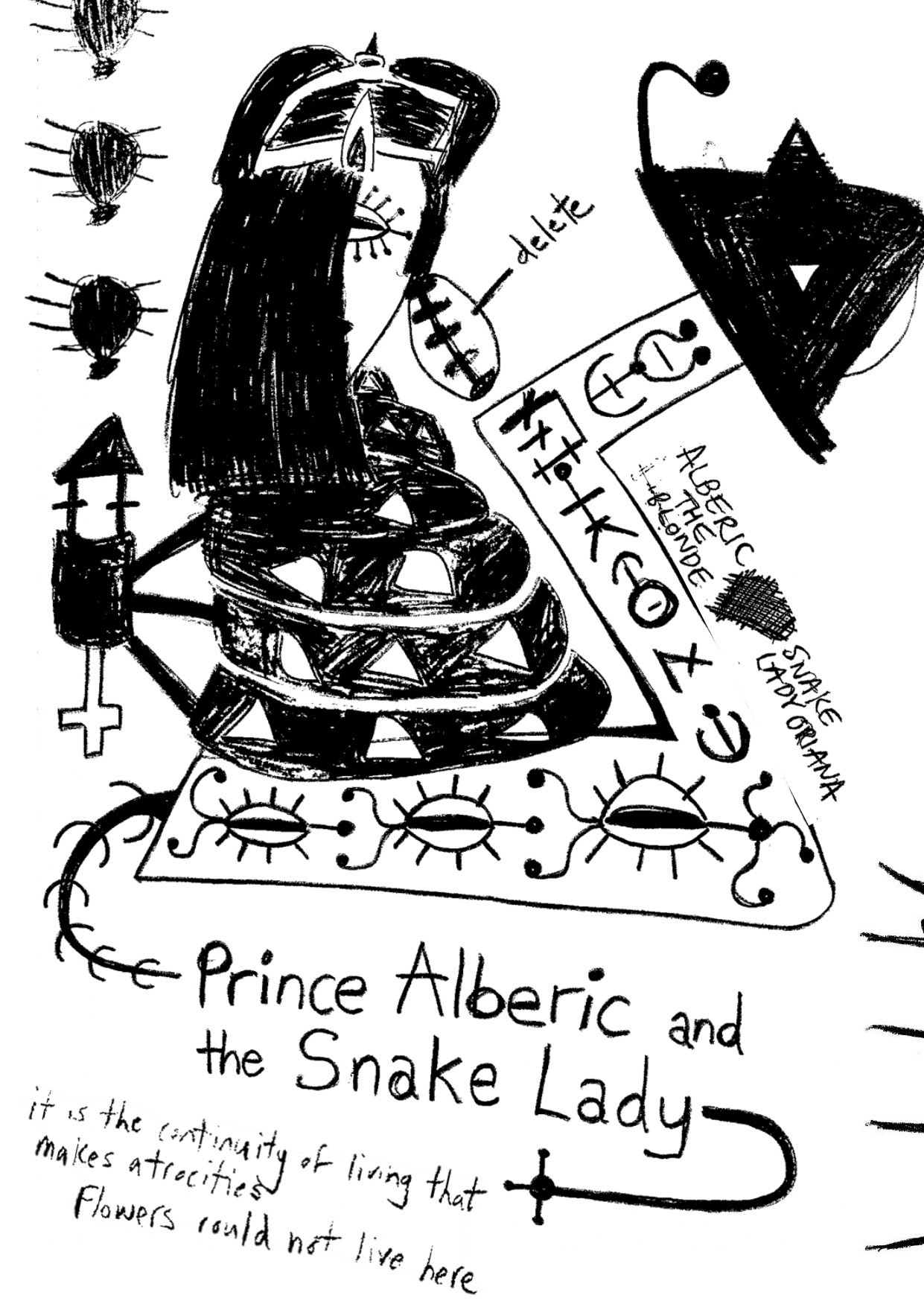
‘The first act of hostility of old Duke Balthasar towards the Snake Lady, in whose existence he did not, of course, believe, was connected with the arrival at Luna of certain tapestries…’
~~~
Like I said before, I thought this was the beginning of a novel when I first read it.
Taking in this opening line, I should’ve known it was a short story. It’s very modern, despite the aesthetic. Introduce an active character [Old Duke Balthasar], something weird [Snake Lady], and a threat of conflict [‘act of hostility’].
Lee is better than that modern template shit, obviously – cos they predate it? – so adds a contradiction [‘in whose existence he did not, of course, believe’] and niche detail [‘certain tapestries’].
This isn’t really an experimental work.
Just a well-written one.
I’ve done a few non-experimental books before on De-con-struc, it’s no problem [length can be though – Serious Weakness was about 400 pages, I could only manage the first 150 or so, nothing against the work itself]. There are always other aspects I can hook on to.
~~~
‘These magnificent operations…aroused in Duke Balthasar’s mind a sudden curiosity…’
~~~
[I may have fucked up a bit here as I wrote down only the beginning of some of the extracted lines in my notebook, and I’ve already taken 7 Daggers back to the library. We’ll just have to imagine what I go on to talk about, I suppose. Assuming it isn’t the full quote. It might be sometimes, I’m really not sure. Sorry.]
Seems like the Old Duke is the self-absorbed type. There has to be a renovation of the castle before he remembers his only grandson.
Not much is made of this.
Maybe it was normal behaviour for aristocrats back then? Or a commentary by Lee on the lack of intimate connection such a rigid existence brings?
From [clotted] memory of reading this nine years ago, I think the Old Duke is immortal, has previously taken an elixir that keeps him young, but I’m not 100% certain. It would explain his lack of interest in his grandson [and only heir].
Or he doesn’t want to think of himself as a granddad, and he doesn’t need an heir cos he’s immortal [he is his own heir]. Is the elixir connected to the Snake Lady? Am I remembering wrong?
~~~
‘…he disliked snakes and was afraid of the devil.’
~~~
More contradictions as a few lines before this we are told that the Duke [who no longer wears the ‘Old’ adjective] is an enlightened type who has no time for the Dark Ages and improbable events.
It’s even more wild if I’m right about the elixir.
~~~
All this springs up cos of the tapestry of Alberic the Blond + the Snake Lady in Prince Alberic’s chamber, which is removed by the Duke and replaced with something benign that the Prince then cuts into strips with a knife from the ducal kitchens.
Is this the Gothic element?
A young prince quick to acts of violence/obsession, a domineering father figure, allusions to a darker, more malevolent era.
I think so.
It sets the stage, at least.
~~~

~~~
The Snake Lady tapestry is tattered and ominous and possesses an inexhaustible charm in the eyes of little Prince Alberic.
How little is he?
Young teen?
At first, it’s the landscape and animals in the tapestry that attracts him, later the knight and the Snake Lady in the centre, her vagina blocked by an ivory crucifix stood on a chest of drawers. Not the most discreet subtext ever.
~~~
Prince Alberic interior [at this stage of the story] = trapped in the Red Palace, in his [red] chamber – all his life up to this point – with this tapestry functioning as his window to something beautiful/euphoric elsewhere, the Snake Lady his first Isabella Adjani, made even more alluring by her snake tail covered in green and gold scales.
~~~
‘For want of that tapestry…’
~~~
[Yeah, I’m fairly certain the quote above is abridged].
Chapter 2 confirms that Prince Alberic has been alone in his room a long time.
No one cares for him except his austere nurse.
Is he a prisoner?
The story tells everything as matter-of-fact, without melodrama or shack-sadism. The Duke has simply neglected his grandson, and now the prince has glued himself to something fantastical, probably cos the other women who come to the Red Palace have neither looked at or helped him, whereas the Snake Lady has always been there, faded, non-judgmental, sexually occluded-…sexual in implication, not visually. Maybe. Unless she’s topless, in which case…
Snakes = temptation
To a boy with no knowledge or experience of real animals, there can only be symbolism, or overwhelming ‘historical emotion.’ Does he know the snake from the Bible? The punishment of Eve?
The text says he studies Latin Catechism, so that’s probably a yes, yet the Snake Lady still draws him in.
The catechism is dry, without tits or a green + gold snake tail.
Sexually, is he unwittingly after the cunt?
Or is it something deeper?
Is that [the spiritual] not rooted in the physical still, the carnal?
He wants to get close to the Snake Lady cos he wants to fuck her, and he wants to fuck her cos she resembles a snake, which is something else entirely.
Is it because she has entranced the knight in the tapestry, who is also called Alberic? Possesses power over someone who on some level resembles his grandfather, who has power over him? Is he following that knight or separating himself?
~~~
‘…Alberic became aware that he had always hated both his grandfather and the Red Palace.’
~~~
Perhaps separating himself.
The Snake Lady is his vessel out of there, his prison. Or his companion in the cell. A filling of the space where his mother should be.
Actually, where is his mum?
~~~
Reading on a bit more, it’s clear he really does loathe his surroundings. Tomato-red walls, twelve Caesars, the grotto of the Court of Honour, its oyster-shell satyrs giving up pure decadence to the roof.
According to the text, it’s linked subconsciously to a terrible dream he had when he was younger. Or continues to have, it’s not clear. Something about seeing his grandfather painted like a demented clown and his head stuck on a pole in an adjacent room, and I’m not sure what this means except maybe a metaphor of/allusion to the line between real and artifice, a face with make-up and the face outside of it.
~~~
‘Taking due counsel with his Jesuit, his Jester, and his Dwarf…’
~~~
All three advisors with capitalised titles, implying equal value or importance [or an ossified association with their official role].
His Dwarf?
No idea.
An inversion of the typical role of the dwarf in Medieval fiction, from tortured curio to valued confidante?
~~~
Prince Alberic is exiled to the Castle of Sparkling Waters, which sounds nice, but not in this Gothic literature where it’s little more than a ruin.
~~~
I’m going a bit slow, which usually happens at the start of a text.
There’s still five other stories to get through.
Maybe ask Soren to do one of them?
~~~
Turns out Soren adores ‘Amour Dure’, the third story in the collection about a young scholar falling in love with a ghost [kind of], but probably doesn’t have the time to write something on it.
Pity.
~~~
The Castle of Sparkling Waters is the home of his ancestor and namesake, Alberic the Blond.
Is that also his grandfather?
Does his immortality stretch back that far?
He may not be immortal, could just be my faulty memory glands.
I sense a Snake Lady appearance soon, like Meena Kumari coming out of the shadows around the fifty minute mark in ‘Sahib Bibi aur Ghulam.’
Though Chhoti Bahu was a tragic figure, the Snake Lady may not be.
A manipulator?
Someone who cares?
~~~
‘Lemons were espaliered against the delicate pink brickwork.’
~~~
Espaliered?
Sounds decadent.
Alberic adores his new home, the vineyards, the garden, the narrow ropes of maize, the tapestry of Alberic the Blond + the Snake Lady which has returned mysteriously in the form and aesthetic of the environment itself.
Actually, I was a bit confused here, I thought the tapestry was back on the wall, but I think he’s just in the place that it was inspired by.
Best exile ever for a kid who’s longed for nothing else but that his entire life.
~~~
Maybe it’s the ‘intense inner voice’ of aestheticism, probably is, but Lee writes all this from Prince Alberic’s internal view, the belief that the castle is some magical transmogrification of his ‘desire-state’ into ‘real-state’.
[Return of the hyphens!]
Instead of the more rational thought that he’s just staying in a castle that was weaved into a tapestry at some point.
For Alberic, it’s the other way round, a case of ‘the window leads forward’ phenomenology.
Although there is a hallucinatory aspect to it as the castle is supposed to be a semi-ruin, yet Alberic sees it as it once was, as it appeared in the tapestry.
But that tapestry itself was faded.
Is he filling in the gaps with fantasy?
No, stronger than that. He’s stamping his own vision on top of it [what I will later discover to be the ‘faculty of association’].
~~~
The citadel on the hilltop feels like something with deity connections from ancient Greece. Deep blue sea, orange and lemon trees, trellised vines on top of stone columns, sacks of coloured seeds etc.
This cannot be a ruin.
Prince Alberic has slipped into the stream, fully.
~~~
There are occasional mentions of broken masonry, shriveled leaves, rough paths.
Maybe fantasy punctured by rifts of reality?
~~~
‘The boy was not afraid [of the snake slithering towards him]…’
~~~
[Another limb of a quote, sorry].
Now there’s a snake.
But not a Snake Lady.
Yet.
Alberic has the naivety of a boy trapped in a castle his whole life. There is tomato-red subtext here.
But is the Snake Lady his liberator or another Old Duke?
~~~
How much weight does the metaphor carry in Gothic fiction?
Soren said something about subversive sexuality, but so far all we have is mild perversion. A mythical woman with a snake tail. A young aristocrat getting lured into his first sexual encounter. What am I missing?
Yearning for the past, something mythical that may have been, had the possibility to be just as good as the myth describes?
Of course, it wasn’t, could never have been, but there’s still a gap in phenomenological terms where Prince Alberic knows the present + his feelings against it, but he doesn’t know the past, not through sight or touch or snake sex.
[the power of horror historical emotion! – there’s no way to “know” it, hence the power]
~~~
‘When his son had died with mysterious suddenness…’
~~~
The Duke clearly murdered his own child, and did take some magical immortality elixir, yet Lee writes it as if everything is mostly normal, if a little peculiar.
Is this a staple of Gothic fiction or just Lee’s own idiosyncrasy?
~~~

~~~
Five pages of subtle statecraft as the Jester, the Jesuit and the Dwarf are given their own inner selves.
Narrated outside themselves, of course, just like Prince Alberic, or even more remote perhaps as they are stuck primarily with the acts of their machinations, but it fleshes them out and injects some colour to the court surrounding the Duke that other short stories might not have bothered with.
I mean, all three advisors are still quite basic in thought and purpose.
They’re ladder climbers, ladder kickers.
But I appreciate their appearance.
And from their perspectives, they were the Duke’s masters, not the other way round. Quite a bold thing for a Jester to state [internally]. Reminds me of the eunuch advisors in the Ming Dynasty, who also thought of themselves that way. No shade on eunuchs in general, just the Ming Dynasty ones, who may not have even been that bad. History is usually written by the non-eunuchs.
~~~
I’m just free-reading now.
Things might become more scattered/fragmentary.
~~~
Despite the unexplained youth of the “elderly” Duke, no one believes in magic.
~~~
Snake Lady as Godmother.
Prince Alberic doesn’t seem to realise it.
What’s that called again?
Dramatic irony?
~~~
If she’s his godmother, is the sexual element being discarded?
Character-wise, I understand a Snake Lady not having any interest in human sex, it may even repulse her, but what of Prince Alberic? From what I can work out, he’s around sixteen years old by Chapter IV.
Will he make a move?
~~~
The Snake Lady has an aversion to her snake form?
That’s Prince Alberic’s view.
Perhaps she’s been cursed to live as a snake?
Or, subtextually, that side of herself is sectioned off, an abject part she wishes weren’t real, that represents “shame” or “the past” or something else, maybe sexual subversion.
~~~
The description in the recounting of Alberic the Blond and the Snake Lady is making me drowsy.
Sorry, Vernon/Gothic fiction.
But you’re treading on water here, just like Tanith Lee did after you.
There’s no character to it.
Cos it’s a recounted fairytale? A stale myth that has no other way but to be stale?
Alberic the Blond is a nothing-form.
No intense inner life.
Must be intentional.
The mythology cuts out the veins, the soul, the heart, the crotch, replaces it with straw-stuffed simulacra of the same thing.
To be fair, I haven’t read all of the recounting.
Too drowsy.
Maybe cos it’s 11am?
‘At night, Mercutio, before noon, a sexless golem.’
~~~
I’ve read it now.
The Snake Lady is actually an imprisoned fairy called Oriana who needs Alberic to kiss her snake form three times in order to secure a permanent release.
Due to a lack of a nearby brothel, he does it.
And the snake transforms into an archetype.
All in all, quite tame.
Would he have fucked the snake?
Sucked off its tail?
Limits of such a repressive era, no doubt. No wonder the occult had a golden age during the later nineteenth century.
~~~
Could be still to come, but this story is lacking deviancy, a struggle for and against and inside of it. Unless it’s all subtextual?
The Prince can’t confront the sexual urge, can’t even name it, which means he can’t begin to incorporate it into other layers of thought.
~~~
A priest enters, receives an intense inner life, dominated on the whole by acute, religious anxiety.
Prince Alberic got sick, knows more of the Snake Lady myth, is unsure what is real and what is delirium.
The priest is useless, obviously.
Archpriest next time?
~~~
There is a ten year period of fidelity to the Snake Lady that must be observed before she can be…set free? Returned to her original form?
I’m not sure.
Does the ten year stretch involve sex or just proximity?
If sex, why did Alberic the Blond cheat on her? Cos he knew deep down she was a snake?
New [subtextual] theory: the fear of men towards encroaching feminism [of the late 19th century]. The idea that something biblically evil is being set free. Evil as in uncontrollable, unable to be dominated [by men].
There is a lot of domination/oppression in this story, in every character, even the priest.
They just view it as different forces.
The Duke > Prince Alberic > the Red Palace.
Prince Alberic/Lee > the peasantry.
Jester/Jesuit/Dwarf > the Duke?
Snake Lady > men [temporarily, until they remember she’s half snake]
Men > Snake Lady/women [she has no real power socially or legally or physically, there are no murders of sleazy men, she relies on the near impossible i.e. fidelity from an rich man to win her freedom, she’s trapped in the body of a snake, detested by most humans.
Prince Alberic doesn’t mind snakes.
The Snake Lady does.
She loathes herself.
Again, similar to the character of Chhoti Bahu in ‘Sahib Bibi aur Ghulam’, she loathes the part that has been demonised by others i.e. the snake [liberty? Perversion? Natural self? Complex psyche?], or in Chhoti Bahu’s case, the wife role to a husband who is a real piece of shit, who she is seen by society as failing.
~~~
The priest chapter is comical by the end.
He believes he has exorcised a demon from Prince Alberic, who goes along with it instead of revealing to him that his godmother is the Snake Lady, possibly cos the priest calls her evil about seventeen times during the “exorcism.”
He does offer some defence of her, saying she was cursed to be a snake and loathes the form, but that’s just like his opinion, man.
I hope she doesn’t loathe it.
But I suspect she might.
In tragic contradiction.
~~~
Thinking about it randomly, it’s weird how the intense inner life is narrated omnisciently from an outside agent.
A reflection of the Victorian era?
That no one would confess it directly, and so fiction must replicate that silence.
But then, ‘Amour Dure’ is epistolatory, uses ‘I/my.’
~~~
~~~
The obligatory 1 week break.
Interstitial thoughts?
How to keep this thing under 10k words as I’ve already done about 4k and I’m still on the first story. Might have to switch to ultra-fragment mode.
~~~
Actually, I skipped to the end of Prince Alberic and the Snake Lady, and everyone dies.
The snake gets stamped on.
Or crushed.
The Old Duke-
~~~
I’m still hung up on the description; at times, it’s incredibly specific and tailored, with parts of the estate and its grounds that I’m unfamiliar with, sounds very Gothic too, while at other times, it’s goes basic with apples and oranges and pears and no solid psychological connection to Prince Alberic.
It’s quite tedious in these moments.
Or has my brain been ruined by modern pacing?
Not sure.
I watched the experimental Jane Arden film, ‘Anti-Clock’, the other day, in ten minute chunks…any longer than that and my mind would start to drift.
[Maybe that’s the point?]
Yet I watched ‘Mirror’ and ‘Solaris’ without interruption, no problem, no abandonment.
I think…recently…there’s the feeling that any time I spend watching a film is a waste and what I should be doing is more writing cos cash is low and this is the only thing I’m good at.
I think I’m good at it.
Could be deluded, there’s a lot of rejections, but I have enough ego to carry me through.
Is Prince Alberic and the Snake Lady boring in parts?
Too short to be boring.
But definitely filling the word count at certain points.
No, at one specific point: the feverish dream sequence. Which isn’t actually a dream, he does kiss the snake, then wakes up in the grass nearby.
On the grass?
On top of the grass?
Amongst the grass?
10k here I come.
~~~
Back on track, page 48, getting close to the end [which I’ve already read].
Prince Alberic is twenty-one now and his ageless granddad is trying to find him a suitable wife. Or any wife really. He does this by sending him around Europe to be bombarded by Disney princesses.
The prince declines all of them, shows zero interest.
He says he’ll remain single until he’s 28 and then find his own wife [the Snake Lady].
I’m just narrating the story now.
There is some tension.
A bit of ambiguity too, as I don’t know if the Duke is connected to the Snake Lady himself, or how he came to be so old.
Did he drink her blood?
Her tears?
~~~
‘…the possibilities of untimely release, and of burial in an unfinished mausoleum, filled him with terrors.’
~~~
Domination and control.
If this story is fixated on anything, it’s this. The Duke desires to die on his own terms, at his own point of choosing [or never die at all, that part is not clear]. It’s a mix of legacy and distraction. The Red Palace will ultimately look so resplendent that people will remember him after he’s gone and he can live in that splendour and pretend that he’ll never be gone. Even as a corpse inside the mausoleum, he’ll be able to marvel at his own stone effigy.
~~~
The mausoleum is asymmetrical.
There’s one statue [of the Duke] surrounded by empty niches in which he finally panics and relents to putting his dad and grandfather [their statues].
~~~
‘State lotteries, taxes on salt, even a sham crusade against the Dey of Algiers, all failed to produce any money.’
~~~
I love this level of detail, all in one solo sentence.
Salt was vital in Sengoku era Japan too, and was often used as leverage i.e. the withholding of it from a rival province.
The Dey of Algiers, a sham crusade?
It’s written so matter-of-fact, as if this was routine for the aristocracy of that period, and it probably was.
Not bringing in any coin now though.
Duke Balthasar of Luna is in trouble.
~~~
If I had a gun to my throat and a poetry grad shouting, ‘metaphor, go,’ I would guess this is Lee commenting on the patriarchal system of the late Victorian era, but I’m not well-read on this, or even semi-read, and I’ve forgotten what the metaphor is, so I’ll leave it at that.
But I’m probably right.
~~~
The Duke’s plan: to marry his grandson to the daughter of a ‘drysalter,’ apparently some kind of dodgy/illegal drug dealer, so he can get enough ducats to finish his death-chapel.
Again, great detail, especially the ‘drysalter’ part.
Narratively, it makes sense as there has to be a reason why no other duke has secured the hand of his daughter and this is it, but it’s so precise, and precision in references is so important; it can really break a story if things are too vague.
~~~
They’re bringing in an ‘only fans’ model from Venice…cos they think the Prince is gay?
Or he’s fucking the snake?
I guess Duke Balthasar has no idea about the Snake Lady, has never interacted with her, otherwise he would’ve figured it out already. It’s a little disappointing that the Snake Lady is not a Snake Man. That would’ve been more sexually subversive [for that era]. But, again, subtext in terms of puritanism. Loving a snake-esque perversion, even if it presents as a beautiful woman, was against the social norms suffocating Lee in the late 1800’s.
~~~
‘…instead of clumsily constructing a lever…’
~~~
The tedious description of the semi-dream sequence earlier is forgiven when there are lines like this [that I forgot to write out in full, sorry], given in response to the failed attempt at a haunting of Prince Alberic.
I half wish Lee had turned this into a novel, or at least a novella.
All the narrated scenes describing already vanquished events have the potential to be expanded on, to show more sides of the Prince and the Snake Lady, the closeness of their relationship.
The domination + control.
It still works as it lays…just my usual lament to stretch things out a bit…to snapping point…but then nothing snaps and we’re beyond character into something else, something captured…
~~~
‘…but he had got tired of sitting in a dark cupboard in his grandson’s chamber…’
~~~
The Old Duke, master-controller, ageless, reduced to petty surveillance.
It’s interesting that he does it himself, instead of delegating it to one of his underlings.
Control is deeply intimate.
Implies he is alone in every single stratum.
Dark cupboard or mausoleum, doesn’t matter.
At least Alberic has his snake.
~~~
Metaphor 2: social comfort vs. comfortable solitude.
The Duke is surrounded by schemers and sycophants, while the prince is seen as reclusive and weird. Only one of them has a real bond to another living thing.
Is it a metaphor?
As a slice of Gothic past, in an aristocratic setting, as symbolic of me and you in modern day, yes, I think it is.
Maybe quite a basic one, but it fits.
The problem: the prince grew up alone and the Snake Lady may be a sociopath. I don’t know. It’s left unsaid, so far. That could be for the best.
I don’t particularly want to know her motivations as the story seems to want to put me in the POV of ‘society-witness’ or ‘half-distant-observer’.
I do not have access to the intimate scenes of Alberic and the Snake Lady, have no sense of who she is as a subject-self.
Most of what I get is hearsay from “society” gossips.
This must be intentional from Lee.
Perhaps the way society viewed him/them?
~~~
To force Prince Alberic to marry the daughter of the drysalter, they:
i] lock him in a glorified prison.
ii] take away his maps, books and harpsicord.
iii] visit and beg him to marry her.
iv] insist this is the way things are, don’t fight it.
v] threaten a lobotomy.
vi] disparage solipsism.
vii] the very idea that a prince could refuse to fulfil their natural role in society which was also very natural.
viii] think of the children, the orphans, the embryos, the amoebas etc.
but they stop short of beheading him or slipping poison into his gruel cos then he wouldn’t be able to fulfil his “natural” role of marrying the drysalter princess.
This is definitely a metaphor [on numerous strata].
~~~
Ah, it turns out it was the Jester and the Dwarf who killed the Snake Lady, not the Duke. He just shrieks at it hysterically.
And Prince Alberic starves himself to death, his body interned in the chapel that remains unfinished, watched over by the elaborately decorated statue of the Duke.
And the narrator, it transpires, was a traveller, passing by many years after the House of Luna had become extinct.
~~~
Metaphor 3: Prince Alberic was queer and the Snake Lady myth was a legend to make it more palatable for that era. Meaning, the metaphor was in-story as well as out.
I’m about 5k words in now, should I do another Lee story?
There are still five more, including ‘Amour Dure’, which from what I remember might be the best. Or at least on a par with ‘Prince Alberic and the Snake Lady.’
The titular ‘Virgin of the Seven Daggers’?
I remember not thinking much of it nine years ago, but maybe I should give it another chance.
It’s not that many pages.
If I get bored, I’ll just stop.
~~~
~~~
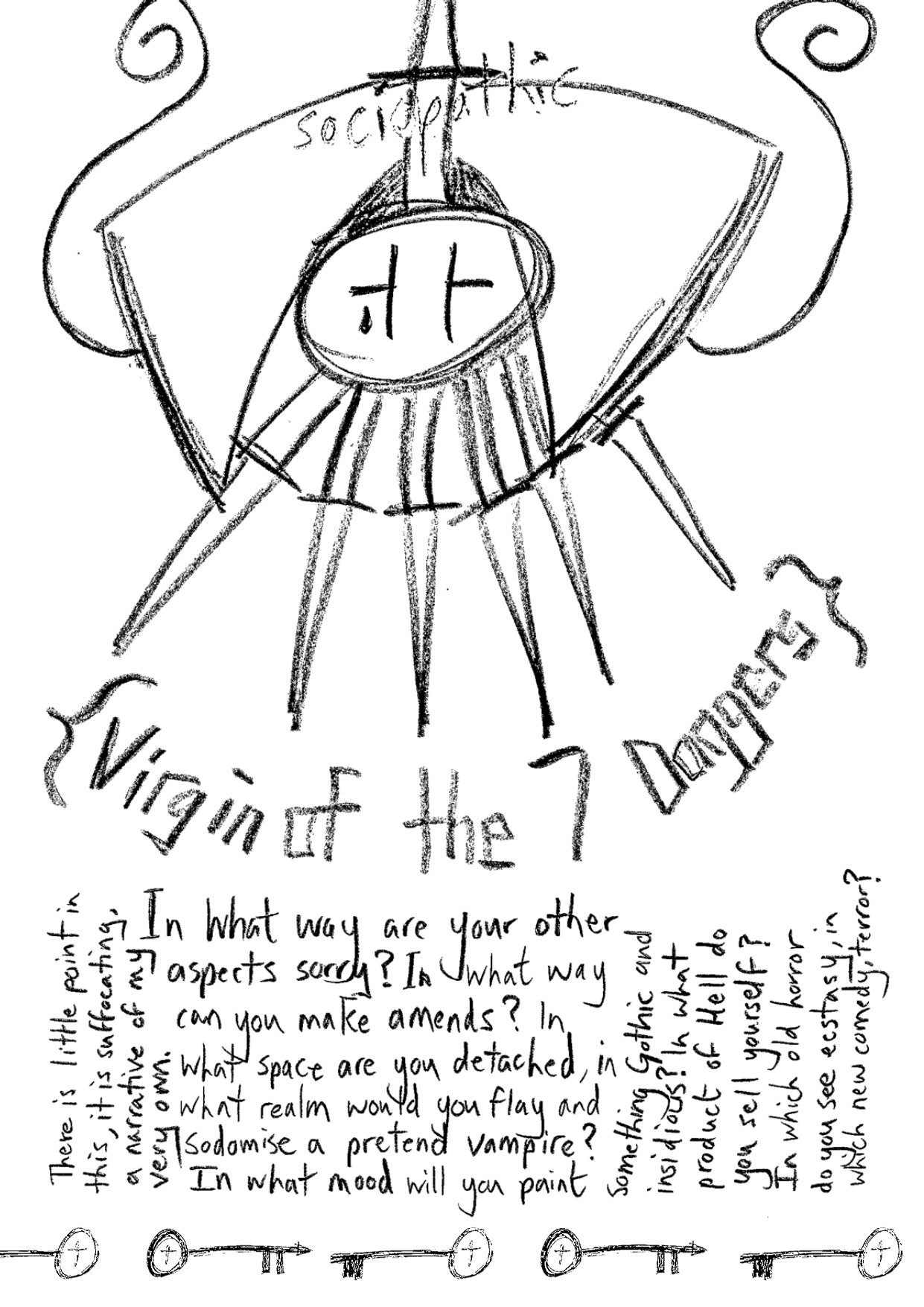
The main character is a sensualist, a rogue, a murderer, a rapist, an unrepentant sinner and wealthy man named Don Juan.
Is Lee taking an aspect of themselves here, or an opposite so that they can torture him?
An analogue for the worst of man?
~~~
The back cover says, ‘he promises to forever proclaim her supreme beauty and asks that in return she save him from damnation.’
Attaching a metaphor, this could be the hypocrisy of the patriarchy proclaiming the purity of a virgin female, a lady of sorrows, while also torturing women collectively via an oppressive system of rules and taboos.
The virgin of the seven daggers = a juxtaposition of purity and death/peril.
Why seven?
It probably has some religious significance.
Soren might know.
~~~
I searched a bit and found an article that said the seven daggers represent the seven sorrows of the Virgin [without naming what those seven sorrows were]. Thematically, it doesn’t matter, the point is, women depicted in Spanish religious art were always miserable or in pain. And a sadist like Don Juan would naturally try to hide within that.
That same article also talked about the ‘faculty of association’ Lee developed, basically the idea that you superimpose your own subjective images from memory over a real object that you are looking at/appreciating. This is quite creepy as it’s pretty much what I’m doing in these de-con-strucs, so much so at times that I wonder if the original work still exists. But then, doesn’t everyone do this to some degree when confronted by art? Perhaps not academics…but even them…
~~~
Opening image: Church of Our Lady of the Seven Daggers, a mix of monstrous architecture overlaid with garlands of pears and melons [covered in stone]. Symbolic of purity vs. death.
Our Lady?
Doubt she yours.
~~~
Further description of spikes for ‘exhibiting the heads of traitors’, dizzy ledges for flinging rebels off, and gold gilded onto everything. The Great Madonna of the Seven Daggers is either slowly sinking or slowly rising, it’s not clear.
‘Her body is cased like a knife in its sheath…’
The sheath pretty, the knife…?
~~~
The Seven Daggers are stuck into her heart or her cleavage, one or the other.
Sex and/or Death.
Or: Groping Tits and/or Death.
She probably won’t let anyone get farther than that.
Further?
Both may fit in this case.
~~~
The narrator is again a future historian, looking back on something that happened more than two centuries ago.
Does that have any relevance?
It fixes me [the reader] outside the intimate centre, serves up mythology and rumour, yet I remember this being quite detailed in its actions, as if I were following Don Juan down into Hell so he could wed a 14th century infanta imprisoned there.
Faculty of association…he’s placed a fantasy woman, a symbol of Spain’s Muslim past, on top of underground dirt and rocks and nothingness, so he can conquer it on the supernatural realm/feed off its powerful ‘historical emotion.’
Is that how it works?
Or is the narrator placing Don Juan’s lunatic journey on top of the deeply unsatisfying present?
~~~
History seduces, robs, fingers and, finally, overwhelms.
~~~
I cheated and skipped to the end again.
Didn’t read what happened to Don Juan, whether he was redeemed or saved or what not, but it seems that this account was seen in a holy vision by a dying Archpriest.
That’s what the last paragraph says.
But then, it also implies that it isn’t actually that holy vision I’ve just read, but a framing of it by ‘unworthy modern hands.’
Reflex metaphor theory: this is about the church trying to cover up its past sins/paedo priests, glorifying those sinners as redeemed instead of damned by a woman with seven daggers lodged in her tit [put there by a man].
~~~
I read back a few pages from the end and Don Juan is forced to answer a question, is Princess Jasmine more beautiful than the Virgin of the 7 Daggers?
This must be referencing either the era of Muslim rule in Spain or something close to it. A battle between faith and the flesh, Stuart Gordon style?
But he [Don Juan] probably wants to fuck the 7-D Virgin too.
Faith-flesh vs abject-flesh?
What is the point of this?
I’ll have to read the rest of the story to find out. There’s a lot of description though. Within a necromantic journey that, as far as I remember, is a series of hallucinations, all of which end in the possibly imagined redemption of a miscreant who deserves damnation, and maybe not a redemption at all as the Church and the Virgin are built on body-horror and this is his natural endpoint as an exemplar of this system, I don’t know.
Maybe I’ll just go back and read some of the first chapter, see if it-
~~~
Don Juan swears eternal fealty to the 7-D Virgin in a soliloquy way too long to type out as an extract. This marks his vision of salvation at the end as a reward for having the courage to say the 7-D Virgin is more beautiful than a Muslim princess. He made a vow and kept it, got his head lopped off because of that.
Yet isn’t this a vow made in expectation of supernatural benefit, without any change in character?
Would he not sexually assault the Virgin of the 7 Daggers if she appeared to him in an unannounced, different form e.g. as a blonde yoga instructor?
I’m confused.
Don’t know what to make of this.
He’s unlikeable and uninteresting, a bit of a simpleton too, with no alienating obsession to compensate any of that.
The journey to the underworld just seems like a whim, a power grab by a bored aristocrat. It doesn’t span months or years or decades, he doesn’t soak himself in it, doesn’t commit like Prince Alberic does.
~~~
I suppose, in a way, it’s apt for a brutal piece of shit to be saved by a symbol of contradictions, a female saint of sex + death. To be courageous on behalf of unproven nonsense. Which in Gothic fiction turns out to be real. Or maybe just a hallucination?
He wasn’t brave because deep down he sensed that he was inside his own mind. There was no Berber of the Rif coming to behead him. He invented the act of courage so he could later invent an act of salvation inside a church of real horror.
It’s possible.
Religion permits anything once accepted.
~~~
After making his vow, Don Juan steps outside the Church and is delineated physically.
‘Tall, of large bone, his forehead low and cheek bones high…’
The description ends quite abruptly [more abruptly than the one above which, once again, is horribly cut off by me thinking I would come back to finish it later].
As if it’s not that important.
It’s the vow that counts, the subservience to a magical woman he’d probably rape if she were standing there in front of him, asking for-
~~~

~~~
Narrator = Spiridion Trepka
Cannot be a real name. Trepka maybe, but Spiridion?
~~~
‘Urbania, August 20th, 1885. I had longed, these years and years, to be in Italy, to come face to face with the Past; and was this Italy, was this the Past?’
~~~
Past with a capital P.
A place that he thinks is sustained still, in his memory?
The architecture?
~~~
I checked the map and assuming I’ve got the right Urbania, it’s a small commune near the east coast of Italy. Surprising that Lee would choose this location, but maybe unsurprising if they a] lived near there, or b] was sick of writing about Florence.
Also, the smallness of the place could mark Trepka as a bit of a hipster [is this word still used? No idea] i.e. Florence is so done, I’m in Urbania, it’s barely on the map, no one knows what English is here etc.
~~~
Following the quote above, Trepka goes on to cry. And moan. About the vandalism that has taken place against his Past, about himself being part of that vandalism.
Of course, he manages to extricate himself later, by saying that he’s protesting the act whereas others are not, and then falling in love with the story of Medea da Carpi, a murderess and fierce independent, who died two centuries earlier at the not at all portentous age of 27.
~~~
‘I often examine these tragic portraits, wondering what this face, which led so many men to their death, may have been like when it spoke or smiled.’
~~~
Medea da Carpi was responsible in some fashion or to some degree for the deaths of five lovers, which is recounted by Trepka drily at first and then later as a white knight, defending his new lust object on each count of murder, trying to mould her as subject within a fort of object-ness, not seeming to realise that truly understanding this woman as subject would lead to his own death too.
[Edit: he does understand it at the end, and embraces it].
Maybe he has a death wish?
To die at the hands of something beautiful, long dead and utterly uninterested in him.
But she must have an interest in him otherwise it’s just generic male lust.
And he’s not generic.
He’s Spiridion Trepka.
~~~
On some level I can relate to this guy. To be disenchanted, enervated by what surrounds you, to be sick of the artifice of conversation [+ attach total definition to the Other based on this shit] and then to find a woman in the history books who died young after a murderous spree conducted on her own terms [from within a societal cage], a woman who can’t respond or disappoint you, who can be folded into subject when you need her to be fascinating and then object-subject when you want to fuck and not die in the act of it, a woman who wouldn’t look twice at you, who only fucked and murdered the wealthy, who was wealthy herself, who manipulated working class simps to do murdering that she couldn’t for logistical reasons, who was unrepentant for all of it, wasn’t she?
I’m not sure, I’ll have to re-read.
~~~
I’ve gone all the way to the end.
Not for the first time.
I think I’ve read this story four times now, over a span of nine years.
~~~
Trepka slips into the slipstream of slippery otherness, going to a church where Medea is surrounded by dead people, where a rose gifted to him turns to dust the next morning, where a letter is left instructing him to cut out the sliver statuette of Medea trapped inside the larger statue of Duke Robert, the man who finally defeated her two centuries earlier [and had her strangled to death in her cell by female baby killers].
Naturally, with nothing better to do, and Urbania a daily disappointment, he accepts, as would we all.
~~~
Is it tragic that Trepka dies at the end?
Isn’t it what he wanted all along, to be added to her list of victims?
I don’t know.
He got killed without first being her lover, which seems to devalue him status-wise.
The physical is not seen as love?
Is an obstacle to it?
To desire without limp ejaculation inside the muff of a two hundred year old corpse is transcendence, a door to real, other love?
~~~
I don’t think this is about love.
It’s loneliness.
Disenchantment with your own reflection, inside a Hall of Mirrors that makes you miserable as default.
Maybe he stabbed himself?
What else would you do if you’d just mutilated the statue of Medea da Carpi’s main enemy, freed her from his bust, and she didn’t bother to turn up afterwards?
~~~
‘Dost thou imagine that thou, with thy ministerial letters and proof sheets in thy black professorial coat pocket, canst ever come in spirit into the Presence of the Past?’
~~~
This is the core of the story, I think.
Written plainly on the first page.
~~~
Should I write a Hong Kong version, with me as Trepka and Anita Mui as Medea da Carpi?
I’m probably not depressed enough.
And Anita’s only been dead a couple of decades. Didn’t murder anyone either, or have anyone murdered via sexual mesmerism.
What next then?
Mrs. Vampire?
Locked Moon Your Vice Is Key Witch?
Mario Maker 2?
~
The Virgin of the Seven Daggers: And Other Stories is available at my local library and maybe yours too. If not, I think you can also find it on the Internet Archive.

 PsYChO hOLosUitE [zine]