
+++
+++
+++
+++
Dedication.
For Augustine.
+++
I.
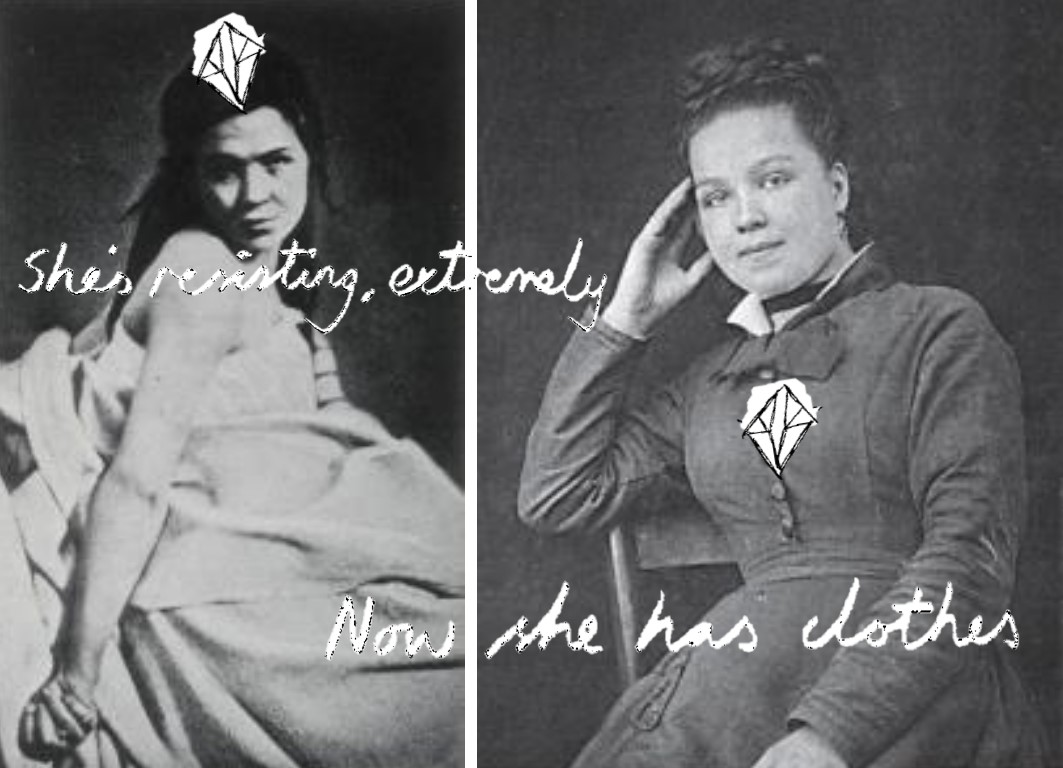
L: Image of Augustine found in book, titled Hystéro-Epilepsie Contracture, Augustine, Paris, 1878, R: Image of Augustine by Albert Londe – “The Girls of La Salpêtrière.” Frontiers of neurology and neuroscience.
+++
You notice, first, that this book takes place in the body. Your body, specifically. Your entire body – Shope writes – is dedicated to this performance of paralysis[…]. You – this you, the you within this text – are Jean-Martin Charcot, a French neurologist. His name lives on in several disorders, and he was very interested in hysteria. By he I mean you. You are particularly interested in a patient named Augustine. You are likely not supposed to be glancing at Wikipedia, open in another tab, while you instruct a captive audience to watch a hypnotized Augustine writhe and whimper on stage, but you do it anyway. Augustine is Louise Augustine Gleizes. There’s a photograph of her in the book, one naked arm twisted beside her. Her eyes are not looking at you directly, but at something just above and behind you. Her hair is loose, uncombed. On Wikipedia, she is well-dressed and smiling, and her hair is neatly braided. This is not a deconstruction of a Wikipedia article, but you are interested to learn that Winona Ryder “appears to Gleizes film stills in the 1992 adaptation of Bram Stoker’s Dracula as she begins to experience early states of vampirism.”
+++
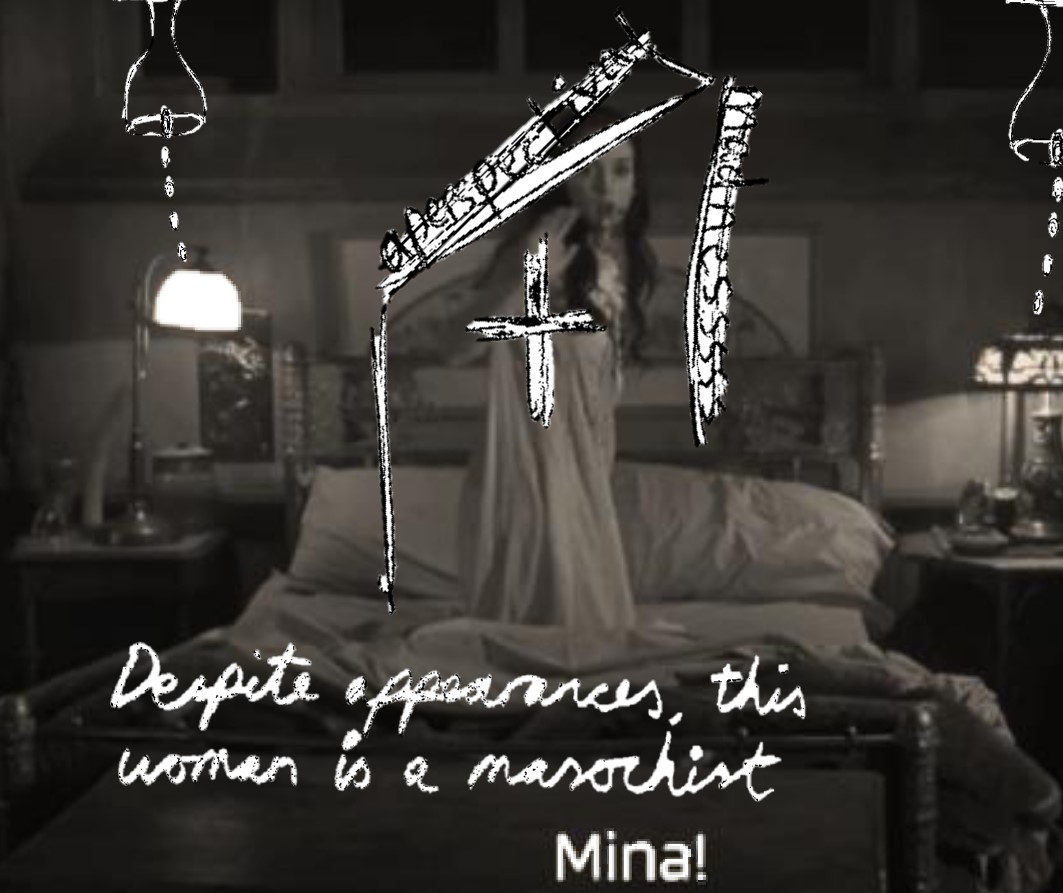
A shot of Winona Ryder as Mina in Francis Ford Coppola’s Bram Stoker’s Dracula, Columbia Pictures
+++
You notice that there is a splicing of the self at work–you have a public self and a private one:
Only in public, in front of a crowd, do you come alive, express awe. [page 17]
Augustine, too, only exists when seen. When you look away from her, she is no longer a body or anything at all.
Wikipedia goes into why this might be in more detail, but you are not deconstructing Wikipedia articles.
You took notes for this novel in a MadHappy journal you found on top of some sort of pale green machine on the sidewalk. You’ve Googled “pale green machine sidewalk” but it brings up other things. Google barely works anymore, but this isn’t a deconstruction of that. You think AI is ruining most things, including your ability to trust what you see. The MadHappy journal, in any case, was usable. Some of the pages were torn out, but it was clean enough, and good for taking notes and tracking your moods. (You were worried about your health when you started taking these notes. You marked “PHYSICAL HEALTH” at  and “MENTAL HEALTH” as :-|) You’ve tracked most references to Greek mythology as they appear in the novel. There are a lot! Bacchus and Agave (birth, deceit), Hera and Argus (eyes), Pan and Syrinx (sound), Hippocrates and Avlavia, Medusa, and of course Pygmalion and Galatea. Pygmalion, as it happens, is also the name of an open-source AI project. In all these myths, bodies are transformed through violence, mostly for pleasure and revenge.
You worry you’re losing the audience’s interest. Are they reading closely? They’re skimming, probably, if they haven’t already stopped altogether. The prose in this book is beautiful and the subject matter is important. They should read it. You’re not doing this text any justice, because your mind keeps wandering and you’ve been waking up at 3:00 or 4:00 in the morning, covered in sweat.
+++
II.

From “Iconographie photographique de la Salpêtrière” (Jean Martin Charcot, 1878)
+++
Augustine exists, still, through photography. There is something evil about photography, of being forced to look at a miniature version of myself, a facsimile, but always changed, always deformed. A simulacrum. Especially now. Think of how easily these can be manipulated. Glossy-skinned Midjourney women with prodigious breasts and cat ears. I read a Bluesky thread about scammers who use computer-generated photos of beautiful women and I couldn’t tell they weren’t real women.
The photographic studio is the eye of the asylum, he announces. [page 50]
Cameras are always looking at me. Mark Zuckerburg famously(?) keeps his laptop camera covered. Every building has a Ring camera, to catch package thieves and delivery people. I am smiling because I am always on camera. When I see myself on camera in the self-checkout line, it makes me want to die.
The photos of Augustine really exist. She looks like an actress playing a role in a silent movie or play. She looks like many different animals, but mostly like birds. A swan. There is a myth about this, too.
On page 51, we encounter yet another myth, that of Zeus and Semele. Hera is jealous and hatches a plot to have Zeus appear to the girl in his “full and terrible splendor.”
But the moment he enters the girl’s bedchamber, his radiance consumes her, splitting her open from sex to scalp like a bolt of lightning. Zeus snatches the half-formed fetus from the smoldering ashes, slicing a gash in his thigh and enfolding the child inside. [page 51]
Thus, Dionysus is brought into the world. Forged in fire, enrobed in flash, drenched in wine and the plump golden limbs of his cult.
We then learn that Dionysus – beautiful, adored – returned to the site of his creation to find his name scorned, his dead mother mocked. He exacts his revenge on Thebes’ king and–
These stories are important because they are about birth and death and doubling: the son of the god’s with the stolen mother turning another mother against her own son. Bodies are transformed and twisted and burned and formed into shapes either hideous or beautiful.
Photography gives us the power to become progenitors and patriarchs of an artform, to depict madness in all its infinite variations via a purely objective medium. [page 52]
But we know better. There is nothing objective about seeing. Every camera is a hungry mouth, a jealous eye.
I call Charcot (that is, again, the neurologist) Maitre throughout. I think the other [De-Con-Struc] are more interesting than mine, with more impressive vocabulary and deeper understanding of the text. They talk a lot more about sex and drugs. Those are in this book, too, but not in the same way. I worry that the other deconstructions are funnier and more inspiring and changing entire lives. Maitre can mean Master. It’s a complicated word that’s not quite right in English. Lawyers can be called maitre. I know you’ve heard of maitre d and in this case, sure, they’re a master in that they are in charge, but in this case it’s more like manager. But in the text, it means several things. I can’t explain French to you.
I didn’t use the right punctuation but they’ve stopped reading. In my notes, in the MadHappy journal, I wrote, “Maitre as titan, turning against god.”
Documented in black and white, irrefutable. [page 63]
Charcot wants to make a plaster mold of me. It’s easier to deal with the image than the thing. I tried looking up “the thing is the thing” because I think it was Donald Judd who said it but Google is showing me a question in r/movies: “Is anyone still The Thing? Is The Thing dead, or is the world doomed?” Or was it Richard Serra who said it? I wish I could remember. I feel stupid for not remembering.
You keep careful watch on the chronometer, ticking out the timing of every attack. You write – 18 seconds of menace, 10 seconds of appeal, 14 of lewdness, 24 of ecstasy, 22 in which rats are seen, 17 in which music is heard, 13 seconds of snapping in time with the shutter of the camera, followed by 23 seconds of lamentation. [page 85]
Two Wikipedia articles and one Instagram reel have convinced me I have OCD.
+++
III.
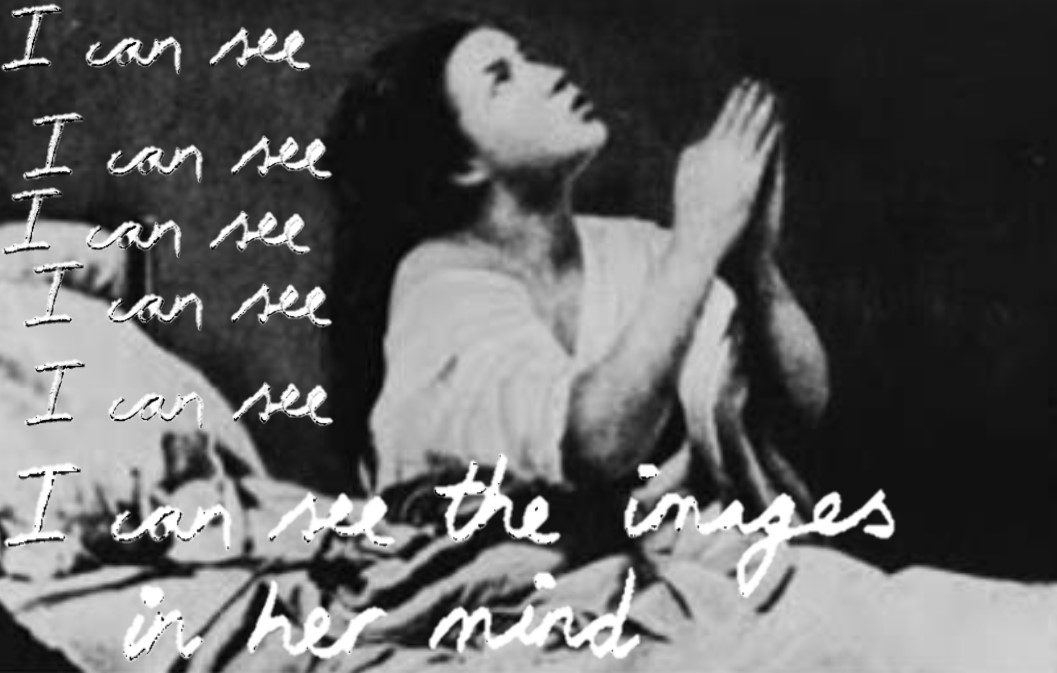
From “Iconographie photographique de la Salpêtrière” (Jean Martin Charcot, 1878)
+++
Torpor taking over. The languor of limbs. [page 93]
She is skipping around, but there is a rich story to be found here. There are vivid images, beautifully-rendered prose. She is skipping around because she is having trouble getting to the core of it and she is too aware that she’s watching you watching. What she is doing, really, is a form of alchemy: from living flesh, paper. From a whole, a hideous synecdoche. She is tearing off and doubling, she is forcing the woman to give birth to more grotesque versions of herself. They’re disgusting and it’s hard to look away but everyone gets tired of looking, eventually.
Humans are not good with bodies. It is unsettling to be in a body. Soil, fungus, parasite. You feed and you secrete and you birth and you shit and people like to look at all this. You are, in a sense, always trapped within your body. She knows this.
In her notes, she’s written “Acteon and [illegible), hounds, undoing.” What did she mean by that? This was written five months ago.
I awake to the flash of a photograph and a world turned black and white. I am grey. Grey teeth. Grey hair sprouting from my head, from my groin, from the darker hollows of my armpits. Protruding around my aureoles like silvered needles. [page 101]
And here she is, grey in a black and white world. Always smaller, always still. Nina Shope is doing something beautiful here, pulling in Augustine’s voice, reanimating dead flesh, still heart. Alchemy, transforming teeth to silver, a spine into a sentence.
There is another myth, this time the one about Mercury cutting off Argus’ head. Hera then scooped Argus’ beautiful, sightless eyes and placed them on the peacock.
Augustine escapes, of course. This is historically true. She stopped allowing herself to be photographed – as much as she could have allowed it before – and eventually escaped the institution in drag. Unbodied.
She received a weird email and he worries about what this means. It’s hard to know when something is not working properly anymore, or working exactly as intended. She’s going to be thinking about this email all weekend. There are sponsored ads in her inbox now for Hyundai CX AI and art museum merch because even though you are not reading this, Google is.
You tell me, Augustine, we are making a mold of you. [page 121]
No quotation marks, which I like – it’s so smooth. It always makes a text breathe better, unless the writer is bad, and then it’s only annoying.
It’s hard to tell what Augustine looked like. She is different in every image. Sometimes she looks like a child, sometimes like a smear.
But, still, there are the photographs. There is only one photograph in the book – the one mentioned before, arm twisted – but there are many more online. In some, Augustine is smiling. In some, she appears to be praying. It is easy to see why people became obsessed, devoted, starved. Smiling, contorted, in agony, Augustine inspired several works of art.
In the novel, on page 123, Augustine is told the story of the Comtesse de la Motte. This is Jeanne de Valois-Saint-Rémy – also a real person with a Wikipedia entry for you to keep open in another tab. She is known for “The Affair of the Diamond Necklace,” which sounds vaguely familiar whether you have heard of it or not. It’s just one of those things. The important takeaways here is that Augustine is being given a template for escape – she can dress like a man, hide her body in unfamiliar clothes, change shape – and she is given a warning. The Comtesse, mistaking tax collectors for authorities dragging her back to her asylum, defenestrated herself. Augustine, imaginative, sees the Comtesse’s broken skull, her perfect face.
I want to linger with her awhile, knowing from the twitching of her lips that she has secrets still to tell me. [page 124]
There are also images of the women portraying Augustine, copying her poses in plays and in movies.
Afterword.
The author describes this as a hysterical text–there are phrases repeated, there are gestures omitted, some words are blended together.
Acknowledgements.
That’s none of my business.
About the Author.
I read this because the author and I follow each other on Instagram, number one, and number two because I am interested in the subject matter. Again, I worry I did not do this justice; I did not deconstruct it well. I constructed instead, a failure on my part. It’s hubris – to take this work and transform it into myself, to contort it on stage for an audience. I worry that, if you find this boring or self-indulgent or lacking in confidence, you will think the novel is also these things and it isn’t. I was fully immersed. I think Nina is doing something wonderful here. This is brutal and delicate, empathetic and exploitative. I mean that neutrally, without judgment.
She has a corgi. I didn’t know that before.
For Augustine, the dedication said. For her body, N-shaped on the mattress, for her mouth, a perfect O in the amphitheater. For Augustine’s bones, for the tendons spasming beneath her flesh. For her armor, flashing gold at birth as she spilled from a split head on a sea of red foam. For our bodies splayed on brightly-lit hospital beds beside humming machines, gloved hands leaving fine white dust on ourbelliesandthighs.Forthenameless,theirhandslily-shaped, tearingthroughpaperandink.
+++
Asylum is available to buy at Dzanc Books and we all know where to find Dracula.
+++
A.A. de Levine is a writer and a short story editor for Coffin Bell Journal. Her work has appeared in New Gothic Review, Goodnight Sweet Prince, and Taco Bell Quarterly.
+++

 PsYChO hOLosUitE [zine]
2 thoughts on “[De-Con-Struc] Asylum // Nina Shope [Guest Written By: A.A. De Levine]”