
+
Text: The Factory
Author: Hiroko Oyamada
Publisher: Green-proof Press
Plot: 3 workers elapse to death at The Factory, aware of the build-up of doom symbolism cormorants but what you gonna do?
Subplot: A middle manager named Goto becomes more than Goto, seeds himself everywhere, in every department. Zero temper tantrums.
Sub-subplot: The Potemkin arrives at the port of Odessa. Goto’s body is taken ashore and displayed publicly by his companions in a tent with a sign on his chest that says: ‘For a spoonful of Borscht.’
+++
Astonishing.
Stellar.
Mindbending.
The eternal slog.
In a hangar, wetting fibreglass on the hull.
Fibreglass as praxis.
Sometimes surreal.
Meaningless.
Oyamada expertly weaves in a series of strange phenomena creating an atmosphere of unease bordering on pernicious.
Where does the factory end and the rest of the world begin?
Substitute ‘world’ for ‘galaxy.’
‘Rest’ for ‘dregs.’
Hints of Kafka.
Sometimes surreal.
Meaningless.
A creeping sense of the absurd, the wry smile type.
Based on Oyamada’s experience as a temp for an automaker’s subsidiary.
Finally something to write about.
One summer into permanent industrial dirge.
Bureaucratic dirge.
Three workers divided from one.
Hiroko or people she talked to/ hid from.
Talked to about the weather near the crows, amassing outside, en masse.
Out there, outside.
A sprawling industrial complex.
Like the knife factories in Kāatlandō or the katana factories in Kawasaki 2075.
One adds the handle.
One checks the blade.
One appraises the knife as a whole.
In this case:
One shreds paper.
One proofreads documents.
One studies the moss growing over Colin Ward’s allotment [RIP].
A proletarian novella for today’s world.
We all want to like it.
Are you from around here?
Come back and visit sometime.
If you’re not too busy with The Hole.
Polishing your Shincho Prize.
I won’t
We won’t throw fibreglass at individual creative success.
You remain ambiguous.
Originally published in 2013.
It’s been a while, hasn’t it?
Temp-town is a ghost town nowadays.
[I lived there too, once]
The margins of reality, dissolving.
Their lives – the three workers – slowly become governed by their work, days take on a strange logic and momentum, and little by little, the margins of reality seem to be disso-
+
+
What am I doing here?
A portrait of absurdity.
‘As I opened the basement-level door, I thought I could smell birds. “Hello, I’m here for a two o’clock interview,” I said to the overweight woman seated under a sign that read PRINT SERVICES RECEPTION.’
Mundane except for the basement and the birds.
The smell of them.
Are they really there?
Goto appears, the interviewer, leads her to a space not a conference room.
Really, he just appears, no walk over, teleported perhaps.
The narrator’s lack of focus or the author’s?
Hiroko wants us to feel a lack of physics.
A lack of A to B to [paper shredding?].
The factory operates inside its own time-space phenomena.
This is a short book.
116 pages, starting on page 3.
I predict up to page 40 for this de-con-struc.
Machine noise, a constant buzz and hum.
Yoshiko Ushiyama, an ex-Wobbly organizer for the United Factory Workers, arrives in Matewan, West Virginia in 1920 to organize workers against the Factory. There, she witnesses a mob of paper shredders angry at wage cuts beating up cormorants who intended to cross the picket line. She takes up residence at a boarding house run by-
Ushiyama is an uncommon [family] name.
Oyamada also?
Mei Ushiyama the legendary beauty mogul, seen with Grace Kelly on the set of To Catch A Thief.
I think that’s who Goto means.
She must be dead by now.
Long dead.
If you’re lost, buy The Factory by Hiroko Oyamada and read along, I’m only on the second page.
The interview is ongoing.
This is Yoshiko Ushiyama’s sixth job since graduation.
She never lasts longer than half a year.
I had a language exchange like that. Every few months she’d come along and say ‘wun gung’ and a week later would be in a different job. Studied English at HKU, a top university. But restless. Constantly buzzing and humming. None of her bosses seemed to care, though she loathed them all by the end.
Yoshiko is giving an incredibly detailed, pointless background path as to how she came to apply for this specific job.
She’s interested in communication, the language used in print media.
In her head, she’s back on a school trip.
The Factory gave her a box of cookies and a pencil case.
Appeared gargantuan like Disneyland.
Was surrounded not by mountains like everything else in the city but nothing.
It lay there as its own construct, in its own pocket realm.
Possibly surrounded by something larger, out of sight.
In the city, the Factory is dominant.
Everyone has at least one family member working there.
Industry as mammoth parasite, run by smaller, much more avaricious parasites.
The prose is efficient, business-like.
Yoshiko lets us inside her head as counterpoint?
She does love the Factory, on some level.
Or is that a lie?
No one loves a factory.
They become accustomed to it.
Factories and shipyard hangars.
The upper level with the endless stacks of fibreglass, the spilt fibreglass on the floor, the fibreglass inside the gloves, the overalls coated in splintered fibreglass shards that have been hardened onto the fabric, fibreglass, fibreglass, fibreglass, fibregla-
There is a Trek comparison here, I just can’t seem to put my finger on it.
No one loves a factory.
Yoshiko will be working there, as a contract worker.
This is the far end of the far end.
NO fixed monthly salary.
NO fixed hours.
‘3 to 7.5 hours daily [at least 2 days a week], somewhere between the hours of 9 and 5.30. I couldn’t figure out the difference between a monthly salary and hourly pay, at least not on the spot, but I was confident that the latter wouldn’t be as good.’
Not sure how it works in Japan [despite living there for 2 and a half years 20 years ago], but here in Hong Kong, hourly pay and erratic working hours on contract is a way for the employer/parasite to keep you outside of typical legal entitlements and benefits. Contract workers can be called part-time, only it feels like full-time. Anything under 30 hours [in HK] is considered part-time and this is the ideal zone for the employer/parasite to keep you in. They do not respect your background or your life or anything really. Die on the assembly line and you’ll be charged for languor. Die at home, they’ll come round with plastic flowers, tap up your kids.
Yoshiko feels both undervalued and prized, speculating that they must see some promise in her or they wouldn’t be offering her a job at all.
It isn’t a bad thing.
A job’s a job.
Even if it’s not permanent.
She’s going to be in the Shredder Squad.
Shredding paper for up to 7.5 hours a day.
For at least 2 days a week.
No more than that cos then they’d have to give her benefits.
Take care of her under threat of legal action [that the parasite would probably win].
Like those benevolent capitalists we’ve all heard so much about.
The father of the Factory, nurturing his-
END OF CHAPTER ONE.
No indication that it was a chapter.
No titles for each break.
All will bleed into the other.
The new Boulogne has no centre, anymore than the factory with the provisional printing press.
+
+
The next day, two Baldwin-Felts men, Goto and Goto, arrive in town and take up residence at the Ushiyama boarding house. Mrs. Ushiyama at first refuses to give them rooms, but Yoshiko voluntarily moves to the hotel, freeing up a room for Goto and Goto and averting trouble for Mrs. Ushiyama. Goto and Goto then start their campaign against the union by forcibly evicting warehouse workers from company-owned houses in-
CHAPTER TWO, title-less.
At first, I thought the black birds were crows, but I was mistaken.
Another misimpression related to birds.
This time crows, or cormorants [in fact], maybe even shags.
Is this still Yoshiko from CHAPTER ONE?
The blurb said there were three main workers.
Do shags live in places like this?
Where the [polluted] river spills into the [plastic] ocean.
In Māori tradition, the king shag is associated with Kupe, a revered figure, and is considered sacred.
In Norway, they carry messages from the dead.
Other places, an ill omen, an aphrodisiac, an anti-labour symbol, an intermediary from the Afterlife.
In Japan, the watchers of the Factory Construct.
Doom in the sense that you signed a contract for it.
A comfortable doom.
With later surrealism.
Hints of Kafka.
We’ll get there.
This, however, is not Yoshiko.
It’s Furufue, the moss whisperer.
He’s switched from the University Research Lab to the Factory.
Against his will?
It’s implied by his internal self-dialogue that he was head-hunted.
As a bryologist.
Yes, head-hunted.
Forced into it by an advisor who eats like a slob, who claims to be on a diet, who won’t stop eating, who is described this way while Furufue sits there and eats nothing.
There is hunger but no love for food.
No joy in the consumption of it.
Consumption is the word.
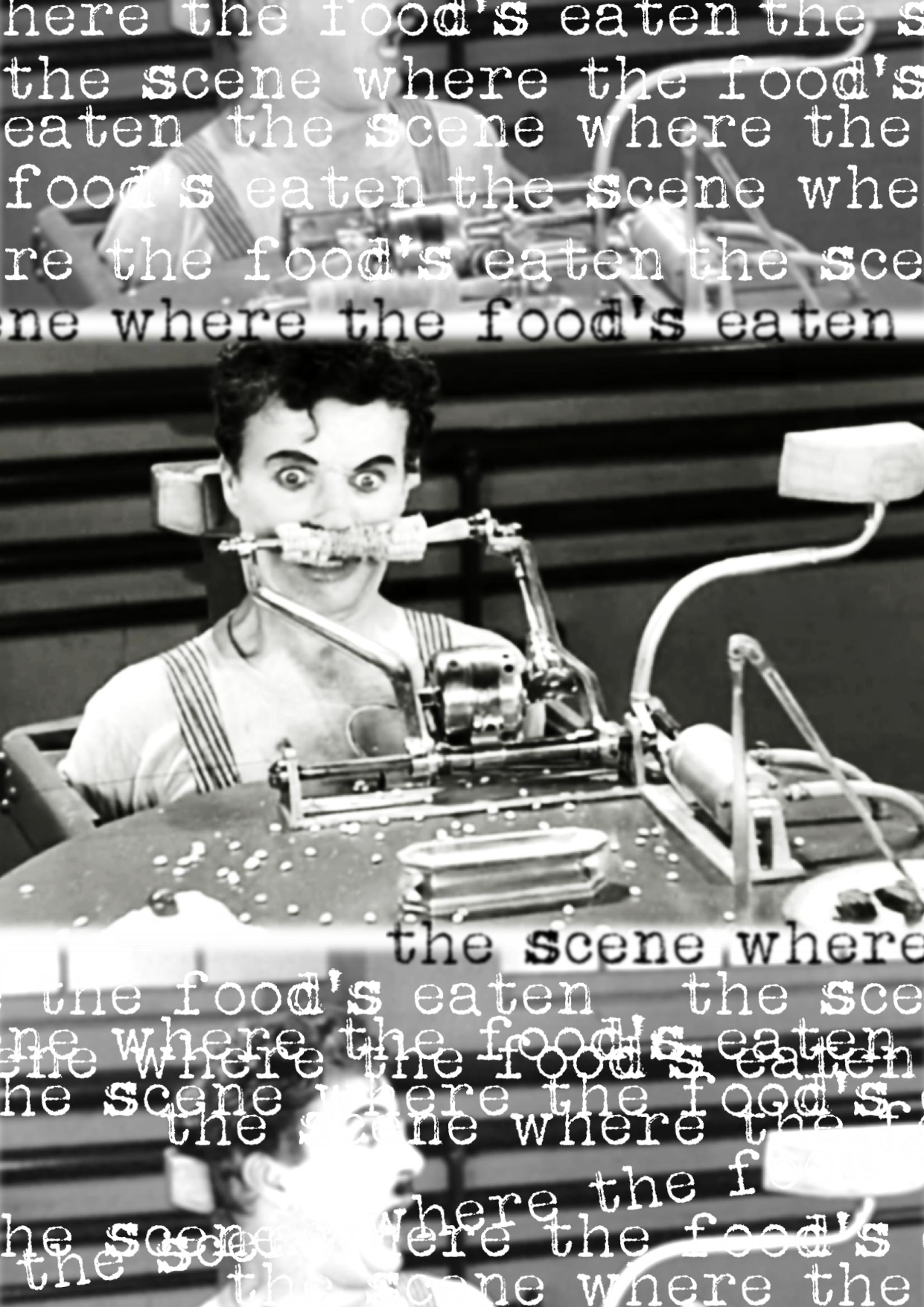
The whole passage is written in a very prosaic way, the putting of one processed foodstuff on another, the CONSUMPTION of it, as if it belongs in the Factory.
A clear metaphor for UNILEVER and its ongoing plastic bag fetish. Infinite joyless consumption. Just like the Factory workers. Just like the Factory.
No name given as of yet.
Not that I remember.
Maybe there was.
At the beginning, in the blurb.
But then, named, it would no longer be the Factory.
The blandness is necessary, will function later as a solid foundation for the surrealism.
Which will end how?
+
+
Furufue runs to a nearby church, where he tells Ushiyama the Priest what happened and vows to turn himself in to Management. The kind-hearted priest tells Furufue not to turn himself in, noting that Furufue didn’t kill Goto the Loan Shark and that many neighbourhood folks are now relieved. She tells Furufue to pray for the loan shark’s rotten soul and burns the-
None of these narrators are working class.
They have a background in higher education.
The message…could be…
Corporations have expanded the claws beyond the menial, the manual, are sucking up the academic sector too, the middle class.
They’ve been doing this for a long time already.
‘”Just don’t try to do anything on your own. Most of all, remember to be thankful.”’
Thankful to the Factory.
For hiring an introvert, says the narrator’s dad.
‘”A man’s mission in life is to make his own way in the world.”’
By working for a parasitic entity.
Some thing creeping over the entire city, spilling into the ocean.
Ah, Goto is back, giving the new recruits a ‘get to know each other’ hike.
The same Goto?
This one works for the PR Department.
The other Goto?
Can’t recall.
Hike interrupted by another interview.
A flashback to one.
It’s not really an interview.
Goto from PR wants to know what Furufue, the moss guy, will need to green-roof the Factory, or check for moss, mossify it.
The details are vague.
Conversation lies within one huge chunk of text.
It’s hard to tell who is saying what.
In the Factory-
It doesn’t matter.
Furufue has the job.
He tries to derail it, suggest private business to green-roof the Factory Complex, but he has it nonetheless.
Collect samples of moss around the site and classify them. Greening comes later. In due course. At some to be agreed upon time.
Sounds exactly what it sounds like.
The Factory observing moss while the planet burns.
Via a one-man team.
‘…it was just too absurd. What idiot dreamed this up?’
Corporatism.
Underneath that, Capitalism.
Later, Adventurism.
As seen in Planet Rasputin.
It has so many names.
‘”Anywhere outside is fine, wherever you need to go to find moss.”’
Furufue starts work on the 1st of April.
You learn as you go.
Green-roofing via orientation hike.
Someone may know something or may not know something.
This job is absurd.
No training, no team, no supervisor, no incompossibles.
Or lots of them.
The next day, Furufue attends Communion as Yoshiko is adorable in her new outfit. Despite the occasion, he appears withdrawn and nervous, still feeling guilty about what he’s done.
Back to the orientation hike, which is actually a tour of the sprawling Industrial Site.
The co-opting of nature trails.
Everything is on site.
Under observation from the cormorants.
Who may also be Management.
An unwitting death omen.
Can’t say they’re not.
In the North Zone of The Factory, a Cormorant March is held on The Twelfth, and an audio tape is handed to Ushiyama, a Japanese human rights lawyer and activist. When Ushiyama arranges to meet the person who made the tape, she is assassinated by a death squad. The gunmen retrieve the tape from-
Nearly 100 cafeterias in the Factory, and a decent number of restaurants too.
This is a kind of Disneyland.
Furufue feels it also.
‘Looking down at my map, I was overwhelmed. The Factory was a world of its own.’
Ripe for surrealism.
Surrealist interludes.
Surrealist totality.
If there’s no social realism, no socialism, why not?
Surrealism, onegaishimasu.
The Ushiyamas, the Oyamadas, and Furufue are arrested for drug trafficking. The police chief, Goto, dreams that the ghost of a former inspector killed in retribution for torturing a student protestor releases the traffickers. He wakes up from the dream to learn that the Interior Minister has ordered them to be released. Furufue dreams that they return to the Ushiyamas’ for dinner but are shot by a rival gang of drug traffickers from Osaka. After waking up, he walks to the kitchen and sloppily eats leftovers stored in the refrigerator.
The map of the site?
3 giant buildings: HQ, the museum and the main warehouse. All others, annexes.
Residential Area.
Product Test Site.
And the North Zone, ‘where the Factory presents itself to the world.’
‘Appearance matters.’
Beware of the cormorants.
They are in the area.
KEEP WINDOW CLOSED.
Weirdly, we end not on that sign but a truncated dialogue leading to “moss hunt.”
END OF CHAPTER TWO.
Twenty pages in, halfway to my target.
I’m not bored, but I’m not a cormorant either.
No one and nothing really stands out.
Just some ‘whys’.
E.g. moss hunt, multiple Goto [potentially], enormity of the Factory site, Disneyland parallel.
The prose is-
Everyone speaks like they are in a satire.
An absurdist one.
The absurdism growing out like moss.
+
+
CHAPTER THREE.
When Ushiyama loses a finger in a working accident, his attitude changes drastically. He joins a radical faction among the cormorants who call for a strike, has an affair with a female co-worker and invites local university students to move into his flat. After the Unionists have reached an agreement with the management, the employees return to work, except Ushiyama-san who has been fired for his agitational behaviour. He goes to see the student protestors, who declare that he is of no use to them because he is an individual case. Ushiyama-san, now on the verge of madness, only vaguely realises that-
Asleep in the office, a new face.
Ushiyama-san.
I skipped ahead to find this name.
He’s there because of his girlfriend.
She’s a co-ordinator at a temp agency.
Was this Hiroko’s girlfriend too?
‘I’d heard about the crows, the beavers, and the other animals around the Factory, but hadn’t seen much of anything myself. Really, I was just happy to have a place to work, a place to go every day.’
The birds are now joined by beavers and others.
Spectating on their stolen habitat.
Waiting for it to be theirs again?
Ushiyama-san is snug and secure.
The partitions allow him to nod off while red-marking someone else’s mistakes.
In some offices…factories…there’s a proofreader for the proofreader.
Mostly they don’t give a shit.
Just catch the obvious errors and it’s good.
Before, Ushiyama-san was a systems engineer, whatever that may mean.
Now he’s a temp corrections worker.
Just happy to be there.
The alternative is jobless at thirty.
‘Instead I’m doing this work that literally anyone could do, as if nothing I’d ever done in my life mattered.’
His internal self-dialogue [no not monologue] isn’t vibrant exactly.
It’s almost identical to that of Yoshiko and Furufue.
Only the details are slightly off.
I’m sure that’s the point.
Three individual workers all surprised/depressed to be at the Factory, all a bit befuddled by the nature of the work, all referencing the birds in some way, all a few other things that don’t particularly stand out.
Is the making of a point via a specific form/style of prose a point ultimately worth making?
I’m not bored.
The prose is smooth enough.
Character thoughts basic yet realistic.
He’s sleeping on the job.
Maybe his co-workers are too.
Let’s see what happens when the Kafka hints drop in.
Right now there’s proofreading.
When Ushiyama-san finds something wrong, leave a note in the margins.
‘”Like this. There are marks you’re supposed to use, which are all in this handbook. Look up the right mark, then use that. Except, well, it’s an old system, invented back when we did everything by hand. Feel free to do whatever works for you.”’
There’s a rulebook but find your own way.
A system but whatever.
This is a job without value, without meaning [put adjectives in, if you want].
He is happy to have it.
On some level, suicidal.
It’s all his girlfriend’s fault, the advisor’s fault, the newspaper advert’s fault.
All ley lines lead to the Factory.
Built on ancient bird burial grounds.
They want it back.
Why not?
The three workers visit a Factory Teahouse, where a cormorant tells them about its childhood. Following its mother’s death, the cormorant’s cold-hearted father sent it to military school. The ghost of the cormorant’s mother informed it that the man was not its real father but its father’s killer; they had duelled over her. She asks her son to poison the culprit, and the cormorant complies. Before dying, the cormorant leans in, asks its father if he ever worked at the-
Seems like the documents in the packets are all arbitrarily dumped in a big pile and Ushiyama-san just has to take one.
Maybe Yoshiko too.
At the end of the proofread, no need to sign.
If they’re on the collection pile…
No, it’s worse than that.
The documents return later, unchanged.
Even the other temp worker doesn’t know what they’re doing there.
She’s like a pre-school teacher.
But not a pre-school teacher.
I don’t think that’s the first comparison where the ideal noun is a job with meaning.
Ideal noun?
The imagined comparison noun?
You know what I mean.
Forget it.
Just don’t screw up.
‘”If anything happens though, it’s everyone’s fault.”’
The first packet/document:
‘Goodbye to All Your Problems and Mine: A Guide to Mental Health Care.’
Cover image: 2 smiling meatballs, under a rainbow.
The contents are a mess.
My brain is drifting.
Is there a union in this Factory?
Socialist allegory or themes?
Or is it an existential piece, liberal + naked of detail?
None of the three main characters appear to be aware of collectivism or Malaparte or anything much except, when the economy picks up, they’ll be elsewhere.
This kind of thing is not their fight.
Everyone knows someone who works at the Factory.
Ushiyama-san has to get married at some point.
His sister has a contract job, not much different from temp work.
It’s not Yoshiko, is it?
I hope not.
No need to miniaturise the world of the text.
There should be millions of contract workers.
And temps.
It’s the gig economy.
Freedom to hang permanently off the cliff of Mt. Hell.
Mt. Jigoku.
Dreaming of breaking through a wall next to Gian Maria Volonté.
He’s dead now.
Died in 1994.
I miss the idea of him, how he would’ve been past 94.
END OF CHAPTER THREE.
This is drifting and drifting and-
Vanzetti attempts to get clemency by pleading guilty, but later retracts, praising the courage of Sacco, who, by not bending to the request for clemency, will have given full testimony of his own innocence.
At some point, the three characters need to blend into one another, switch histories, turn into a patch of surly moss or a patient cormorant.
That may not be the type of surrealism permitted.
Exterior surrealism only.
Narrators kept intact psychologically, as ‘this is absurd, what is this?’ observer of events.
Ideally, everything should disintegrate.
If there are no unions, no socialist ideas.
Why not?
Liberals can wake up from dreams.
Real crows wouldn’t wear a crown of thorns and peck you to death.
Management remains Management.
Cannot be named.
I’m way off text here.
Going back.
+
+
Page twenty seven.
We’re with Yoshiko again.
The contract worker in the Shredder Squad.
Some blocks of text are a scene in one place and one specific time then the next block of text is back in the Factory without a bridging point.
Example: Yoshiko is at home, telling her lover[?] about her new [contract] job, then, no transition, ‘the interview ended and Goto walked me over to the shredding station.’
Scenes outside of the Factory are denied their own space, instead planted in as fragments that are soon overpowered by the workplace.
The majority of your life elapses there.
Weekends perish in a flash.
And half of that time is spent dreading a return to you-know-where.
Well, I’m freelance, without even a contract, fucked since 2021, so I have freedom [to some degree].
I use this freedom to cultivate new layers of depression and ‘what am I gonna do if I’m fifty and no one’s reading Planet Rasputin?’
Can’t think about kids anymore, that’s gone.
Yoshiko?
She’s describing her area of the Factory that I don’t really care enough to try and make a mental picture of.
This chapter is another twelve pages.
Right now, it’s too vague to read any more of.
I just don’t really care.
On the train ride en route to the planned assassination, Yoshiko engages in a discussion with the political philosopher, Francis Jeanson. He says violence, non, she says, oui, violence, why not?
Ah, Yoshiko Ushiyama.
She IS the sister of the other narrator then.
Goto tells her to dress casual.
But no shorts or tank tops.
Is this the zone of the re-territorialised housewife? The stereotype of one?
Her co-worker, Itsumi, is getting her an apron.
Shredding = waste disposal
Doing the washing-up.
Maybe they’re shredding the documents that have just been proofread?
Goto is useless, apparently.
Didn’t tell Yoshiko so many things.
‘The bathroom was clean and bright…when I left I saw the exit…all I could see was a parking lot with a few company vehicles…a utility hose and a plastic tub… not exactly a cheery place.’
A lot of abrupt counterpoints in the Factory delineation. It’s both bright and clean and not stuffy but also quite sparse and grey and uniform.
It is never one fixed thing.
Perhaps to reflect the sense of comfort and sub-sense of despondence?
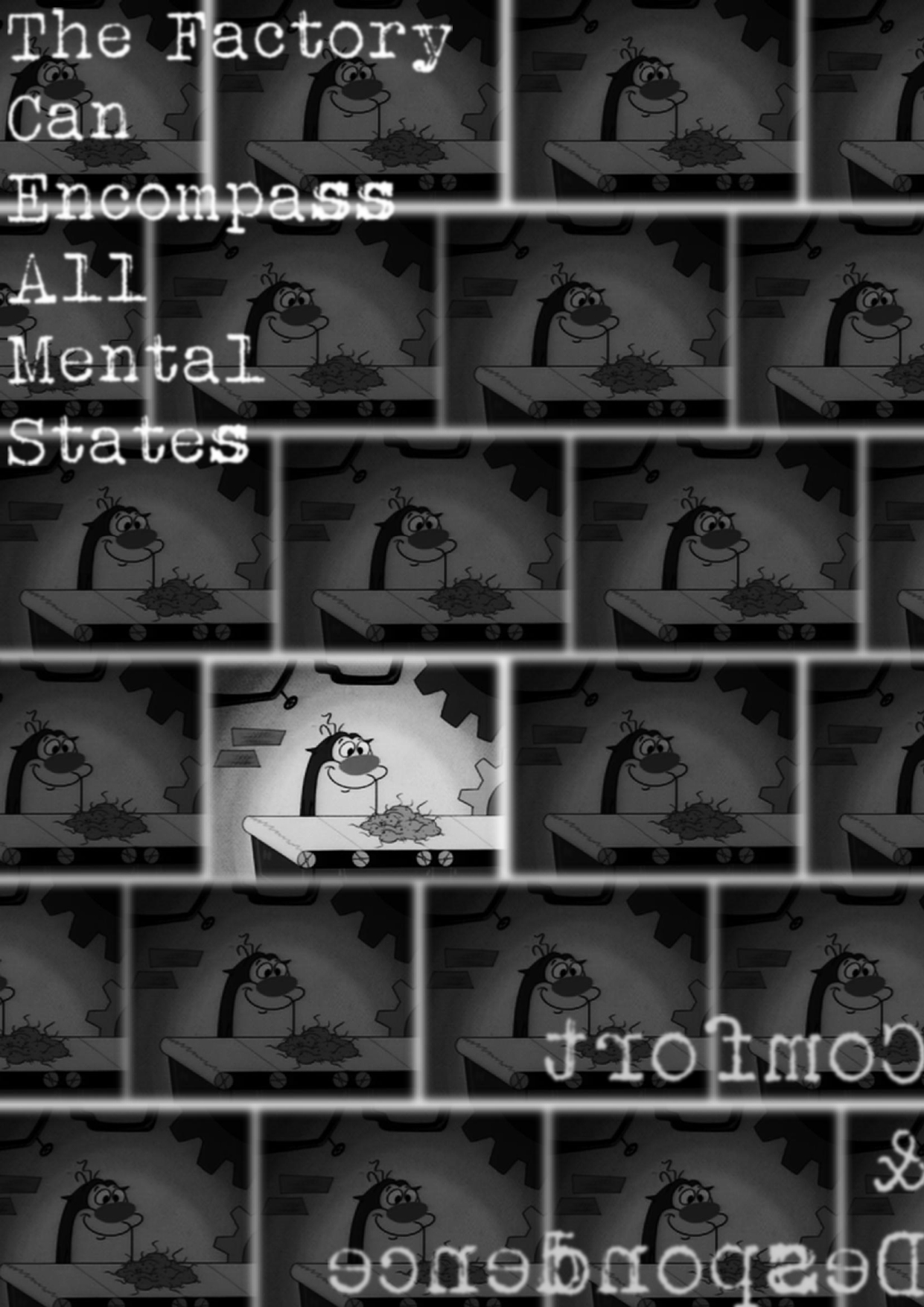
The Factory can encompass both mental states.
All mental states?
Government agents disrupt the funeral, and Yoshiko falls into the open casket. Through a black void, she lands in a street from her daydreams and tries to escape police and monsters by climbing a pile of flex-ducts. Opening a door, she passes through it and is surprised to be in a truck driven by Furufue. The two leave the city together, her right hand helping him with-
The Captain [boss of Shredding] is back.
He’s back from the hospital.
Seems like a good person, thinks Yoshiko.
Because he’s senile?
They’re all going to get MOO MOO YAKINIKU, which is called a ‘commercial’ in-narrative, slang for ‘break’ no doubt. The cow icon at the YAKINIKU place is getting ready to cook and eat its own kind. They do that in real life restaurants too. Force the animal to cannibalise itself.
The co-workers in this scene are coloured in a bit, avoid truly answering each other’s questions.
One of them almost had his leg cut off but thanks to the Factory could ultimately keep working.
Cos of Workers’ comp?
Unanswered.
There is no detail here.
The Factory is of worship, that’s it.
+
+
CHAPTER FOUR
Gonna aim to do two more CHAPTERS then stop.
This chapter begins with footage of ducklings, kittens, piglets, and geese. A child then wakes his father for work ironically with no work to do, they laugh and frolic. The factory is shown vacant and still with birds moving in. The children act out what their fathers had done, wheelbarrowing a goat in a mob. The owner, Goto, is frustrated by orders arriving and the frozen plant. Demands are formulated: an 8-hour work day, fair treatment by the administration, 30% wage increases, and a 6-hour day for minors. The shareholders, multiple versions of Goto, get involved with the director, Goto, and read the demands. They discuss dismissively while smoking cigars and having drinks. Presumably on the orders of the shareholders, the police raid the workers, and they sit down to protest. At their meeting the shareholders use the demand letter as a rag to clean up a spill, and-
Now it’s the MOSS FINDER GENERAL.
‘Join the hunt with Doctor Moss! An event for parents and children.’
Furufue is now a pre-school teacher!
His lab sits next to a cleaning facility.
Almost touching it.
In fact, he’s living there, on site, not in the cleaning facility but next to it.
A hunt for moss becomes a hunt for himself.
Am I just narrating here?
Not much to really say.
The subtext, themes, seem obvious.
Still no Socialist aspect.
No union drive.
Just a generic form of social malaise.
A comfortable social malaise where the “social” has been expanded to include the workplace.
It’s depressing but not cartoonishly so.
Japan has one of the largest Communist parties in the world, but politically they’re nowhere.
Any-place-whatever if you’re an optimist.
The road inside the Factory grounds runs on both sides, is classified as prefectural. There’s a bank, a post office, a travel agency. Like one of those little Libertarian fiefdoms. Run by Corporate Moss.
‘We have a museum too. Most of the work is created by factory artists and employees, but it’s definitely worth a look.’
Also a shrine with a priest and everything.
No graveyard as of yet.
Death has too much colour?
It would certainly force something, a retreat, a conspiracy of cormorants, with them.
+
+
Governor Goto sends in the military. A child [Furufue] walks under the soldiers’ horses and his mother [Yoshiko] goes under to get him and is struck. Rioting commences, and the crowd is chased off through a series of gates and barriers heading to the mossy forge, then their apartments. The crowd is chased and whipped on the balconies of the North Zone. A policeman [Goto] murders a small child. The workers are driven into a field of impossible moss by the army and shot en masse. This is shown with alternating footage of the slaughtering of a cormorant.
I’m skimming the text.
Goto is driving through and describing the social/residential aspects of the Factory, endlessly.
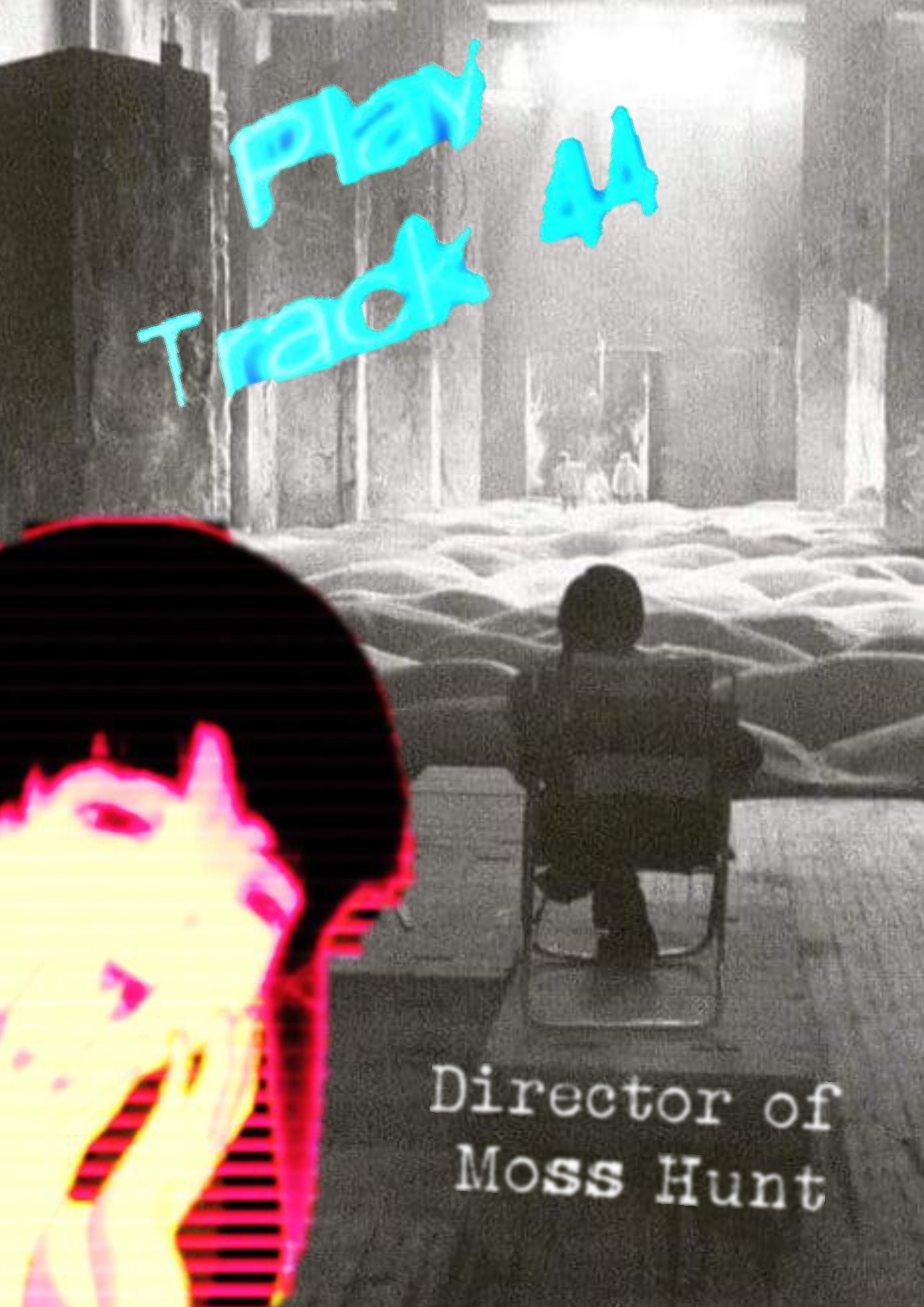
CUT TO [with, again, no warning]: MOSS HUNT, THE FOLLOWING DAY.
Again, the characters need to switch roles here, become the Other without explanation, just do it, Hiroko.
Do something.
I’m almost halfway through the book and it’s not bad, but it’s saying nothing that MAY have a black hole attached to it.
The general theme is clear enough i.e. Unilever is Satan.
Still awaiting greater surrealism.
Given up completely on the union stuff.
Modern life is work, the Factory-scape, and we are even more passive than the birds. We actively convince ourselves this is a good thing, a worthy thing to do with 92% of our life.
Should I keep reading?
I probably will, it’s quite short and I wanna see if the surrealism turns up, if the main characters bleed into each other.
Here end the notes.
There’s a sex pervert in the forest.
But he hasn’t done anything yet.
Successfully.
‘”See this here? This is moss. Believe it or not, this stuff can grow anywhere.”’
It can work any hours for any price. It can live next to a laundromat. It can hunt for moss and categorise it for no real reason. It can’t green-proof the roofs of the Factory, but it can do that maybe sometime in the future when it’s too late to be done and everything’s grey and consummated consumed. It can float beside the cormorants if it comes to that.
‘There was moss everywhere, all around the factory.’
A grandfather turns up, after the moss hunt.
Furufue lets him in, phases back to the hunt.
Then the birds, then the river.
Then the hunt.
Then sometime in the future, when he’s given up on the green-proofing.
+
+
The wildlife is encroaching, mutated, larger and less fearful than it should be.
Moss is everywhere.
The Factory is stamped on the terrain, destructive and co-operative. As in it pretends it is supposed to be there, has integrated with the “social.”
Maybe the surrealism lies in the narrative jumps, or time jumps.
Back and forth and between.
Or maybe the birds, the animals are gonna rise up?
Surreal from the workers’ perspe-
Maybe it’s all the food consumption scenes squashed into the dialogue about animals running wild and really big rats scaring the workers inside the Factory-Construct.
Maybe the Factory is eating up the land the same way Ushiyama-san eats up those purple pickles.
Maybe the sex pervert in the forest is a romantic at heart.
Maybe a union is just round the next cor-
+
+
Professor Ushiyama, a labour activist on the run from the police in Nagoya, hops off a freight train and comes to hide in the Factory neighbourhood. There, he runs into a meeting where the full-time workers discuss the idea of all coming to work an hour late to make their point. “Why come to work at all? Go on strike.” “You sound fiery.” “He sounds right, work is a prison sentence, I’m sick of it.” “What you need is to build up a stock of supplies and a strike fund. I can help with that.” “Help in what way?” “I have experience in this. Trust me.” “You look bookish.” “He’s not one of us.” “Bookish is just the face, not the heart. That is iron.” “If you say so.” “I do.” The next day at work, a suspicious accident at the plant results in Furufue’s death that is investigated as a work accident caused by negligent safety protocols, which Yoshiko and her brother realise was a murder coordinated by the Factory due to the incriminating knowledge they possess against their fake union. Later, Yoshiko is turned by the cormorants while her brother falls to the charms of Goto, who offers promises of a higher salary and a new red pen. As long as you’re not a goat, says their dead father, goat meaning sheep, of course.
+++
The Factory is available from any good library, with a pic of a bin on fire on the cover, surrounded by pink.
+++

 PsYChO hOLosUitE [zine]